The 7 Best AI Receptionists and Virtual Receptionists for Law Firms (2026)
October 12, 2026 · 29 min read

An AI receptionist answers your firm’s calls and messages in software, while a virtual receptionist does the same job with a remote human staff. The format that suits a law firm depends a lot on whether you only need calls answered or want new enquiries to turn into booked consultations.
To help you make an informed decision on whether you should go for AI receptionists or virtual receptionists, we’ve compared seven options that law firms use. Each of the platforms discussed in this article has been compared on channels they cover, their English and Spanish support, whether they qualify and book, and what each publishes about their price. We’ve compared the latest information available on every vendor’s website, as of October 2026.
But here’s why do you need AI or virtual receptionists as a law firm? You need it because it helps your firm stay operational 24/7, just like a website keeps your practice visible at all times. An enquiry that reaches voicemail at 7pm can go to the next firm that answers. Answering the phone after hours closes part of that gap, but it is important to note that a picked-up call is not necessarily a booked matter.
So, that’s where AI and virtual receptionists come in. Not only do they answer calls, they also qualify the enquiry, book the consultations, and keep following up.
Here’s your summary for choosing the best AI receptionists and virtual receptionists for law firms.
- Best if you want more than a receptionist: Choose Juryo. Jorge qualifies, books and follows up every enquiry in English or Spanish across phone, WhatsApp, email, and web chat. Additionally, its pricing is based on successful lead conversions.
- Best AI-plus-human hybrid: Smith.ai. Its AI receptionist handles routine calls, while its human service provides a staffed option with live agent escalation available on every AI plan.
Lastly, before we get into a detailed comparison of how each of these platforms perform against each other, we’d like to state that Juryo publishes this comparison and appears first because the article’s focus is the gap between answering an enquiry and turning it into a qualified, booked consultation.
AI receptionist vs virtual receptionist: What is the difference?
A virtual receptionist is a remote service staffed by people, while an AI receptionist does the same front-door job in software, answering calls, holding the conversation, taking details and booking or routing the caller.
As you can see, both perform the same front-door jobs and can be categorised as front-door tools. Primarily, they prevent enquiries from ending in voicemail. Their difference mainly lies in what happens after the call is answered.
Even though the difference used to be very clear before, the lines are blurring today, more than ever before. For example, Smith.ai combines AI capabilities with the option for human escalation. Similarly, Ruby adds AI-powered transcripts and sentiment analysis to its human receptionist service.
A receptionist can establish who is calling, take a message, and pass it on. It is a different level of work to know what to ask a caller about a despido improcedente enquiry, size of a revolving-card claim, or work out which questions to ask after a road traffic accident. An employment enquiry close to a tribunal time limit also needs more than a name and callback number.
This is why law firms must clarify how far past answering does it need to go. Reception keeps the front door open, intake qualifies the enquiry, books the consultation, and moves the matter towards the fee earner. As a law firm, you must choose whether you need just the reception or both the reception and the intake.
Is an AI receptionist the same as legal intake?
No, an AI receptionist answers and routes enquiries. An intake agent qualifies the enquiries against the firm’s criteria and moves them towards a consultation. The answering service versus full intake section below looks at that distinction in more detail.
What to look for in a receptionist for a law firm
We’ve considered seven criteria that separate a receptionist that keeps the phone answered from the one that helps bring in instructed matters.
- Legal-native, not a generic call bot: Intake logic should reflect how law firms actually handle enquiries, rather than simply following a generic call script.
- Real qualification: The service should qualify enquiries against practice area, conflicts, and urgency, instead of only taking a message.
- Bilingual support: If you serve English and Spanish speakers, look for an agent that has one memory to ensure conversations do not reset when the language changes.
- Multiple channels: Phone, WhatsApp, email, and web chat support gives your clients more than one way to start an inquiry.
- CRM and calendar sync: The record should be pushed into the system you already use. The right scheduling workflow also keeps appointments connected to the intake process.
- Automated follow-up: A single callback request is easy to lose. Follow-up should continue after the first contact until the prospect responds.
- Human escalation: Some calls need a person. The service should be able to hand sensitive or otherwise unsuitable enquiries to a member of the firm.
Multilingual AI receptionists for law firms
A multilingual receptionist is useful when the same agent can qualify and book in a second language, rather than simply greet callers in it.
When it comes to the seven best AI receptionists and virtual receptionists we’re ranking, each of them tackle multilingual AI receptionists differently. First, Smith.ai offers bilingual support, with a dedicated Spanish line costing $1.00 per call on its human plans. Ruby includes Spanish and bilingual call handling as an optional feature. LegalClerk.ai puts multilingual support on its Enterprise plan. CaseGen.ai explicitly lists Spanish among its 17 supported languages.
Jorge handles English and Spanish as one agent across phone, WhatsApp, email, and web chat. This means a Spanish-speaking enquiry can be qualified and booked without moving the person to another agent or channel. This persistent client memory also carries across channels, so switching from phone to WhatsApp also does not start the intake again.
Confidential and privilege-sensitive calls
A law firm receptionist should collect only the details intake required, escalate sensitive matters to a team member when needed, and keep the resulting record in a controlled and secure data environment.
Human escalation features are available on Smith.ai. Smith.ai offers live agent escalation on every AI plan, LegalClerk.ai offers it on its Enterprise plan, and CaseGen.ai transfers high-value or insistent callers live. LegalClerk.ai offers the same feature on its Enterprise plan through live transfer. Jorge (Juryo) can also escalate an inquiry to a human when required.
The 7 best AI and virtual receptionists for law firms, compared
The seven options we’ve ranked cover reception and intake differently. The key difference is who answers, who qualifies, and books, and which channels each service covers.
| Tool | Best for | Type | Channels | English and Spanish | Qualifies and books | 24/7 | Pricing |
|---|---|---|---|---|---|---|---|
| Juryo.ai | Intake that turns enquiries into consultations | AI intake agent | Phone, WhatsApp, email, web chat | ✅ Yes (one agent) | ✅ Yes (with CRM handover) | ✅ Yes | Based on successful lead conversion |
| Smith.ai | AI with human backup | AI and human hybrid system | Phone, SMS, web chat | ✅ Yes | ✅ Yes | ✅ Yes | AI from $0 for 25 calls; human from $300/month for 30 calls |
| Ruby | Premium human reception | Human service with AI features | Phone, live chat | ✅ Yes | ✅Yes (Optional add-on) | ✅ Yes | From $250/month for 50 minutes |
| CaseGen.ai | Attorney-built AI intake for US firms | AI intake agents | Phone, SMS | ✅ Yes | ✅ Yes | ✅ Yes | Not published |
| LegalClerk.ai | Scripted capture with HIPAA and ABA positioning | AI receptionist | Phone | ⚠️ Multilingual only on Enterprise plan | ✅ Yes | ✅ Yes | $400 per seat a month |
| Lex Reception | A person on every call, law firms only | Human receptionists | Phone, live chat | ✅ Yes | ✅ Yes | ✅ Yes | Not published |
| Retell AI | Custom voice-agent builds | Build-your-own platform | Phone, chat, SMS, API | ⚠️ Multilingual, configured by you | ⚠️ Via your build | ✅ Yes | $0.07 to $0.31 per minute |
Of the seven tools compared, only Juryo answers on WhatsApp natively and prices on conversion rather than seats, minutes or calls.
1. Juryo: best if you want more than a receptionist
Best for: UK and Spanish firms in high-volume consumer practice areas such as personal injury, immigration, debt, employment, and civil law that lose enquiries after hours or after the first contact.
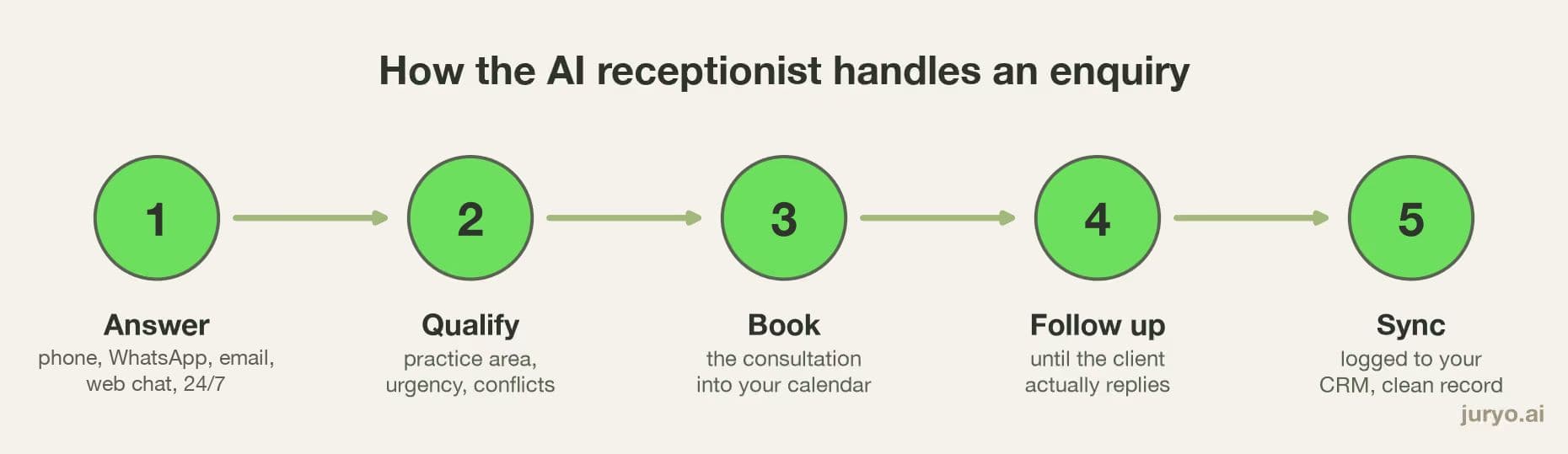
Jorge does the work of an intake specialist, taking an enquiry from the first conversation through to a signed engagement letter. He answers the phone, replies to messages on WhatsApp, emails, and web chat. Not only that, Jorge qualifies each inquiry against the firm’s own criteria, books consultations, collects documents, gets engagement letters signed, and even follows up until the prospect responds. When a call needs a person, Jorge escalates it to a fee-earner.
Jorge also keeps shared memories across channels. Someone who rings on Monday and messages on WhatsApp on Tuesday remains one enquiry only. Jorge has the ability to pick up where the first conversations left off, thanks to his shared persistent memory.
At the end of each conversation, Jorge turns the intake into structured fields such as case type, accident date, opposing parties, and qualification outcome. The record can be pushed by REST API or other secure webhook integrations into Clio Manage, Filevine, MyCase, or a spreadsheet. Juryo can build a mapping layer for legacy systems, while a queue and retry process prevents a lead from being lost if the CRM is temporarily unreachable. Bookings land in Google Calendar, with Gmail and Pipedrive also supported in the product.
The firm controls how Jorge works, this includes defining his practice areas, urgency rules, and speaking tone. You can upload your firm’s entire knowledge base into Jorge so that he can answer firm-specific questions.
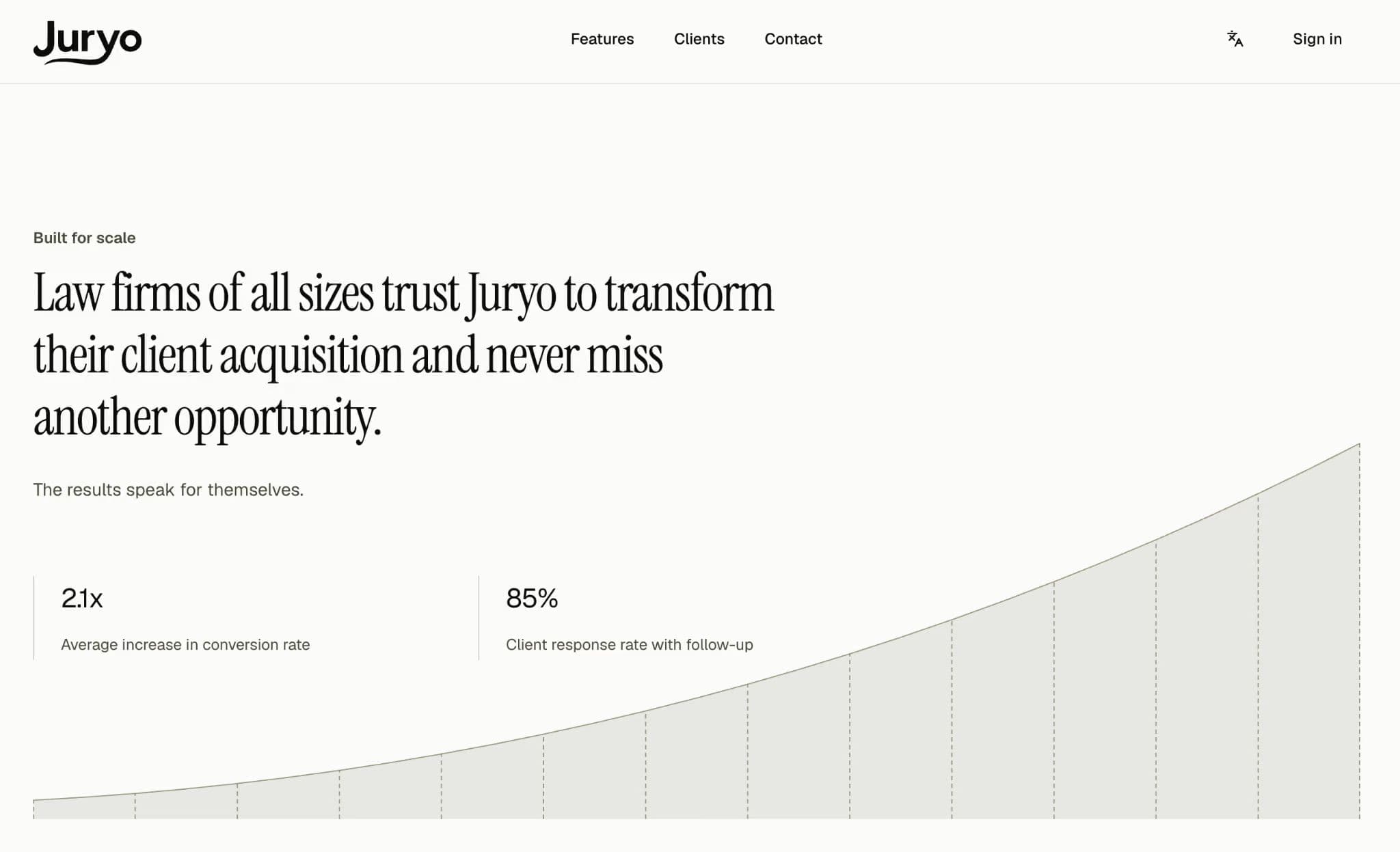
Juryo reports a “2.1x average increase in conversion rate” and an “85% client response rate with follow-up” across its customers.
The pricing model also reflects the differences between reception and intake. Reception services sell availability by the seat, minute, or call. Juryo charges based on conversion.
Key features
- Phone, WhatsApp, email, and web chat with shared memory
- English and Spanish handled by one agent
- Qualification against the firm’s own criteria
- Consultation booking, document collection, and engagement letters
- Follow-up until the prospect responds
- Human escalation when a call needs a fee-earner
- CRM handover with queue and retry
Pros
- Goes beyond reception: Legal-grade qualification and lead conversion, not message-taking
- Answers on all four channels: Phone, WhatsApp, email, and web chat
- Truly bilingual: English and Spanish in a single AI agent, with no handoff
- Automated multi-channel follow-up: This is done until the client replies
- Direct booking and record sync: Jorge works alongside Clio Manage, Filevine, MyCase or a spreadsheet
- Pricing: Juryo offers a unique successful conversion-based pricing rather than per seat, minute, or call
- Strong fit for high-volume B2C intake: Thanks to all the key features listed above, Jorge is a perfect fit for high-volume B2C intake
Cons
- Pricing is not disclosed publicly, it is based on successful lead conversions.
Pricing: Juryo’s pricing is based on successful lead conversions, it is not available online.
Book a demo and hear how Jorge handles a real enquiry.
2. Smith.ai: best AI-plus-human hybrid

Best for: Firms that want AI reception for routine enquiries with human support available when a call needs a person.
Smith.ai offers both an AI receptionist and a separate human receptionist service. The AI receptionist service comes with a free plan that can get users 25 calls per month. Its human receptionists are available 24/7, with agents based in North America, the service is priced starting at $300/month for 30 calls. Smith.ai also offers 24/7 website chat handled by AI and human agents.
Key features
- AI receptionist with free, pro, and enterprise tiers
- Human escalation on paid AI plans
- 24/7 human receptionist service
- 24/7 website chat with AI and human agents
- Spanish support, including a dedicated Spanish line on human plans
- Legal integrations with MyCase and Actionstep
- Refund of the first plan fee if you cancel within two weeks (human plans)
Pros
- Offers a choice between AI reception and human reception
- 24/7 website chat extends service coverage
- Human escalation options provide a way to route calls
- Established legal integrations with MyCase and Actionstep
- Useful options for firms comparing different levels of receptionist support
Cons
- Human receptionist pricing uses call allowances and additional calls are charged at $11.50 on the Starter plan
- A dedicated Spanish line costs $1.00 per call on human plans
- There is no documented WhatsApp support
Pricing: Smith.ai’s pricing is as follows:
- AI Receptionist plans
- Free tier: 25 calls per month
- Pro tier: starting at $150/month for up to 75 calls
- Enterprise tier: starting at $500/month for up to 300 calls
- Human-first plans
- Starter: 30 calls for $300/month
- Basic: 90 calls for $810/month
- Pro: 300 calls for $2,100/month
- Enterprise: Custom quote-based pricing
If you are weighing Smith.ai alternatives, see our guide.
3. Ruby: best premium human-backed virtual receptionist

Best for: Law firms that want a premium human receptionist service with 24/7 coverage and bilingual call handling.
Ruby offers a human-first approach to legal reception. They offer 24/7 receptionist coverage with full bilingual support (English and Spanish). The service also supports live chat, while AI transcripts and sentiment analysis come with every plan at no extra cost.
Ruby is a benchmark in the human-first intake process for law firms. The service is great for firms that want a person to handle every conversation rather than automating the intake process. The use of receptionist coverage rather than taking every enquiry through automated qualification and follow-up is one of Ruby’s primary strengths.
Key features
- Human receptionists available 24/7
- Spanish and bilingual call handling
- No activation, onboarding, or customisation fees
- Live chat
- Adding chat to a receptionist plan cuts the chat price by 20%
Pros
- 24/7 coverage
- Human call handling rather than a bot
- Spanish and bilingual support
- AI transcripts and sentiment analysis adds value without additional charge
- Established service for firms that prioritise human reception
Cons
- Pricing is per minute, so cost rises with call volume.
- Less automated intake features than an AI agent
- No documented WhatsApp support
Pricing: The pricing details for Ruby are as follows:
- Virtual receptionist plans
- $250/month for 50 minutes
- $395/month for 100 minutes
- $720/month for 200 minutes
- $1,725/month for 500 minutes
- Live chat plans
- $143/month for 10 chats
- $335/month for 30 chats
- $520/month for 50 chats
- Adding chat to a receptionist plan cuts the chat price by 20%.
4. CaseGen.ai: best purpose-built legal answering

Best for: US law firms that want an AI intake service built specifically for legal enquiries.
CaseGen.ai uses three named AI agents for different parts of the intake process. Justina acts as the intake manager, answering calls, completing full intakes, and filtering spam. Justin handles intake outreach and follows up with prospects to complete unfinished intakes. Maya acts as the medical coordinator and tracks treatment.
Key features
- 24/7 AI intake for law firms
- Justina for answering calls
- Justin for follow-up
- Maya for medical coordination
- Text-based with photo upload support
- Live transfer to the firm’s team when requested
- Spanish support among 17 languages
- Integrations with Zapier, Google Sheets, Calendly, PracticePanther, Smokeball, MyCase, Lawmatics, Clio, Filevine, and LawPay.
Pros
- Custom built for legal intake
- Three specialised agents for different intake processes
- Connects with a broad range of business tools
- Allows prospects to upload photos
- Goes beyond answering and also follows up
- Supports Spanish
Cons
- The service is positioned specifically for US law firms
- Pricing is not available publicly
- The experience is primarily phone-led
- No documented WhatsApp support
Pricing: CaseGen.ai does not publicly post its pricing officially. You can request a quote from their website to learn about pricing.
5. LegalClerk.ai: best for compliance-led intake capture

Best for: Law firms that want a 24/7 AI legal receptionist focused on capturing calls, producing call records, and supporting appointment scheduling.
LegalClerk.ai positions its services as a “24/7 AI legal answering service and law firm virtual receptionist” that also offers call summaries, transcripts, appointment scheduling, CRM integrations, and call analytics. The service also claims HIPAA and ABA compliance.
Key features
- 24/7 AI legal receptionist
- Live agent escalation feature on Enterprise plan
- Multilingual support on Enterprise
- Call analytics
- Appointment scheduling
- CRM integrations
- Call summaries and transcripts
Pros
- Built specifically around legal reception
- Unlimited calls on the standard plan
- 24/7 availability
- Call summaries and transcripts available
- Appointment scheduling reduces manual booking work
Cons
- No documented WhatsApp support
- No documented SMS or chat support
- Multilingual support and live agent escalation are limited to Enterprise
- The per-seat model can be less aligned with firms that want pricing tied to converted matters
Pricing: A 7-day free trial is available for new users. The paid plans start at $400/month per seat, with unlimited call support and no setup fee. The service also comes with an Enterprise plan that has custom quote-based pricing.
6. Lex Reception: best human legal receptionist for US firms

Best for: US law firms that want a human receptionist on every call.
Lex Reception is built specifically for law firms and uses human receptionists all the way through. Its team is available 24/7/365 and can handle legal intake, appointment scheduling, live transfers, overflow calls, outbound follow-ups, payment collection, and live chat. English and Spanish support are available for all users.
Key features
- Human receptionists available 24/7/365
- Legal intake and appointment scheduling
- Live chat
- Payment collection
- Live transfer and overflow handling
- English and Spanish support
- Integrations with Clio, MyCase, PracticePanther, Filevine, Lawmatics, LawPay, and Zapier
Pros
- A person handles every call
- English and Spanish support
- Expansive legal software integrations
- Covers intake, scheduling, and live transfers
- Focused exclusively on law firms
Cons
- Human-only reception means the service does not offer AI-first intake features
- WhatsApp is not a documented channel
- Pricing is not published on Lex Reception’s official website
Pricing: Lex Reception does not publish pricing on its own site.
7. Retell AI: best for custom voice-agent builds

Best for: Firms that want to build and control their own AI voice agent rather than use a ready-made legal receptionist.
Retell AI is a build-your-own voice-agent platform. It is not specifically a legal receptionist service. It supports phone, web, in-app chat, SMS, and API access to users. This lets you create your own workflows and integrations.
Key features
- Custom voice agents
- Multilingual voice agents
- Phone, chat, SMS, and API support
- Custom workflows and business logic
- Integrations with HubSpot, Twilio, Make, n8n, and Go High Level
Pros
- Broad integration options
- Offers multilingual voice agents
- Supports phone, chat, and SMS
- Flexible enough to build a receptionist around your firm’s own workflow
Cons
- No native WhatsApp; possible only via the chat API or an unofficial automation connector
- It is not built specifically for legal intake
- A custom build requires more setup than ready-made legal receptionist platforms
Pricing: Voice agents cost $0.07 to $0.31 per minute with no base fee. You also get $10 of free credits. Chat messages cost from $0.002 per message, SMS costs $0.01 per message, and phone numbers cost $2/month. Enterprise pricing is available on request.
Reception, intake, or people: which should your firm choose?
The right choice depends on what you need to happen after someone contacts your firm. The job of reception is to attend to the enquiry. Then intake qualifies the enquiry and moves it towards a consultation. Human receptionists provide an all-in-one front door service of taking the enquiry and qualifying it as per firm policy. So, which one should you choose?
Here’s a simple guide to help you:
- Buy reception if: your top priority is making sure calls get answered and basic details of the caller are identified. LegalClerk.ai fits this model well. CaseGen.ai also offers similar features with its AI agents also having the ability to follow up on unfinished tasks.
- Buy intake if: you want enquiries to qualify against your firm’s criteria, consultations booked, and prospects followed up. Juryo is the strongest option in this category with Jorge handling phone, WhatsApp, email, and web chat with a persistent memory.
- Buy people if: you want a specialist legal receptionist for every conversation. Ruby and Lex Reception specialise in this segment with their human-first options. If you want both AI and human support, Smith.ai offers hybrid AI and human reception features.
This differentiation is based around the fact that even though receptionist is used as a blanket term, the role has specific responsibilities and limitations. Intake takes responsibility for more of the client journey in a pipeline, since they are in charge of qualifying the lead and converting it into a paying customer. So, based on your requirements, you should choose between receptionist, intake, or human-first receptionist services.
Meet Jorge, Juryo’s intake agent
Jorge is Juryo’s intake agent, built to take an enquiry beyond the initial answer and towards a qualified booked consultation. He works across phone, WhatsApp, email, and web chat, in English and Spanish with persistent memory that is maintained across channels.
Jorge can be configured around the firm’s practice areas, urgency rules, and preferred tone. Firms can also upload their own knowledge base so he can work from firm-specific information rather than a generic script.
The same agent can qualify an enquiry against the firm’s criteria, book a consultation, collect documents, get an engagement letter signed, and follow up until the prospect replies. When a conversation needs a fee-earner, Jorge can escalate it.
So, if you’re a law firm looking to automate law firm intake, Jorge is designed to handle that process rather than stop at just taking messages.
Proof: firms already running on Jorge
Juryo reports that firms including Legalitas, Sello Legal, Indemnizame, and DVuelta already use Jorge to make their intake workflows autonomous.
Across its customers, Juryo reports a 2.1x average increase in conversion rate and an 85% client response rate with follow-up. These are Juryo-reported averages, rather than results attributed individually to the four named firms.
Juryo pricing
Juryo uses a different pricing model from other receptionist services. Its pricing model is based on successful lead conversions. Compared to other receptionist services, this is unique because most services base their pricing by seat, minute, or call.
Book a demo to see how Jorge fits into your firm’s intake workflow or contact our team to get a quote today.
Frequently asked questions
1. Are AI receptionists GDPR compliant?
Compliance depends on the provider and how your firm configures and uses the service. Juryo stores data in the EU, lets firms set retention periods, (including not storing data at all), provides a DPA and does not use conversations to train its models. UK firms should still assess the provider's data handling against their own GDPR requirements.
2. What is the difference between an AI receptionist and a virtual receptionist?
An AI receptionist uses software to answer and handle enquiries, while a virtual receptionist uses remote human staff. The more important distinction for a law firm is what happens after the enquiry is answered: reception may take a message, while intake can qualify the enquiry, book the consultation and follow up.
3. Can an AI receptionist replace a human receptionist at a law firm?
An AI receptionist can handle many routine enquiries, but some conversations still benefit from human involvement. Juryo's Jorge can escalate sensitive or complex calls to a fee-earner, allowing firms to automate routine intake without removing people from conversations that need them.
4. Do AI receptionists work on WhatsApp?
Among the seven options compared here, Juryo is the only one with documented native WhatsApp support. Jorge handles phone, WhatsApp, email and web chat with shared memory, so an inquiry can move between channels without becoming a new conversation.
5. Can an AI receptionist answer in both Spanish and English?
Yes, although the level of Spanish support varies. Jorge handles English and Spanish across all four supported channels. Ruby and Lex Reception offer bilingual human handling, while Smith.ai offers a dedicated Spanish line at $1.00 per call on its human plans. CaseGen.ai lists Spanish among its 17 supported languages.
6. How much does an AI receptionist for a law firm cost?
Pricing varies by model. Smith.ai's AI Receptionist starts free for 25 calls, with Pro from $150/month. Ruby starts at $250/month for 50 minutes, LegalClerk.ai costs $400/seat/month, and Retell AI charges $0.07 to $0.31 per voice minute. CaseGen.ai and Lex Reception do not publish prices. Juryo uses successful conversion-based pricing rather than a published seat, minute or call rate.
7. Do AI receptionists work for law firms?
Yes, an AI receptionist can work well for law firms when it is designed for legal intake, follows the firm's qualification criteria, books consultations, handles structured information and escalates sensitive calls when necessary. Generic call bots can answer enquiries, but the firm's staff may still need to perform the qualification work afterwards.
Final verdict
The best AI receptionists and virtual receptionists for law firms depend largely on your specific requirements. As mentioned in this guide, there are different levels to AI receptionists and virtual receptionists. So, if you need the following, here are our baseline recommendations:
| For | Choose |
|---|---|
| Unanswered calls | LegalClerk.ai or Smith.ai to get 24/7 receptionist coverage |
| Person on every call | Ruby or Lex Reception |
| Custom build | Retell AI to build your own AI agent |
| Qualified, booked, and followed-up enquiries | Juryo to get phone, WhatsApp, web chat, and email handled in English and Spanish by one agent. |
Juryo’s Jorge goes beyond taking a message. He qualifies enquiries against the firm’s criteria, books consultations, collects documents, gets engagement letters signed, and follows up with prospects. So, if your goal is to move from answering enquiries to actually progressing them in your pipeline, check Jorge out today.
Recommended Reading
- 5 Best AI Legal Intake Tools for Law Firms (2026)
- The 7 best AI tools for lawyers (2026, tested)
- The 7 Best Intaker Alternatives for Law Firm Intake (2026)
- The 7 Best Lead Docket Alternatives for Law Firm Intake (2026)
- Legal Workflow Automation with AI: How Law Firms Actually Do It
- How to Use Legal AI in Your Law Firm: A 2026 Guide