The 7 Best Lawmatics Alternatives for Law Firms (2026)
October 28, 2026 · 35 min read

Lawmatics is a popular legal CRM, marketing automation, and AI lead engagement platform, but it isn’t the right fit for every law firm. We compared the leading Lawmatics alternatives on lead qualification, channel coverage, language support, integrations, and pricing, using product information current as of October 2026.
Since the requirements differ for every law firm, it is important to consider factors like feature availability, total cost, and integration capabilities before committing to a new platform. The right choice for your firm depends on the areas where you need the most support. If your marketing automation and reporting already work well, Lawmatics may still suit your firm.
However, if you need English and Spanish coverage across phone, WhatsApp, email, and web chat, 24/7, and support well beyond the first call, Juryo is worth evaluating. Its AI agents qualify leads, close the sale, collect the signed engagement letter, and onboard new clients.
7 best Lawmatics alternatives: Quick comparison
The table below will help you get a quick look at the different features of the top Lawmatics alternatives available in 2026.
| Tool | Best for | Platform type | Lead qualification | Channels | Spanish support | Pricing |
|---|---|---|---|---|---|---|
| Juryo | B2C law firms wanting AI agents for intake, sales, signing, and onboarding, 24/7 in English and Spanish | AI operating system for B2C law firms | Yes: AI agent (George) qualifies against firm criteria, follows up, books appointments | Phone, WhatsApp, email, web chat (24/7) in English and Spanish | Yes (English and Spanish) | Based on successful conversion |
| Clio Grow | Firms already using Clio | Legal CRM and client intake platform | Yes: Grow AI agents assess leads and book consultations | Phone (US only), email, website chat | Not specified | Add-on for eligible Clio plans (included in Elite and Elite Work); Grow AI is $25 per hired matter in the US (£20 in the UK), with a monthly cap |
| Law Ruler | Firms needing structured intake and automated follow-up | Legal CRM, intake, and marketing automation | Yes: custom intake forms qualify prospects; AI Email Assistant and ChatGPT integration | Email, text message campaigns | Not specified | Quote-based, plus a one-time onboarding fee |
| Lead Docket | Personal injury and high-volume firms in the Filevine ecosystem | Legal intake and lead management | Yes: custom intake scripts; LeadsAI for motor vehicle accident leads | Website forms, live chat, answering services, texting and tracking numbers | Not specified | Custom quote |
| MyCase | Firms wanting all-in-one practice management | Practice management with legal CRM and intake | Yes: customisable intake forms with conditional questions (Pro plan and above) | Two-way texting, call logs | Not specified | From $50/user/month (Basic, annual); CRM and intake from $100/user/month (Pro, annual) |
| Captorra | PI and mass tort firms with high lead volumes | Legal intake and lead conversion platform | Yes: configurable intake scripts based on case type and firm criteria | Communication tools (channels not specified) | Not specified | Pricing on request |
| Smith.ai | Firms wanting 24/7 AI, human, or hybrid phone answering | Call answering and legal intake service | Yes: configurable call flows screen and route enquiries | Phone (24/7) | Dedicated Spanish line for human receptionists at $1 per call | AI: free up to 25 calls/month, paid from $150/month for 75 calls; Human: from $300/month for 30 calls |
7 best Lawmatics alternatives
The best Lawmatics alternatives are the ones that fill the gaps in your client-facing workflow. The following platforms serve different needs, from legal CRM systems to AI-powered intake and human answering services.
1. Juryo

Best for: B2C law firms that want AI agents to run the client journey from first enquiry to signed engagement letter and onboarding, in English and Spanish, across phone, WhatsApp, email, and web chat, 24/7.
Juryo is an AI operating system for B2C law firms, built to manage client-facing work from the first enquiry through signing, onboarding, and ongoing support. Its agents handle different stages of the client journey and maintain a persistent shared memory, so clients don’t have to repeat information when their conversations move between agents.
Each agent covers one stage of the client journey and follows the firm’s own rules, tone, and processes across its channels:
- James (sales): handles the pitch and objections, sends the engagement letter, and collects the signature
- Jessica (onboarding): collects the case documents until the file is complete
- George (qualification): contacts new leads, qualifies them against the firm’s criteria, and books appointments
- Julia (customer support): answers existing clients’ questions and escalates urgent matters
- John (collections): contacts clients about overdue instalments
Juryo also connects to the firm’s existing CRM and case software, including Clio Manage.
Key features
- Sales and signing: James takes qualified leads through the sale, sends the engagement letter, and collects the signature.
- Onboarding: Jessica collects the case documents a matter needs before handover, so files are complete without staff chasing clients.
- Phone, WhatsApp, email, and web chat coverage: Juryo supports conversations across these channels, with 24/7 availability.
- Lead qualification in English and Spanish: George contacts new leads in under 35 seconds on average, qualifies them against the firm’s criteria, and books appointments.
- Shared memory: Information gathered at one stage carries forward to the next agent, reducing repeated questions and manual handovers.
Pros
- Combines lead qualification with sales, signing, onboarding, and customer support
- Supports English and Spanish across its client-facing operations
- Pricing is based on successful conversion
Cons
- Built for B2C law firms, so it is not designed for corporate or commercial practices with low enquiry volumes.
Pricing: Based on successful conversion, so firms pay when a lead becomes a signed client.
2. Clio Grow
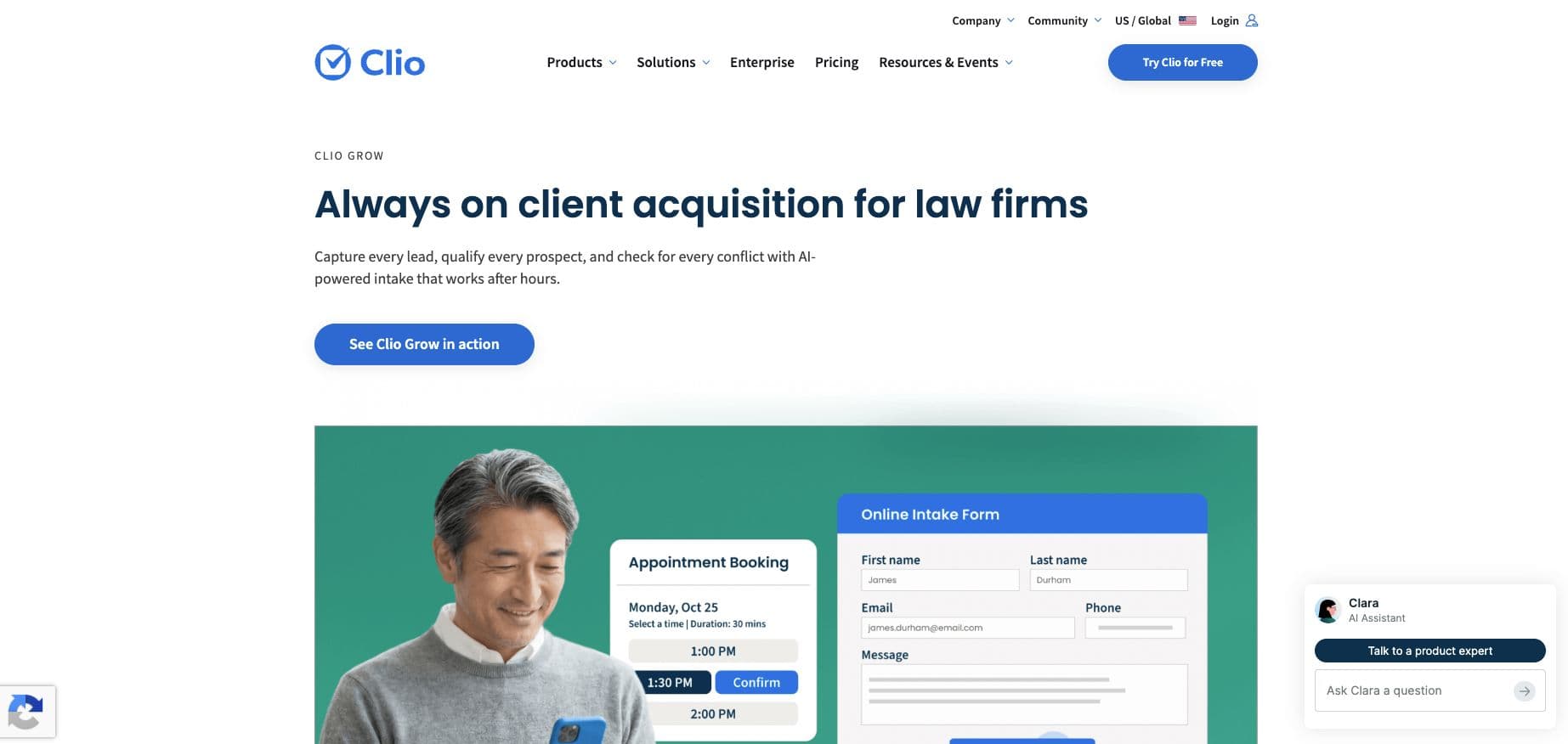
Best for: Law firms already using Clio that want AI-powered lead capture, qualification, and follow-up within their existing workflow.
Clio Grow is a legal CRM. It also doubles as a client intake platform that helps law firms capture enquiries, screen leads, and manage the journey of the lead until it becomes a hired matter. The Grow AI features, launched on 20 August 2026, add AI agents that answer enquiries, gather case details, assess lead suitability, and book consultations.
Key features
- AI-powered intake: Grow AI handles enquiries through phone, email, and website chat, collecting case information, and assessing leads against the firm’s criteria.
- Lead assessment: The platform evaluates prospective clients based on factors such as practice area, location, and potential conflicts, helping firms identify suitable enquiries.
- Appointment booking: Qualified leads can book consultations directly, which reduces the intake staff workload.
- Automated follow-up: Grow AI follows up with leads who have not completed intake forms or signed agreements.
Pros
- Connects AI-powered intake with Clio’s wider client and matter management capabilities
- Allows firms to configure intake criteria and questions for their workflows
Cons
- The phone agent is currently available only for US law firms.
Pricing: Clio Grow is available as an add-on for eligible Clio plans and is included in the Elite and Elite Work plans. Grow AI is billed per hired matter: £20 in the UK and $25 in the US, with an optional monthly spend cap.
3. Law Ruler
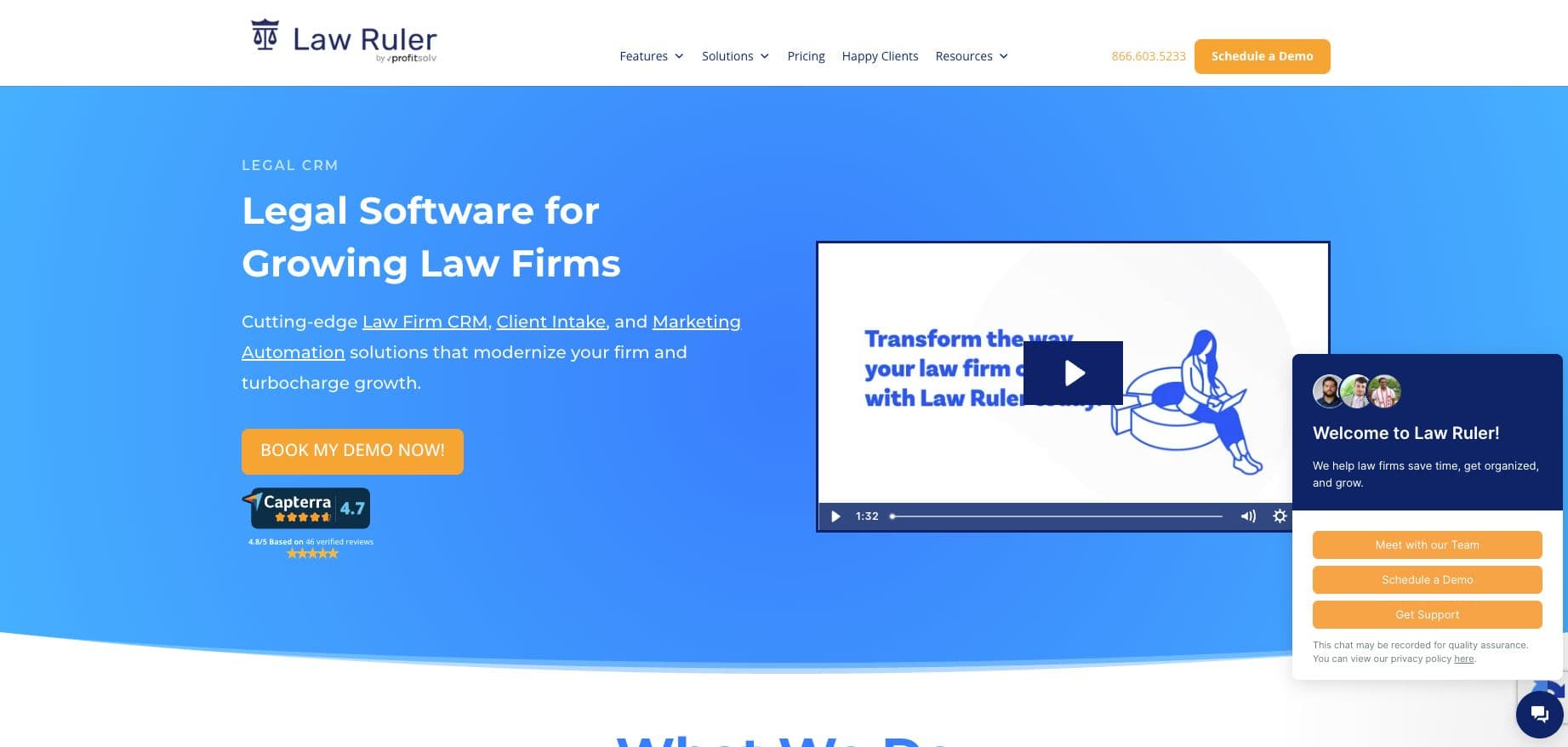
Best for: Law firms that need a legal CRM that supports structured client intake and automated lead follow-up with marketing performance reporting.
Law Ruler combines legal CRM, client intake, and marketing automation in one platform. It helps firms organise prospects, collect case information, manage communications, and track which marketing channels generate leads. Its AI features include an email assistant as well as a ChatGPT integration. You also get access to tools for automating follow-ups and routing leads based on case type or other criteria.
Key features
- Legal CRM and lead management: Organise leads, track their progress through the pipeline, and manage follow-up tasks from a central system.
- Automated marketing: You can set up text message campaigns and email sequences to nurture prospects over time.
- Custom intake forms: Build forms that collect case details, qualify prospects, and support document collection, along with e-signatures.
- AI-assisted communication: You can use the AI Email Assistant or the ChatGPT integration to draft enquiry responses, intake questionnaires, reminders, and other routine messages.
- Reporting and analytics: Monitor lead sources, marketing performance, and other firm-specific metrics through configurable dashboards and reports.
Pros
- Includes an AI Email Assistant and ChatGPT integration for drafting routine messages
- Offers configurable intake forms and automated follow-up
- Combines CRM, intake, marketing automation, and reporting for a law firm
Cons
- Pricing is not publicly listed
- Pro and Premium plans carry a one-time onboarding fee
- The Pro plan includes only three automations (Premium includes 100)
Pricing: Law Ruler offers Pro and Premium plans for up to three users. The minimum user base for an Enterprise plan is 10 users. Prices are available by quote with a one-time onboarding fee.
4. Lead Docket
Best for: Personal injury and other high-volume law firms that need lead tracking, marketing attribution, and structured intake workflows within the Filevine ecosystem.
Lead Docket is a legal intake and lead management platform that helps firms capture enquiries from multiple sources. Firms can then track those enquiries through intake and measure which marketing activities generate valuable cases. Its integration with the Filevine ecosystem transfers signed leads into the case management system.
Key features
- Lead capture and tracking: You can collect leads from website forms, live chat, answering services, advertising campaigns, and other sources in one system.
- Marketing attribution: Lead Docket helps you identify which marketing channels bring in the most leads and which convert best.
- Intake forms and qualification: You can use custom intake scripts to collect contact details and qualifying case information to help staff assess and route enquiries
- Workflow automation: Automate follow-up messages, recurring tasks, form delivery, and other intake steps.
- LeadsAI: Applies sentiment analysis and predictive scoring to motor vehicle accident leads, based on lead details, messages, and notes.
- Filevine integration: Transfer signed leads into Filevine as new projects and map custom fields between the systems.
Pros
- Provides detailed lead-source and marketing ROI reporting for law firms
- Supports integrations with third-party answering services
- Connects lead tracking and intake workflows with Filevine case management
Cons
- Lead Docket does not publish subscription pricing
Pricing: Custom quote.
5. MyCase
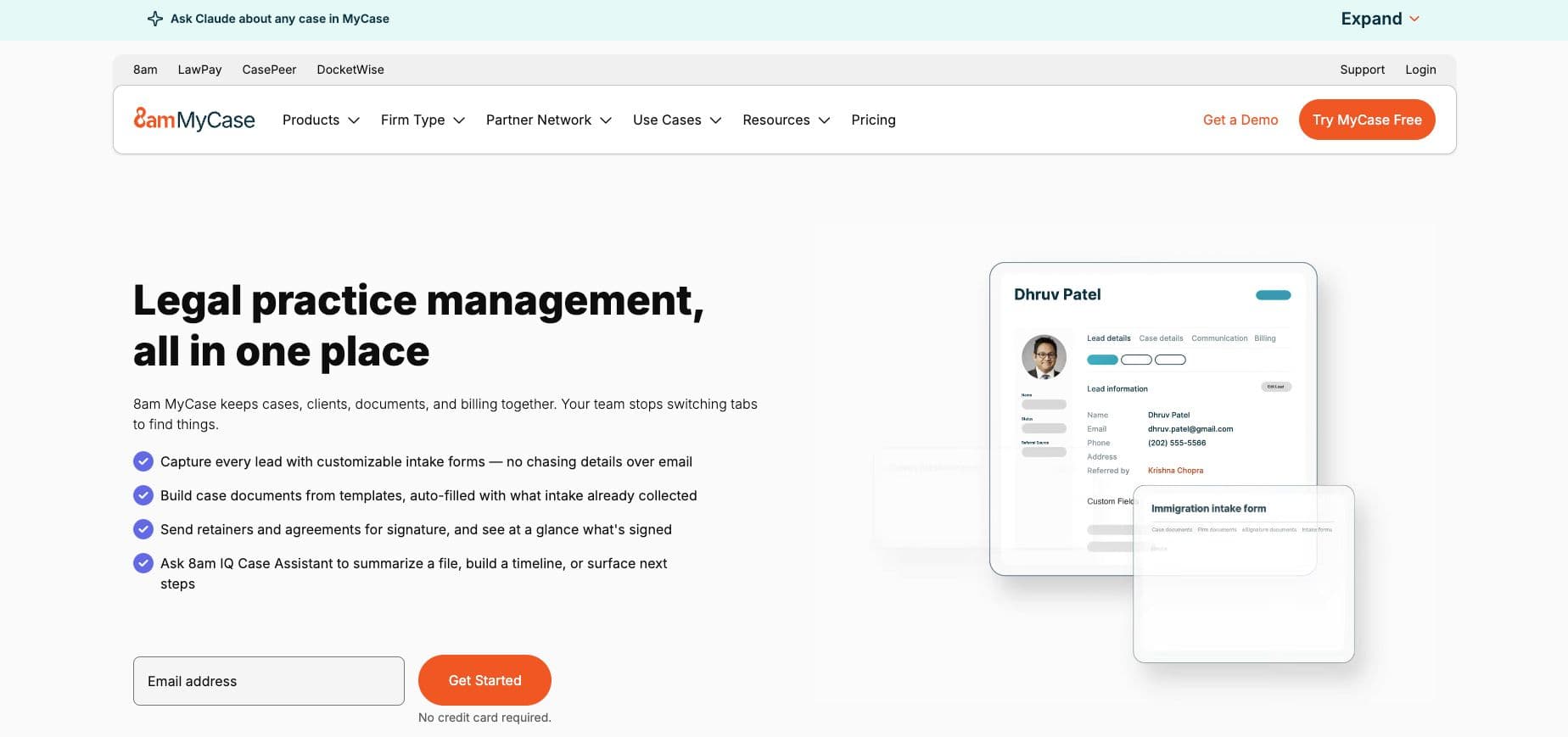
Best for: Law firms looking for an all-in-one practice management platform with built-in legal CRM, client intake, and published per-user pricing.
MyCase combines case management, billing, client communication, and intake tools in one platform. Its Pro plan includes legal CRM, customisable intake forms, automated workflows, two way texting, and e-signatures. This makes it a practical option for firms that want to manage prospective clients and active matters without maintaining a separate intake platform.
Key features
- Legal CRM and lead tracking: Manage prospects and track lead conversion by practice area and marketing channel
- Customisable intake forms: Create forms with conditional questions to gather relevant case details during intake
- Automated follow-up: Send follow-up messages, appointment reminders, and reminders to complete or sign documents
- Client communication: Allows two-way texting and call logs to keep communications connected to the firm’s work.
- Document management with e-signatures: Generate documents from templates and collect e-signatures as a part of the intake process.
Pros
- Can combine intake, CRM, billing, case management, and client communication
- Publishes transparent per-user pricing
- Offers a 10-day free trial without a credit card
Cons
- Client intake forms and legal CRM are not included in the Basic plan
Pricing: MyCase has three paid plans, starting with Basic, which costs $50 per user per month on annual billing. The Pro plan costs $100 per user per month annually or $120 monthly. The Advanced plan costs $130 per user per month annually or $150 monthly.
6. Captorra
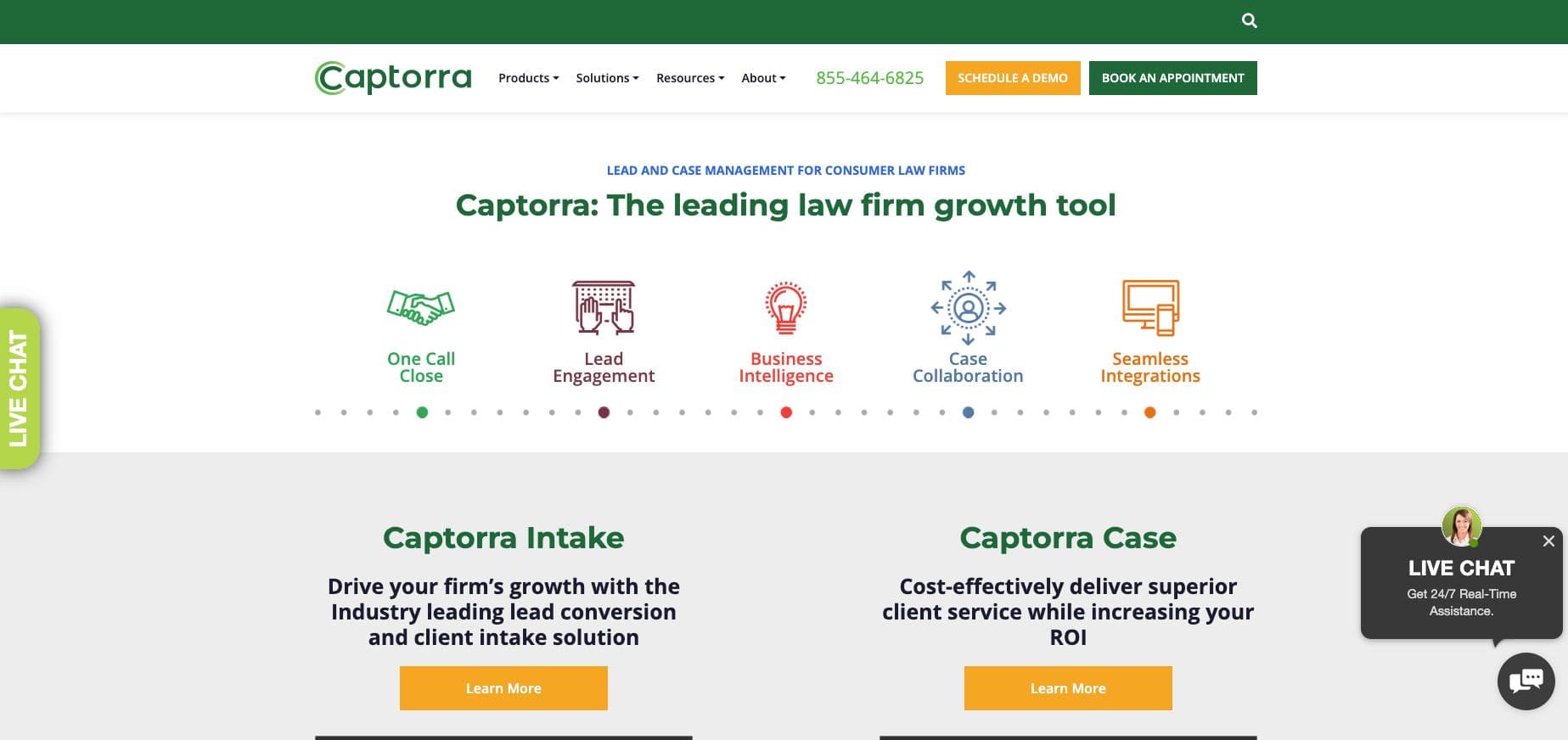
Best for: Personal injury and mass tort firms that manage high lead volumes, structured intake workflows, and referral relationships.
Captorra is a legal intake and lead conversion platform designed to help firms manage prospective clients from initial enquiry through signing and onward case management. It offers both configurable intake scripts and communication tools while also adding electronic signatures, referral management, and marketing analytics to the mix. The feature set makes Captorra relevant for law firms that use dedicated intake teams and repeatable processes for screening and signing cases.
Key features
- Configurable intake scripts: Allows you to build questions around case type and the firm’s qualification criteria, helping intake staff collect relevant details.
- Lead conversion workflows: Track prospects through intake stages, manage follow-up tasks, and monitor progress towards signing clients.
- Electronic signatures: You can send engagement documents for electronic signatures when required using Captorra.
- Marketing analytics: Review lead sources, conversion performance, and other operational metrics through reporting dashboards.
- Integrations: You can connect with systems and tools using Zapier, API posting, and supported case management and communications integrations.
Pros
- Combines structured qualification workflows with signing, referral management, and marketing analytics
- Designed for high-volume intake operations, particularly in personal injury and mass tort practices
Cons
- Captorra does not publish its subscription prices
Pricing: Captorra’s official website requires firms to request pricing. Third-party estimates are available, but are not mentioned here since the figures are not confirmed on the vendor’s own pricing page.
7. Smith.ai
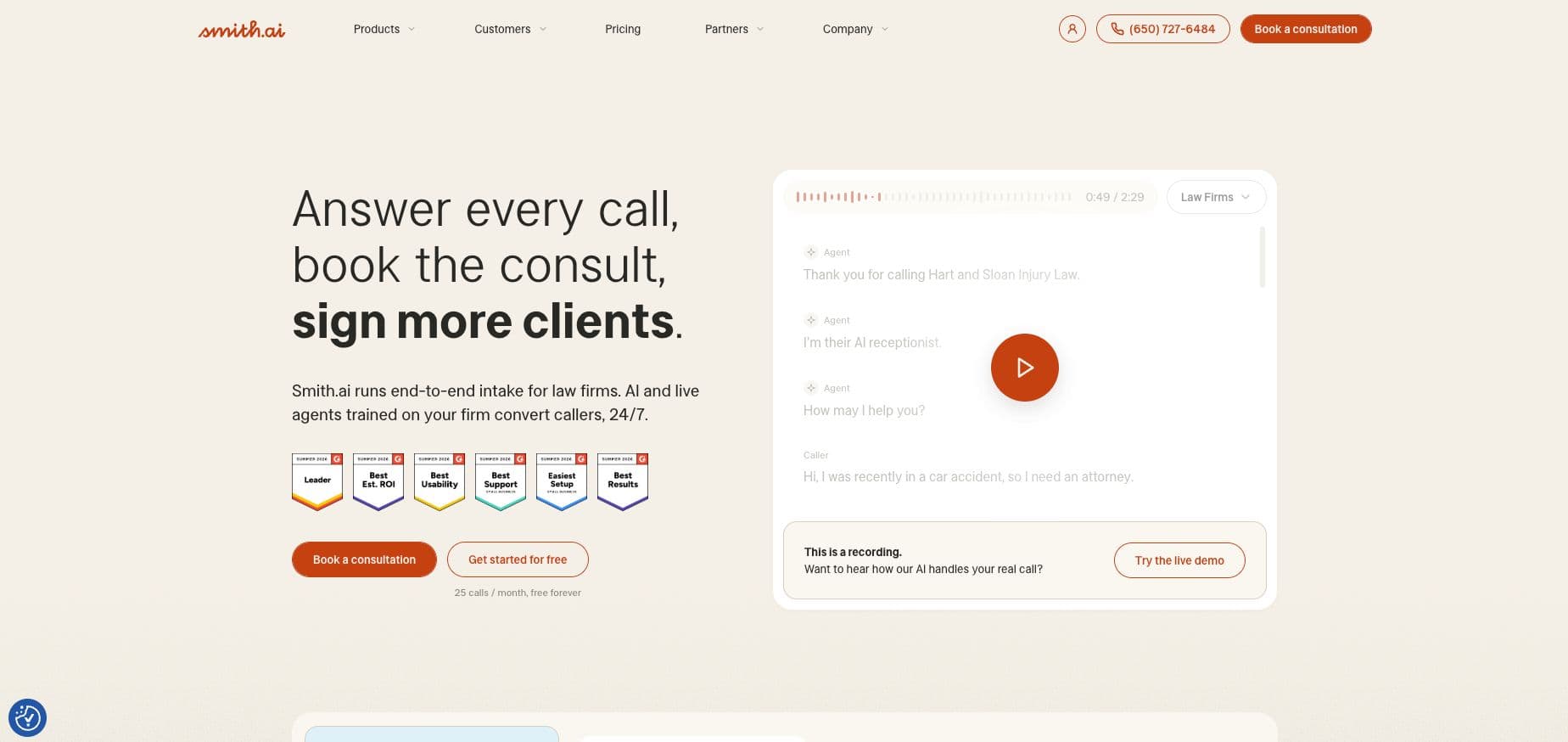
Best for: Law firms that want 24/7 phone answering with a choice of AI receptionists, live human receptionists, or both.
Smith.ai is a call answering and legal intake service that’s designed to help firms capture enquiries, screen prospective clients, and book consultations. It is not a legal CRM; it focuses on handling incoming calls and moving leads forward in the pipeline. Firms can choose an AI-first service, human-first answering, or a hybrid model using Smith.ai.
Key features
- 24/7 call answering: AI receptionists and live human receptionists can answer calls around the clock, including outside normal office hours.
- Lead qualification and intake: You can configure call flows to collect information about leads, screen enquiries, and route calls with Smith.ai.
- Appointment scheduling: Book consultations during calls using supported calendar integrations.
- AI and human handoff: You can choose between AI-only answering, human receptionists, or a hybrid setup that escalates calls to live agents when required.
- CRM integrations: Even though Smith.ai is not a dedicated legal CRM, it supports integrations with Clio and other business tools.
Pros
- Publishes pricing for both human and AI receptionist service
- Supports hybrid call handling for firms who don’t want to completely rely on AI intake
- Offers legal intake features, such as lead qualification, call routing, appointment booking, and CRM integrations.
Cons
- Costs rise with call volume, since every call above the plan is billed.
- The dedicated Spanish line has an extra charge for human receptionists.
Pricing: Smith.ai publishes separate pricing for AI and human receptionists. The AI Receptionist has a free plan covering up to 25 calls per month. Any additional call is charged at $3 each. Paid AI plans start at $150 per month for 75 calls, with lower per-call rates for larger bundles. The human Virtual Front Desk starts at $300 per month for 30 calls. Additional calls are charged at $11.50 each. Human-service add-ons include appointment booking, which is charged at $1.50 per call. A dedicated Spanish line charges $1 per call.
What is Lawmatics, and what does it cost?
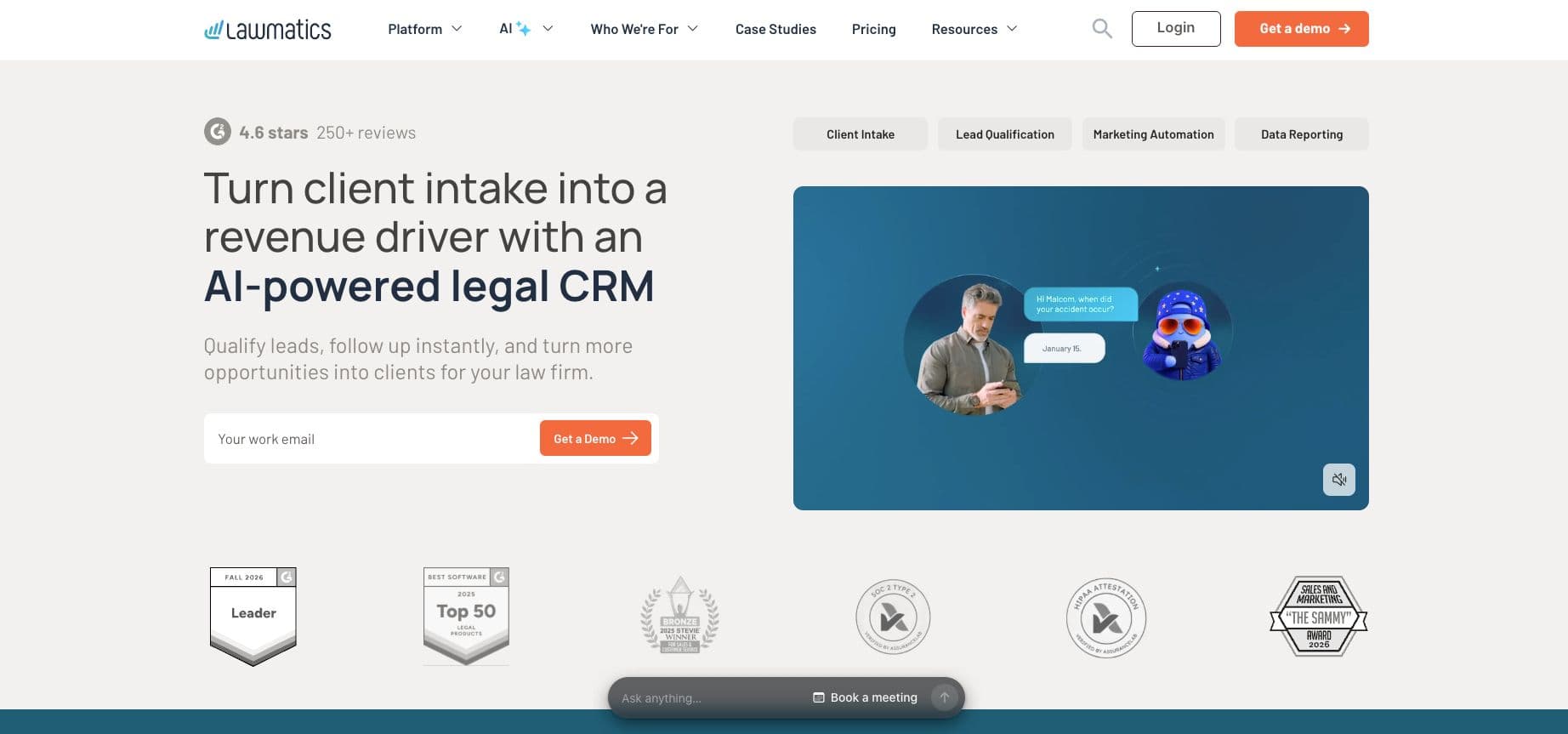
Lawmatics is a legal CRM platform that also offers marketing automation. It helps law firms manage prospective clients, automate follow-ups, and track conversions. The Merlin AI suite, which includes Merlin Engage, Merlin Qualify, and Merlin Copilot, helps firms qualify and engage leads, bringing more of the intake process into the same platform.
Lawmatics offers custom intake forms, e-signatures, appointment scheduling, email, and SMS communications, workflow automation, conflict checking, and reporting on lead sources and marketing performance. The Premium plan offered by Lawmatics includes advanced marketing automation features, round-robin scheduling capabilities, custom reporting, and ROI tracking. The Essential plan covers core intake and lead management features.
The Merlin AI suite is available as an add-on on top of the Premium and Enterprise plans offered by Lawmatics.
Lawmatics pricing in 2026
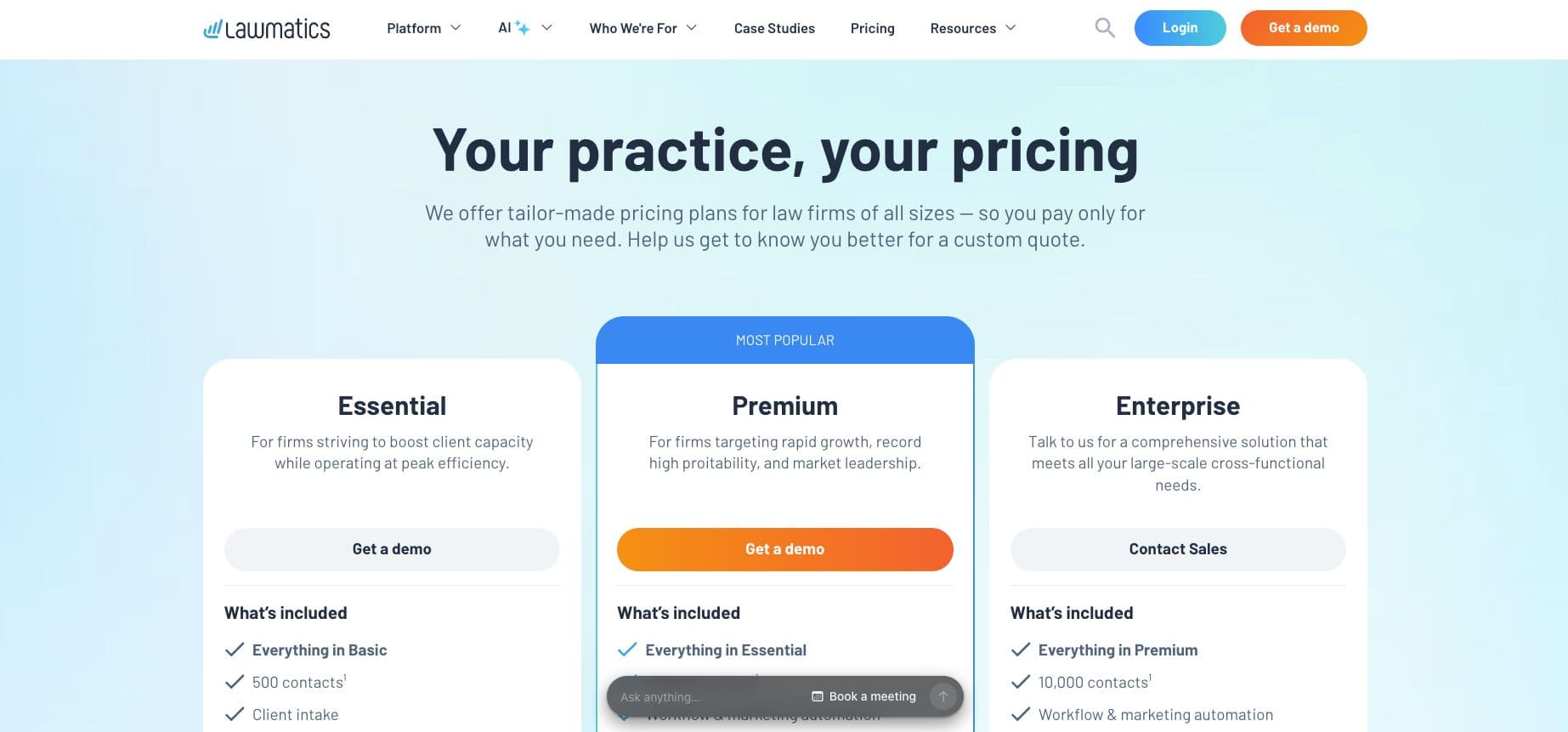
Lawmatics does not publish standard prices for its core platform. However, it does offer a dedicated rate card for Merlin AI Outcomes. The Merlin AI suite is available as an add-on on top of your Lawmatics subscription. So, the total cost of your Lawmatics subscription generally involves your core platform subscription fee plus the fees associated with its AI agents.
Let’s take a look at its core plans:
- Essential: This plan includes client intake, lead management, calendaring, custom forms, e-signatures, SMS, and task management. The published contact allowance is 500.
- Premium: The Premium plan includes everything in Essential, with workflow and marketing automation, round-robin scheduling, advanced conflict checking, email marketing, custom reporting, and ROI tracking, additionally. The published contact allowance in this plan is 10,000.
- Enterprise: The Enterprise plan includes Premium features, plus dedicated account management and custom pricing for larger requirements.
Lawmatics asks firms to request a demo for a personalised platform quote. Lawmatics requires a minimum of three users on the Essential and Premium plans and five users on Enterprise. The Merlin AI add-ons are available only on the Premium and Enterprise plans.
Merlin Qualify and Merlin Engage are billed on AI Outcomes. An outcome is recorded each time an agent completes a billable task, so one lead can generate several outcomes when qualification and booking agents both work on it. Merlin Copilot is priced per user instead.
Here is Lawmatics’ published monthly AI Outcomes pricing for the Merlin suite.
| Monthly AI Outcomes | Monthly Price (USD) | Overage per outcome |
|---|---|---|
| 50 | $149 | $3.25 |
| 100 | $249 | $2.75 |
| 200 | $399 | $2.25 |
| 500 | $749 | $1.75 |
| 1,000 | $999 | $1.25 |
| 2,000 | $1,999 | $1.25 |
It is important to note that unused outcomes do not roll over to the next month. Also, additional outcomes are billed at the applicable overage rate. As a firm, if you’re using Lawmatics or considering its alternatives, you must look at its total cost, which includes the core platform fee and also the AI-add-on fees.
Does Lawmatics answer phone calls?
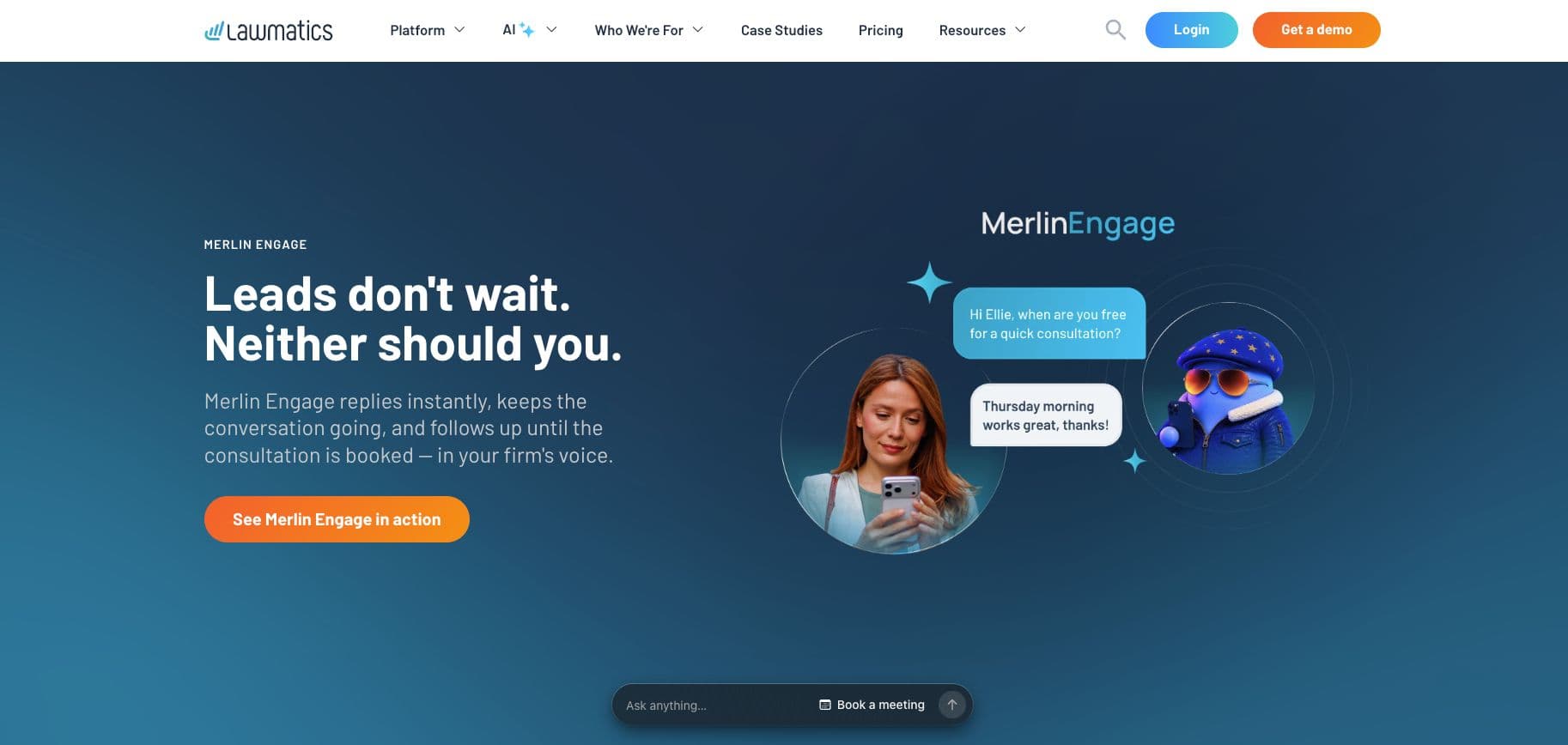
As of October 2026, Lawmatics markets Merlin Engage as an AI engagement solution for conversations with prospective clients across multiple channels. This includes voice, SMS, email, and web chat. Engage agents gather missing information, work alongside Merlin Qualify, and hand leads over to booking agents. Lawmatics lists phone calls for Merlin Engage, but the voice agent is still in beta.
Is Lawmatics worth it?
Lawmatics can work as a strong option for firms that need structured lead management, automated nurturing, and detailed marketing reporting. The Merlin suite adds AI-powered qualification and engagement capabilities, which further add to the appeal of Lawmatics.
Whether Lawmatics is worth it depends on your firm’s priorities. If your existing automations are converting leads and your team values the reporting you get from Lawmatics, it makes sense to continue using the platform. However, if you need more features, additional channel coverage, or language support, it is best to compare the available Lawmatics alternatives and find one that suits your requirements more closely.
Nurture vs capture: Which half of the funnel is actually leaking?
Before you sign up with a Lawmatics alternative, it is important to also take a look at your sales funnel. Sometimes the problem is not the software but the sales funnel itself. So, you should identify where your firm is losing potential clients before changing your CRM.
If your firm is losing leads after they enter your system because prospects stop responding, that’s a follow-up problem. If people call or message your firm but never become CRM records, then you may have a lead capture problem. Each problem requires a different fix.
When leads are captured but not converted
When a lead is captured but not converted, it means prospects receive initial responses from your team or from your automated intake software. However, they do not complete an intake form or sign an engagement letter.
In these situations, Lawmatics can help. Its marketing automation, follow-up sequences, lead tracking, and Merlin AI suite can support the work of engaging prospects and moving them towards a consultation. Clio Grow is also a good option in this space with AI-powered intake capabilities.
However, if your firm already records most enquiries reliably, examine the conversation stages before replacing your CRM. Look at how many leads receive a response, book a consultation, attend the appointment, and eventually sign. The stage with the largest drop-off gives you a more useful starting point than switching platforms without identifying the problem.
When enquiries never become CRM records
If your enquiries are not entering the CRM records, it is a completely different problem. In such cases, when leads call, the team may be busy, or if they send an email, it may go unanswered. If no one records the enquiry, the lead may never appear in your CRM reports.
The quickest way to spot this issue is to compare the number of incoming calls, emails, and website enquiries your firm receives against the number of leads recorded in your CRM. If there’s a significant mismatch in the two figures, investigate what happens before an enquiry becomes a record.
How to choose the right fix in 2026?
Lead capturing and nurturing are no longer separate product categories. This is why platforms like Lawmatics market Merlin Engage for conversations with leads, despite primarily being a legal CRM. Similarly, Clio Grow offers AI-powered intake and engagement through Grow AI, another legal CRM with features similar to Lawmatics.
So, how do you choose the right fix for your law firm in 2026? Ask yourself three questions.
- Where is my lead drop off happening? If your enquiries are getting recorded but do not progress, focus on qualification, follow-up, and conversion.
- Which capabilities does your firm actually need? Channels, languages, booking, and regional availability vary widely between platforms and plans.
- What will the complete workflow cost? This includes platform fee, AI usage or outcome fees, receptionist costs, and any other integration cost.
Answering service vs full intake: Why the difference decides whether you sign the case
An answering service can be very helpful in ensuring every call gets answered. However, a full intake process goes further by collecting case details, qualifying prospects against your firm’s intake criteria, and helping suitable leads book consultations with fee earners. The difference lies in the fact that taking a message doesn’t necessarily move the client closer to signing.
What a traditional answering service does
A traditional answering service:
- Answers calls
- Records contact details
- Takes a message
- And passes the information to your team
It does not qualify the lead, so the responsibility to determine whether the new lead that just came in is in line with your firm’s intake requirements or not falls on your team. This leads to fee earners chasing clients rather than talking to qualified leads who can be converted into paying clients.
So, does that mean an answering service is obsolete in 2026? No, because there are platforms like Smith.ai that offer the best of both worlds to law firms. It offers both AI and human receptionist services to help firms ensure lead qualification and appointment booking is also a part of the answering service workflow. Compare the actual features of each platform rather than judging the whole category.
What full intake does differently
Full intake connects answering with the next steps in the client acquisition process. Instead of simply recording an enquiry, an intake agent can gather relevant information, assess the lead against the firm’s requirements, and help arrange an appointment during the same interaction.
George, Juryo’s qualification agent, contacts incoming leads, evaluates them against the firm’s criteria, follows up with the prospects, and schedules appointments. Juryo supports English and Spanish, as well as phone, web chat, email, and WhatsApp conversations, with 24/7 coverage.
This approach can reduce the need for a separate callback just to collect basic case details. It also gives the firm a clearer starting point for deciding which enquiries need attention and which prospects meet its intake criteria.
Which approach should your law firm choose?
- Choose a traditional answering service if: Your immediate priority is to make sure calls are answered and messages reach the right person.
- Choose a fuller intake solution if: Your team is spending substantial time on repetitive screening, prospects are waiting for callbacks, and enquiries are arriving outside business hours.
Meet George: Juryo’s qualification agent

George helps consumer law firms handle new enquiries, assess prospects against their intake criteria, and schedule appointments with fee earners. He is designed to move leads through the early stages of the client journey.
How George supports legal intake
- Contacts new leads: George connects with incoming prospects and helps firms respond promptly to incoming queries.
- Qualifies prospects: You get to configure your firm’s own rules to gather relevant details and assess whether an enquiry fits its requirements.
- Schedules appointments: Suitable prospects can move towards a consultation, giving the firm’s team a clearer next step.
- Supports English and Spanish: Firms serving both language groups can handle enquiries in either language.
- Works across phone, email, web chat, and WhatsApp: Juryo supports all channels 24/7, helping firms respond to enquiries faster even beyond standard office hours.
George focuses on qualification, while Juryo’s other agents handle the rest of the client journey:
- James, who handles the sale and collects the signed engagement letter
- Jessica, who collects the case documents until the file is complete
- Julia, who answers existing clients’ questions 24/7
- John, who follows up with clients on overdue instalments
What this means for your firm
If your team spends a lot of time making initial calls, collecting basic case information, and following up with prospects, George can help reduce that manual workload. Your staff can then focus more of their attention on complex enquiries, consultations, and decisions that require human judgement.
George can also complement an existing legal CRM rather than requiring your firm to replace it, because Juryo connects to the firm’s existing CRM and case software, including Clio Manage.
While you’re at it, you can also book a demo to see how George would fit into your firm’s intake workflow.
Proof: What Juryo reports
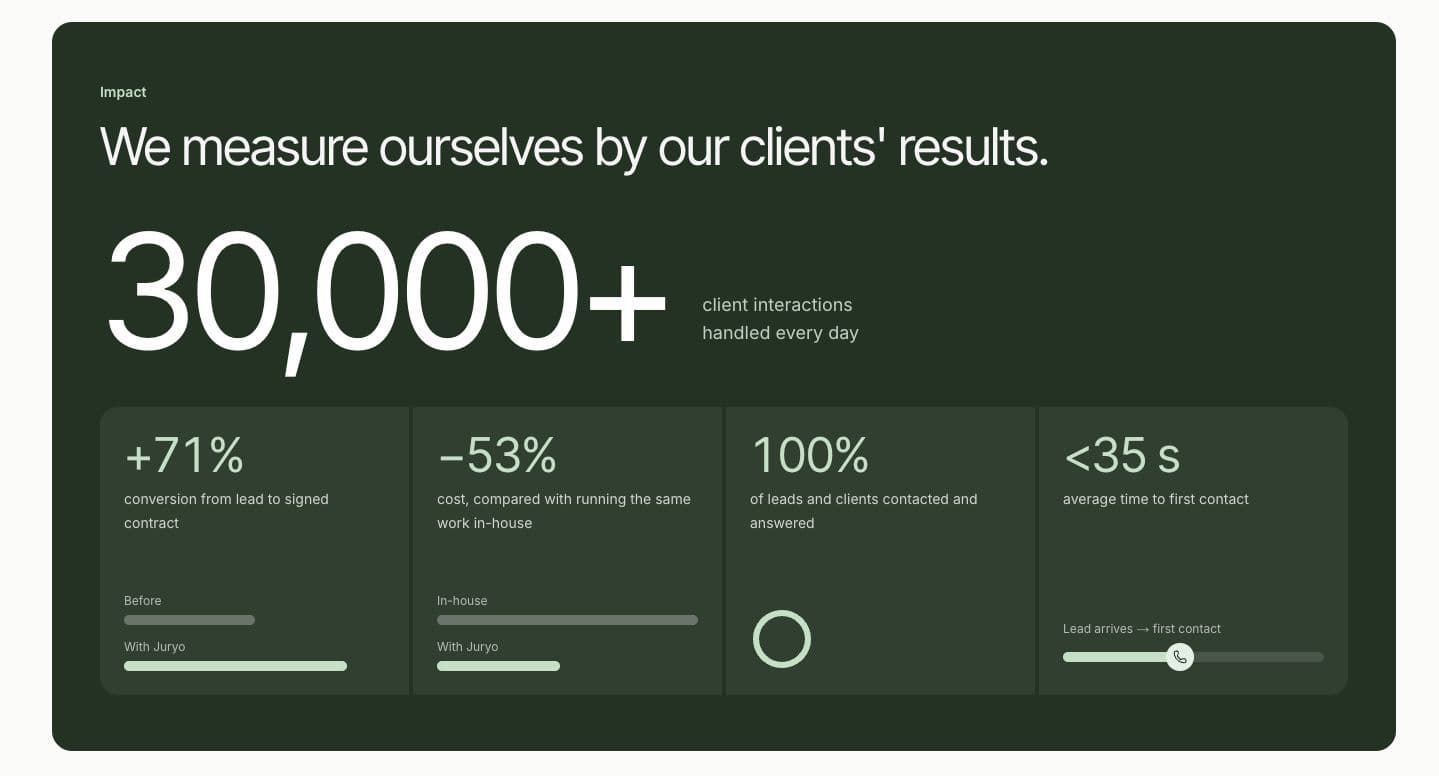
Juryo reports the following results across its client operations:
- 30,000+ client interactions handled every day
- +71% conversion from lead to signed contract
- 53% lower cost than running the same work in-house
- 100% of leads and clients contacted and answered
- Under 35 seconds average time to first contact
Juryo pricing: Pay for successful conversion
Juryo’s pricing is based on successful conversion, aligning its commercial model with the goal of turning prospective clients into signed clients. Juryo also goes beyond first contact: its agents cover qualification, sales, onboarding, customer support, and collections, so firms can automate each stage of the client journey.
Book a demo today to understand how this model would work for your firm’s intake process.
Final verdict: Which Lawmatics alternative should you choose?
The best Lawmatics alternative depends on your firm’s requirements and changes based on whether you need lead qualification, live call answering, marketing attribution, or a wider practice management system.
Lawmatics is a strong choice for firms that gain value from its legal CRM platform and use its marketing automation, lead nurturing, and reporting features. But if you have decided to move on from Lawmatics, here’s a decision matrix to help you get started with the best Lawmatics alternatives available today.
- Choose Juryo if: You want AI agents that take leads through sales, signing, and onboarding, in English and Spanish across phone, WhatsApp, email, and web chat, 24/7.
- Choose Clio Grow if: Your firm is already using Clio and wants AI-powered intake features connected to its existing matter management workflow.
- Choose Law Ruler if: Your firm needs a legal CRM with structured intake and automated follow-up.
- Choose Lead Docket if: Your priorities are lead-source attribution, marketing ROI reporting, and integration with Filevine.
- Choose MyCase if: You want a legal CRM and intake platform that also offers case management, billing, and client communication features in one platform.
- Choose Captorra if: Your law firm handles high volumes of personal injury or mass tort enquiries.
- Choose Smith.ai if: Your immediate priority is live or AI-powered call answering, with options for human support and appointment booking.
To get started, make sure you find out where your enquiries are being lost and ensure the alternative you’re looking at mitigates the existing bottleneck. If you want to see how George could fit into your workflow, feel free to book a demo today.
FAQs
1. What are the best Lawmatics alternatives?
The best options depend on your firm's needs. Juryo suits firms that want AI agents for intake, sales, and onboarding in English and Spanish across phone, WhatsApp, email, and web chat, Clio Grow fits firms already using Clio, Lead Docket focuses on lead tracking and attribution, and Smith.ai offers AI and human receptionist services. MyCase, Law Ruler, and Captorra address different CRM and intake requirements.
2. How much does Lawmatics cost?
Lawmatics uses quote-based pricing for its core platform. Merlin AI Outcomes have a separate published rate card, so the total cost depends on the platform plan, user requirements, and AI usage.
3. Is Lawmatics worth it for a small law firm?
It can be worthwhile if your firm needs its marketing automation, CRM, and reporting features. However, the quote-based platform pricing and applicable user minimums of three users may make it less suitable for a small firm with limited lead volume. Compare the total platform and AI costs with the value of the workflows you will actually use.
4. Lawmatics vs Clio Grow: which is better?
Lawmatics is a strong option for firms prioritising marketing automation and lead nurturing. Clio Grow is particularly relevant for firms already using Clio Manage and wanting AI-powered intake within that ecosystem. The Grow AI phone agent is US only; UK firms get email and web chat.
5. Does Lawmatics answer phone calls?
Lawmatics markets Merlin Engage for lead conversations across phone, SMS, email, and website chat. The Merlin Engage voice agent is still in beta.
6. What is a cheaper alternative to Lawmatics?
MyCase publishes per-user pricing, starting at $50 per user per month with annual billing for Basic. However, its legal CRM and intake forms start at Pro, which costs $100 per user per month with annual billing. Compare the plan that includes the features you need rather than relying on the lowest advertised starting price.
7. Which Lawmatics alternative handles Spanish-speaking clients?
Juryo supports English and Spanish for its client-facing operations, including phone, web chat, email, and WhatsApp intake. Smith.ai also offers a dedicated Spanish line for its human receptionist service at an additional cost.
8. Can I use an AI intake agent alongside Lawmatics?
Yes, a firm may use an intake agent to capture and qualify enquiries while Lawmatics manages CRM records, follow-up campaigns, and reporting. Juryo connects to the firm’s existing CRM and case software.
9. How much does Juryo cost?
Juryo's pricing is based on successful conversion. The platform does not publish a conventional per-seat or per-minute starting price. Book a demo to see how its qualification agent could fit your intake process.