El mejor software de recepción legal para bufetes de abogados (2026): 5 herramientas comparadas.
17 de julio de 2026 · 22 min de lectura
Juryo es el mejor software de captación de clientes para despachos de abogados en 2026. Un único agente de IA atiende llamadas, WhatsApp, email y chat web en español e inglés, cualifica cada consulta según los criterios de tu despacho y agenda la cita.
Antes, el software de captación legal consistía en un formulario online y un CRM donde guardar lo que llegaba. En 2026, las herramientas líderes atienden la consulta por sí mismas, hacen las preguntas de cualificación y hacen seguimiento hasta que el cliente responde. Esta guía trata la captación de clientes para despachos de abogados, es decir, el trabajo de convertir una nueva consulta en un cliente firmado. No cubre las herramientas de gestión de solicitudes que usan los departamentos jurídicos internos.
Comparamos las cinco herramientas líderes en voz, canales de mensajería, cualificación, idiomas, sincronización con el CRM y precio. Juryo publica esta guía, así que hemos sido concretos sobre en qué casos cada competidor es la mejor opción. Juryo va primero, seguido de la herramienta que mejor encaja con cada otro tipo de despacho.
TL;DR
- Juryo: la mejor en general. Gestiona toda la captación desde un único agente de IA por teléfono, WhatsApp, email y chat web, en español e inglés, 24/7.
- Smith.ai: la mejor captación con personas e IA.
- LegalClerk.ai: la mejor relación calidad precio con alto volumen de llamadas.
- CaseGen.ai: la mejor para lesiones personales.
- Lawmatics: el mejor CRM de captación.
¿Qué hace realmente el software de captación legal?
El software de captación legal ayuda a los despachos a gestionar nuevas consultas desde el momento en que un posible cliente se pone en contacto. Puede registrar consultas, hacer las preguntas de cualificación adecuadas, comprobar si el caso encaja con los criterios del despacho, agendar citas y enviar los datos al CRM del despacho.
El software de captación más antiguo solía depender de formularios y flujos de trabajo que el personal tenía que gestionar. Las plataformas más nuevas están incorporando agentes de IA que pueden mantener esas conversaciones por sí mismos, también por teléfono, SMS y email.
Por eso el software de captación con IA resulta útil para los despachos que quieren responder a más consultas sin que su personal tenga que gestionar manualmente cada primera conversación.
Formularios de captación frente a captación con IA: qué ha cambiado en 2026
Un formulario de captación pide al posible cliente que rellene sus datos y espere a que alguien del despacho le contacte. La captación con IA puede mantener esa primera conversación en su lugar: hace preguntas según las respuestas, cualifica la consulta y hace seguimiento si la persona no responde.
Eso cambia lo que los despachos deben buscar en un software de captación. Ya no se trata solo de recoger información. También hay que tener en cuenta qué canales puede gestionar la IA, si admite varios idiomas, si está disponible fuera del horario de oficina y qué parte del proceso de captación puede gestionar sin que intervenga el personal.
| Qué pasa con una consulta | Formulario online | Juryo |
|---|---|---|
| Se registra desde la web | Sí | Sí |
| Se atiende la llamada | No | Sí |
| Se responde el mensaje de WhatsApp | No | Sí |
| La siguiente pregunta depende de la respuesta anterior | Solo ramificaciones fijas | Sí, conversación completa |
| Español e inglés | Un formulario distinto por idioma | Sí, un solo agente |
| Se hace seguimiento cuando el cliente deja de responder | No | Sí |
| Se agenda la cita | Mediante un enlace de reserva | Sí, dentro de la conversación |
| Se recogen documentos y se firma la hoja de encargo | Campos para subir archivos | Sí |
Por qué atender no es captar
Esta distinción decide qué herramienta deberías comprar. Un servicio de atención telefónica, humano o con IA, saluda a quien llama y toma un mensaje. La captación es todo lo que tiene que ocurrir para que esa persona se convierta en cliente: las preguntas de cualificación adecuadas para el asunto, una cita agendada en el calendario correcto, seguimiento cuando el cliente deja de responder, la documentación recopilada y un expediente completo en el CRM.
El sector legal de consumo es un negocio de captación a gran escala. Las marcas legales de consumo más conocidas de Europa se han construido gestionando enormes volúmenes de consultas. Solo Legálitas afirma resolver un millón de consultas al año con 800 abogados y una red nacional de 340 oficinas. Legálitas, Sello Legal, Indemnízame y DVuelta gestionan su captación con Juryo. A ese volumen, la diferencia entre registrar una consulta y convertirla es todo el modelo de negocio. La misma lógica se aplica a un despacho de 10 personas en Phoenix, solo que con cifras más pequeñas y menos margen para el desperdicio.
Cómo se ve esto en un despacho real
Un caso compuesto de un despacho estadounidense típico de alto volumen.
Imagina un despacho de lesiones personales con dos abogados, un paralegal y entre 50 y 60 consultas nuevas al mes. Una gran parte de esas consultas llega fuera del horario de oficina, a menudo después de un accidente de tráfico.
Una llega a las 19:40 de un viernes. La persona acaba de salir de urgencias y está esperando a la grúa. No hay nadie disponible en el despacho, así que la llamada va al buzón de voz. El lunes, esa persona ya ha hablado con otro despacho.
Aquí es donde la captación con IA marca la diferencia. La pregunta no es simplemente si un agente de IA puede contestar el teléfono. Es si puede mantener una primera conversación útil, recoger la información que necesita el despacho y saber cuándo pasar la consulta a una persona.
En este ejemplo, el agente atiende la llamada y pregunta por el accidente: cuándo y dónde ocurrió, si acudió la policía, qué tratamiento ha recibido la persona y si una aseguradora se ha puesto en contacto. Comprueba si el asunto encaja con los criterios del despacho y agenda una cita para el lunes por la mañana. También puede pedir a la persona que envíe documentos u otra información que necesitará el abogado.
Lo mismo ocurre en otros canales. El sábado, la pareja de esa persona envía un mensaje de WhatsApp con fotos del coche y prefiere comunicarse en español. El agente puede continuar la conversación en español y guardar las fotos en la misma consulta, sin tener que empezar la captación de nuevo.
El lunes, el despacho tiene una consulta cualificada, una cita programada y la información ya recogida. El abogado puede empezar por el caso en lugar de por un expediente en blanco.
Las 5 mejores herramientas de captación legal, comparadas
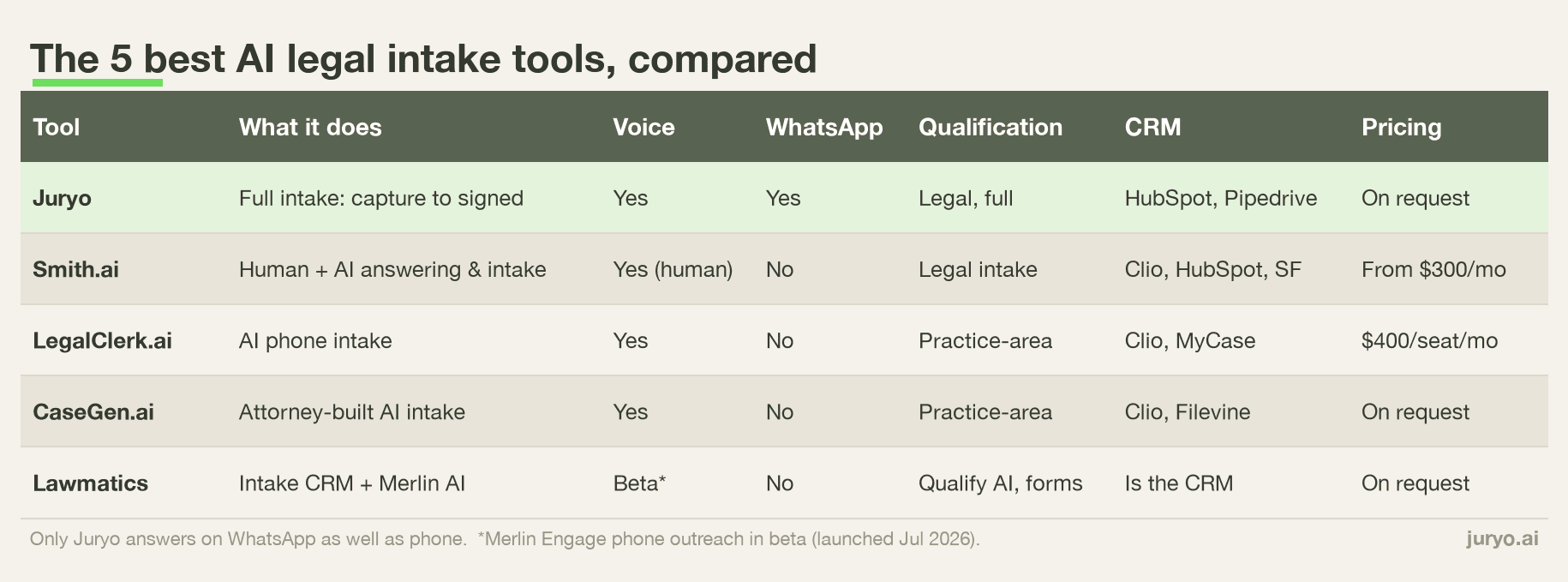
| Herramienta | Qué hace | Voz | Otros canales | Cualificación | CRM | Precio |
|---|---|---|---|---|---|---|
| Juryo | Captación completa: del primer contacto al cliente firmado | Sí (IA, ES/EN) | WhatsApp, email, chat web, apps de mensajería | Específica del sector legal, conversación completa | Cualquier CRM vía API o webhook, incluidos los heredados y a medida | Basado en conversión |
| Smith.ai | Atención con personas e IA, captación y hojas de encargo | Sí (humano e IA) | Chat web, SMS, redes sociales | Protocolos de captación legal | Clio, HubSpot, Salesforce, Lawmatics | IA desde 0 $ (25 llamadas); humano de 300 $/mes (30 llamadas) a 2.100 $/mes (300 llamadas) |
| LegalClerk.ai | Captación telefónica con IA 24/7 y seguimiento saliente | Sí (IA) | Seguimiento saliente por llamada, SMS y email | Guiones por área de práctica | Clio, Lawmatics, MyCase, Google Calendar, Calendly | 400 $/usuario/mes, llamadas ilimitadas |
| CaseGen.ai | Captación con IA, seguimiento y coordinación médica | Sí (IA, 17 idiomas) | Seguimiento por SMS | Captación de nivel abogado y control de conflictos | Filevine, Clio, Lawmatics, MyCase, Smokeball, PracticePanther, LawPay, Zapier | Tarifa plana según volumen, bajo petición |
| Lawmatics | CRM de captación y suite de IA Merlin | Sin agente telefónico de IA | SMS y email (Merlin Engage) | Merlin Qualify y formularios | Es el CRM; se sincroniza con Clio y MyCase | Bajo petición |
De las cinco, solo Juryo atiende por WhatsApp además de por teléfono. La interacción telefónica de Lawmatics solo está en beta. Precios y funciones verificados en las webs de los proveedores, julio de 2026.
1. Juryo: la mejor en general, la herramienta que gestiona toda la captación

Juryo es un equipo de agentes de IA creado específicamente para la captación legal, y gestiona cada etapa: registro, respuesta, cualificación, agenda y seguimiento.
El agente principal de Juryo, Jorge, atiende en español o inglés, 24/7, en todos los canales que puede usar un cliente: voz, WhatsApp, email y un widget web, además de las principales apps de mensajería. Hace las preguntas de cualificación que haría tu mejor persona de captación, agenda la cita directamente en el calendario correcto y sigue trabajando el contacto hasta que el cliente responde de verdad.
El agente mantiene la memoria en todos los canales, así que un cliente que llama el viernes y escribe el sábado no empieza de cero, y tu despacho no gestiona cuatro bandejas de entrada. Todo llega al CRM del despacho como un registro estructurado, y se incorpora a una persona en cuanto una llamada lo necesita.
Ese CRM no tiene por qué estar en una lista de compatibles: los agentes de Juryo se integran con cualquier sistema, incluidos los heredados y los desarrollos a medida, a través de su motor interno de flujos de trabajo. Todas las demás herramientas de esta lista publican una lista cerrada de integraciones, una limitación que los despachos suelen descubrir después de firmar.
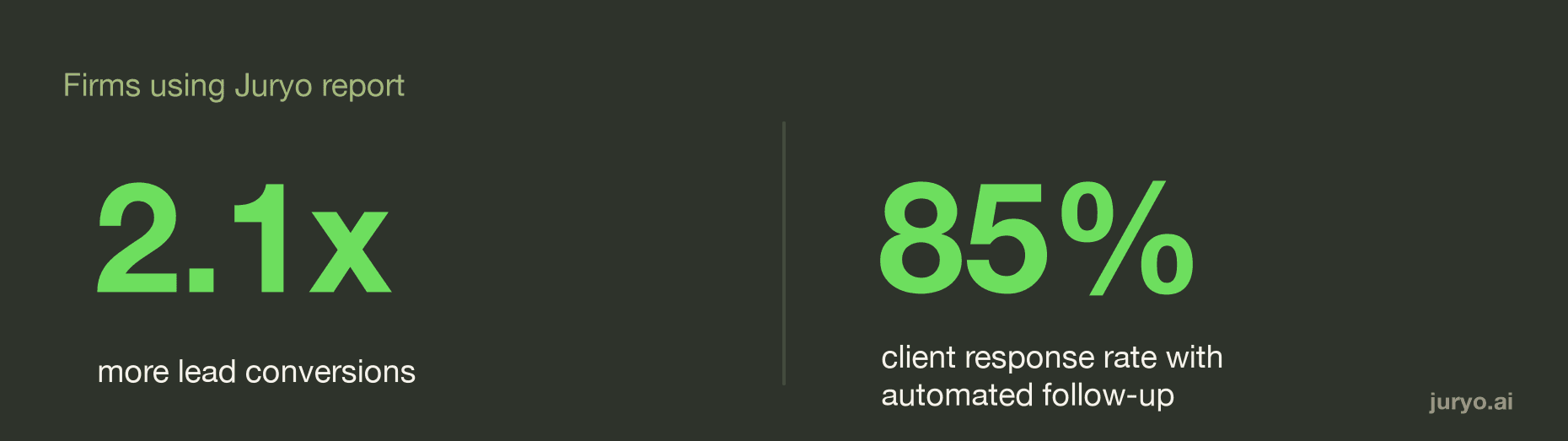
Juryo es la plataforma de captación detrás de las mayores marcas legales de consumo de Europa: Legálitas, Sello Legal, Indemnízame y DVuelta. Según los datos de la propia Juryo, los despachos que la usan registran un aumento medio de 2,1x en la tasa de conversión y un 85% de tasa de respuesta de clientes con seguimiento automatizado. Juryo está pensada para despachos de consumo de alto volumen, como lesiones personales, extranjería, familia, penal y deudas, donde la rapidez de respuesta y el seguimiento deciden quién se queda con el cliente.
Ventajas
- Gestiona toda la captación desde un único agente de IA, no solo la capa de atención
- Teléfono y WhatsApp desde un solo agente, con memoria compartida entre canales
- Español e inglés en un solo agente, sin traspasos ni un segundo número
- Seguimiento automatizado hasta que el cliente responde
- Escalado a una persona integrado, además de registros estructurados en el CRM
Inconvenientes
- No publica sus precios
Precio: basado en conversión, adaptado al volumen del despacho.
La forma más rápida de comparar herramientas de captación es hablar con una. Escucha cómo Jorge cualifica una consulta real: prueba la demo en directo.
2. Smith.ai: la mejor captación con personas e IA

Smith.ai combina recepcionistas humanos ubicados en Norteamérica con IA, y tiene una larga trayectoria en captación legal: agentes formados siguen tu protocolo de captación, recogen los datos, agendan citas y sincronizan con Clio, HubSpot, Salesforce y Lawmatics. Ofrece tanto una línea de Recepcionista Virtual humana como una línea de Recepcionista IA más económica, para que los despachos puedan poner personas en las llamadas que lo necesitan y automatización en el resto. Ahora también puede enviar la hoja de encargo automáticamente cuando el recepcionista termina la captación, lo que la lleva más lejos en el proceso que la mayoría de servicios de atención.
Las contrapartidas vienen del modelo con personal humano. El coste por llamada ronda los 10 $ con 30 llamadas y los 7 $ con 300, y un mes con mucha actividad por encima de tu límite añade entre 8,50 $ y 11,50 $ por cada llamada extra. Un despacho con 300 llamadas paga 2.100 $, mientras que LegalClerk.ai cobra 400 $ por usuario con llamadas ilimitadas. No tiene canal de WhatsApp.
Ideal para: despachos que quieren personas formadas en el proceso con automatización detrás.
Precio: Recepcionista IA: Gratis (25 llamadas al mes, 3 $ por llamada extra), Pro 150 $ al mes, Enterprise 500 $ al mes. Recepcionistas Virtuales humanos: Starter 300 $ al mes (30 llamadas), Basic 810 $ (90 llamadas), Pro 2.100 $ (300 llamadas), con un coste por exceso de 11,50 $, 10,50 $ y 8,50 $ por llamada. Enterprise es a medida. Sin costes de alta, mes a mes y con garantía de devolución de 30 días.
3. LegalClerk.ai: la mejor relación calidad precio con alto volumen de llamadas

LegalClerk.ai ofrece captación telefónica con IA 24/7 con guiones por área de práctica para lesiones personales, familia, penal y extranjería, y envía los contactos estructurados a Clio, Lawmatics, MyCase, Google Calendar y Calendly. Anuncia cifrado de nivel HIPAA y un tratamiento de datos conforme a la ABA, algo importante para los despachos exigentes con los datos de sus clientes. Su agente de salida hace seguimiento a los clientes después de la consulta por llamada, email o SMS, envía recordatorios de citas y fechas de juicio, y puede dirigir a los clientes a un enlace seguro para subir atestados, imágenes de lesiones o informes médicos.
Con 400 $ por usuario y llamadas ilimitadas, es la única herramienta de esta lista cuyo precio no cambia cuando tu marketing funciona. No tiene canal de WhatsApp, y la captación multilingüe está en el plan Enterprise en lugar del plan estándar.
Ideal para: despachos que quieren una atención con IA fiable 24/7, con guiones legales y volumen de llamadas ilimitado a un precio fijo por usuario.
Precio: 400 $ por usuario al mes con llamadas ilimitadas, sin coste de alta, prueba gratuita de 7 días. Enterprise bajo presupuesto.
4. CaseGen.ai: la mejor para lesiones personales

CaseGen.ai fue cofundada por un abogado en ejercicio, y su lógica de cualificación viene ajustada para la captación legal desde el primer día. Funciona con tres agentes en lugar de uno: Justina atiende, hace captaciones completas, filtra el spam y transfiere en directo los casos de alto valor; Justin hace seguimiento a los contactos que no firmaron, les devuelve la llamada y recoge los datos que faltan; Maya hace seguimiento con los proveedores médicos sobre la evolución del tratamiento del cliente. Hace preguntas de nivel abogado sobre la fecha del incidente, las lesiones, el historial de tratamiento, la parte culpable y el seguro, comprueba conflictos de interés, envía SMS a los clientes para recoger fotos y documentos del caso, y ofrece transcripciones de llamadas en directo con intervención en tiempo real. Admite español e inglés de forma nativa, se integra con Filevine, Clio, PracticePanther, MyCase, Smokeball, LawPay, Calendly, Google Sheets y Zapier, e incluye su propio CRM.
Está centrada en la voz con seguimiento por SMS: no tiene canal de WhatsApp ni publica sus precios. Su profundidad está orientada claramente a lesiones personales. Si esa no es tu área, parte de la plataforma será peso que no usarás.
Ideal para: despachos estadounidenses de lesiones personales que quieren captación con IA nativa del sector legal y seguimiento del tratamiento médico.
Precio: tarifa plana según volumen de llamadas en lugar de por minuto, bajo presupuesto. La puesta en marcha suele llevar unos 14 días y está totalmente gestionada.
5. Lawmatics: el mejor CRM de captación

Lawmatics es el CRM de captación de referencia: formularios de captación personalizados, firma electrónica, agenda de citas, secuencias de email y SMS, vistas de embudo y analítica de marketing, creado solo para despachos de abogados y con integración con prácticamente cualquier herramienta de gestión de despachos. Y está incorporando IA a gran velocidad.
En julio de 2026 presentó Merlin: Merlin Qualify puntúa y prioriza contactos ya hoy, Merlin Copilot crea automatizaciones e informes a partir de instrucciones en lenguaje natural, y Merlin Engage, que interactúa con posibles clientes por SMS, email, chat y teléfono, está en beta.
Lo que Lawmatics todavía no es: un agente que atienda tu primera línea. El producto disponible de forma general no contesta llamadas, no tiene canal de WhatsApp y requiere una configuración considerable para sacarle partido: es un motor de flujos de trabajo que maneja tu equipo, no una conversación que mantiene por ti. La mayoría de despachos lo combina con una capa de atención, que es exactamente el hueco que los agentes de IA anteriores cubren por sí solos.
Ideal para: despachos que quieren un CRM de captación completo y automatización de marketing detrás de su recepción.
Precio: bajo presupuesto, tres niveles según volumen de contactos.
Cómo elegir
- Si los contactos se pierden sin atender o sin seguimiento: necesitas un agente, no una base de datos. Juryo y CaseGen.ai atienden y siguen trabajando el contacto; LegalClerk.ai cubre la capa telefónica.
- Si tus clientes escriben en lugar de llamar: solo Juryo atiende mensajes entrantes por WhatsApp, email y web desde el mismo agente. Smith.ai vende el chat web como un plan aparte. CaseGen.ai y LegalClerk.ai envían SMS salientes, pero no responden a mensajes entrantes. Lawmatics cubre varios canales a través de Merlin Engage, todavía en beta.
- Si trabajas en lesiones personales y los informes médicos son el cuello de botella: Maya, de CaseGen.ai, hace seguimiento del tratamiento con los proveedores, algo que no hace ninguna otra herramienta de esta lista.
- Si tu volumen de llamadas es alto o irregular: la tarifa plana de LegalClerk.ai de 400 $ por usuario con llamadas ilimitadas supera al pago por llamada en cuanto tu marketing funciona.
- Si tu sistema de gestión de casos es antiguo, a medida o de desarrollo propio: el motor de flujos de trabajo de Juryo se conecta con cualquier CRM. El resto de herramientas se integra con una lista publicada, así que comprueba que tu sistema esté en ella antes de firmar.
- Si tu marca necesita una voz humana: Smith.ai pone personas formadas al teléfono con IA detrás.
- Si tu captación está atendida pero desorganizada: Lawmatics organiza el embudo y ahora puntúa contactos con IA, y se combina con cualquiera de las anteriores. Si trabajas dentro del ecosistema de Clio, Clio Grow es la opción nativa, con un agente de voz de lanzamiento progresivo para el desbordamiento fuera de horario. Clio no publica un precio independiente para Grow; se vende como complemento o incluido en el plan superior de Clio, así que pide presupuesto.
- Si atiendes a clientes que hablan español e inglés: Juryo y CaseGen.ai gestionan ambos idiomas de forma nativa en un solo agente, sin traspasos ni un segundo número. Smith.ai ofrece español, pero comprueba si está incluido o es un extra en tu plan.
Para la capa de atención en concreto, consulta nuestra comparativa de las mejores recepcionistas virtuales y con IA para despachos de abogados. Para la guía de implantación, consulta cómo automatizar la captación de clientes paso a paso.
Preguntas frecuentes
¿Qué es el software de captación legal?
El software de captación legal gestiona cómo un despacho registra, cualifica y convierte las consultas de nuevos clientes: atiende llamadas y mensajes, cualifica, agenda citas, reclama documentación y sincroniza los registros con el CRM. Las herramientas modernas usan agentes de IA que mantienen la conversación por sí mismos.
¿Qué diferencia hay entre un servicio de atención telefónica y un software de captación?
Un servicio de atención telefónica saluda a quien llama y toma un mensaje. El software de captación convierte a esa persona en cliente: cualificación, agenda, seguimiento y un registro completo en el CRM. La mayoría de contactos se pierden después del saludo, por eso la distinción importa.
¿Funciona el software de captación legal por WhatsApp?
En la mayoría de casos, todavía no. De las herramientas líderes, Juryo es la que atiende y cualifica por WhatsApp además de por voz, email y web, con memoria compartida entre todos ellos. CaseGen.ai y LegalClerk.ai envían SMS salientes pero no responden a mensajes entrantes, y el chat de Smith.ai es un producto independiente de sus planes telefónicos.
¿Cuánto cuesta un software de captación legal?
Depende de si pagas por llamada o por usuario. Los planes humanos de Smith.ai van de 300 $ al mes por 30 llamadas a 2.100 $ al mes por 300, con costes por exceso aparte; su plan de IA empieza en torno a 95 $. LegalClerk.ai cobra 400 $ por usuario al mes con llamadas ilimitadas. Los CRM de captación como Lawmatics y las plataformas de captación completas como Juryo trabajan bajo presupuesto según el volumen.
¿Puede la IA cualificar contactos como una persona especializada en captación?
Dentro de unas reglas claras, sí. Un agente especializado en el sector legal hace las mismas preguntas de cualificación que haría tu equipo de captación, sobre área de práctica, jurisdicción, urgencia y conflictos de interés, registra las respuestas de forma estructurada y deriva a una persona cualquier asunto delicado. Recoge información y cualifica; no da asesoramiento jurídico.
¿Cumple la captación con IA con mi deber de confidencialidad?
Tiene que cumplirlo. La información relativa a la representación de un posible cliente está protegida por la Regla Modelo 1.6 de la ABA, y el deber se extiende a los posibles clientes según la Regla 1.18. Exige a cualquier proveedor, como requisito imprescindible, un acuerdo firmado sobre el tratamiento de datos, respuestas claras sobre dónde se almacenan los datos y verificación de identidad antes de compartir ningún detalle del caso. Consulta también las directrices del colegio de abogados de tu estado, que pueden ir más allá de las Reglas Modelo.