Juryo vs Ruby Receptionist vs Answering Legal: which is best for legal intake in 2026?
September 11, 2026 · 17 min read
A law firm's phone answering service can do more than make sure every call gets picked up. The real question is what happens after someone answers. Ruby Receptionist, Answering Legal, and Juryo.ai all help law firms handle inbound calls, but they take very different approaches.
Ruby focuses on delivering a polished, human receptionist experience, while Answering Legal is built around professional legal call handling at scale. Juryo takes a different approach: its AI agents can qualify callers against criteria set by the firm and book consultations during the same conversation: over phone or WhatsApp, in English or Spanish, without requiring a human to join the call.
That difference makes the choice between them fairly straightforward. Choose Juryo if your firm wants to move beyond simply answering calls and have the conversation lead to a qualified, booked consultation without your team stepping in. Choose Ruby Receptionist if a warm, polished human first impression is the priority. And choose Answering Legal if you need legal-trained receptionists to help manage a busy phone line around the clock.
The decision matrix
| Feature | Juryo | Ruby Receptionist | Answering Legal |
|---|---|---|---|
| Best for | After-hours and bilingual leads that need qualifying and booking | A warm, on-brand human first impression | High call volume answered by legal-trained humans |
| Who answers the call | AI intake agent (Jorge) | Human receptionist | Human receptionist (plus some AI) |
| Qualifies the caller against your case criteria | Yes | No, message-taking | Script-based, follows your intake form |
| Books the consultation on your calendar | Yes, in the same conversation | Yes, on plans with scheduling | Yes, scheduling available |
| Runs practice-area-specific intake questions | Yes | Limited, generalist scripts | Yes, legal-specific scripts |
| Bilingual English and Spanish | Yes, native qualification | Offered on some plans | Yes, Spanish included |
| WhatsApp coverage | Yes | No | No |
| 24/7 including nights, weekends and holidays | Yes | Yes, on eligible plans | Yes |
| Handles simultaneous calls | Yes, no queue | Limited by staffing | Limited by staffing |
| Integrates with case management | Yes | Yes, Clio and others | Yes, Clio and MyCase |
| Starting price | Conversion-based, pay per converted lead | From $245 per month, per-minute bundles | Per-minute minute packages, quote after free trial |
Prices for Ruby and Answering Legal are the providers' published figures, checked in 2026, and both bill by the minute, so the headline number is a floor rather than a monthly total. Every row is answered honestly, including the ones where Ruby or Answering Legal is the stronger fit.
What legal intake means
Legal intake is the process of turning an inbound inquiry into a qualified, booked consultation: answering the contact, asking the firm's qualifying questions, confirming the matter fits the firm's practice areas, and scheduling the appointment. An answering service performs only the first step and passes a message to the firm. Juryo performs every step, which is the distinction that decides whether a lead becomes a case.
Ruby Receptionist: what it is and who it suits
What it is
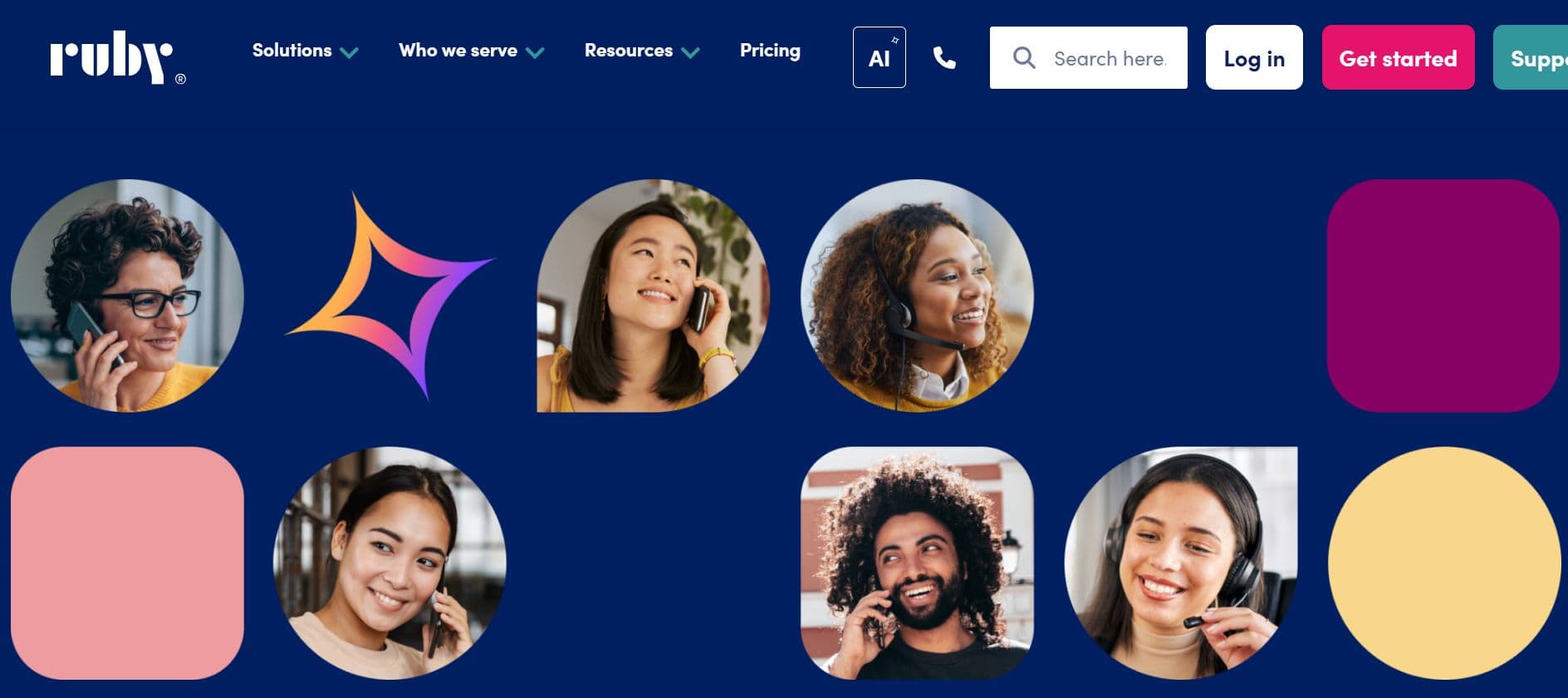
Ruby Receptionist is a live virtual receptionist service that answers calls with trained human receptionists in your firm's name. It handles brand-matched call answering, message-taking, appointment scheduling on eligible plans, and legal live chat, and it has a long track record and strong reviews across professional services.
Pricing
Ruby prices on receptionist minutes. Published plans start at $245 per month and scale with call volume into four-figure monthly plans, billed by the minute, so a long intake conversation draws down the same bundle a quick message does. Contracts run month to month.
Who it suits
Where Ruby stops is qualification. Its receptionists take messages and route calls warmly, but they are generalists answering to a script, not running your firm's case-qualification criteria and deciding whether a caller's matter fits your practice areas. Ruby is the right choice for a firm whose priority is a warm, human, on-brand first impression and whose own team can handle qualifying the lead afterward.
Answering Legal: what it is and who it suits
What it is
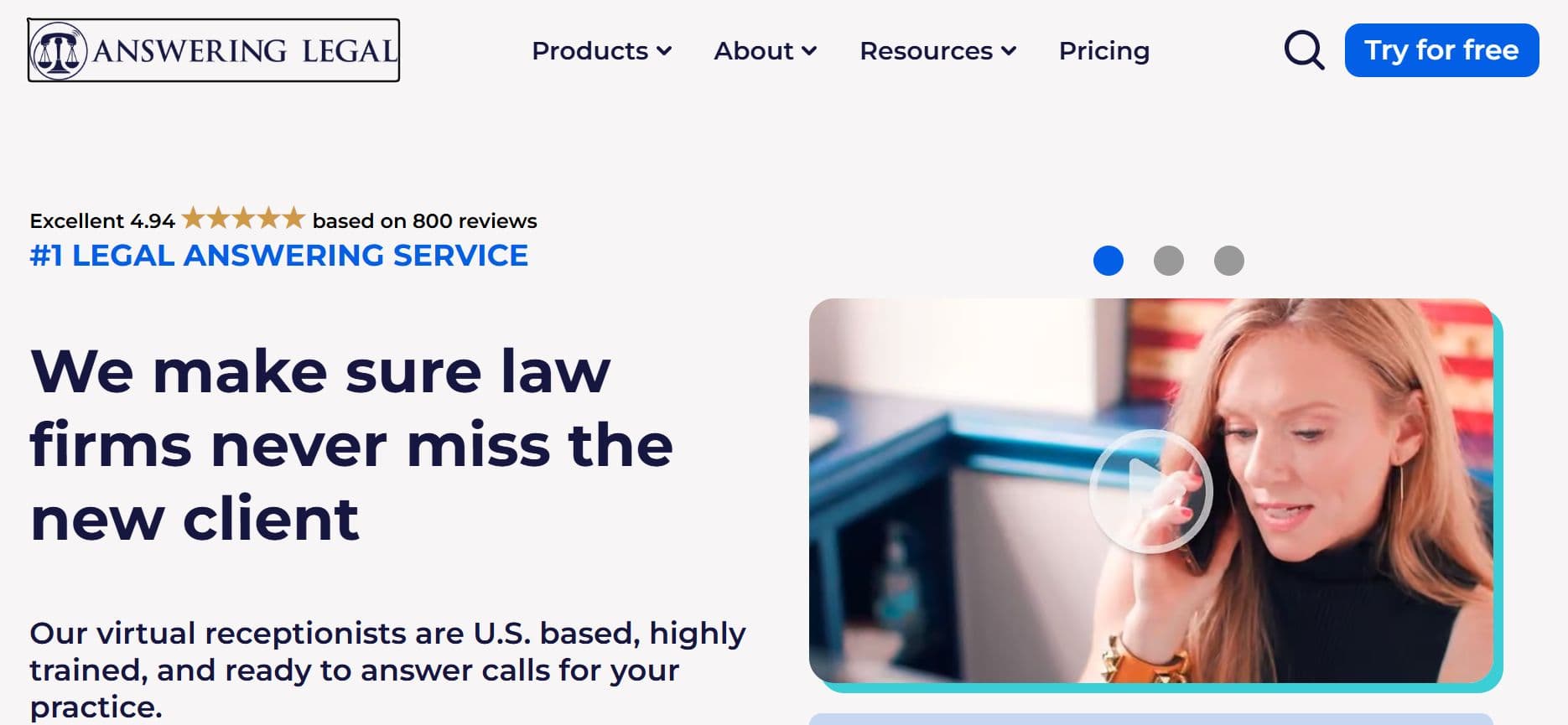
Answering Legal is an answering service built specifically for law firms, with legal-trained human agents covering the phones 24/7 and following legal intake scripts. It is well established, handles high call volume, and includes Spanish-language answering, and it has more recently added AI automation alongside the live team.
Pricing
Answering Legal bills per minute through monthly minute packages. There is no single published starting figure: firms begin with a free trial, and a package is sized to their call volume, with third-party estimates landing around $3 per minute before overage. Because billing is per minute, a detailed intake conversation that runs long costs more than a short message, which is the trade-off to model before signing.
Who it suits
Where Answering Legal stops is that it remains an answering service. Its agents capture intake details against your form, but the qualifying decision and the booking still come back to the firm as a follow-up step. Answering Legal suits high-volume firms that want legal-trained humans on the phones around the clock and are set up to work the leads on callback.
Juryo: what it is and who it suits
What it is
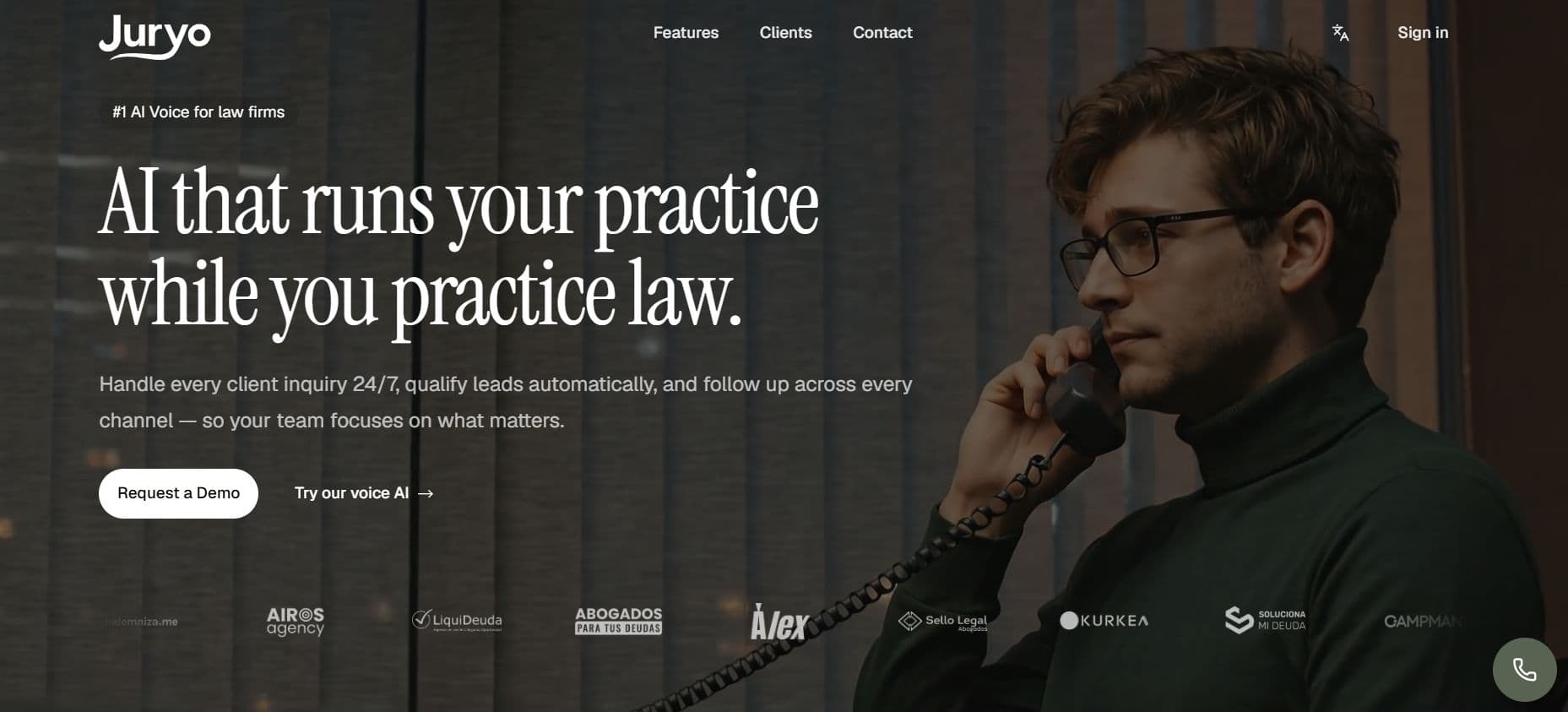
Juryo is the AI intake platform for law firms in Spain and the US. Jorge, Juryo's AI intake agent, holds a real qualifying conversation, applies the firm's own criteria, checks that the matter fits the practice area, books the consultation into the lawyer's Google Calendar and requests documents before it happens, on phone and WhatsApp, in English and Spanish, 24/7.
Pricing
Juryo does not share its pricing publicly. The company uses a conversion-based pricing model. You can contact the team to learn more about the pricing for Juryo and get a quote.
Who it suits
Where Juryo stops is stated plainly. An AI agent qualifies and routes, but an attorney still decides on complex or borderline case merit, and a firm with very low call volume will see a smaller relative gain than one losing leads every evening. Juryo is the right choice for a firm losing leads to missed calls, after-hours inquiries, or slow bilingual response.
Answering service versus full intake: the difference that decides whether you signed the case
A traditional answering service takes a message or basic contact details and passes them along. It does not qualify the caller against the firm's practice areas or case criteria, which creates a second manual step: someone at the firm still has to call the lead back, ask the qualifying questions, and decide whether to book. The delay and the drop-off risk are pushed downstream, not removed, and Spanish-speaking callers and WhatsApp inquiries are rarely covered to the same standard as the English phone line.
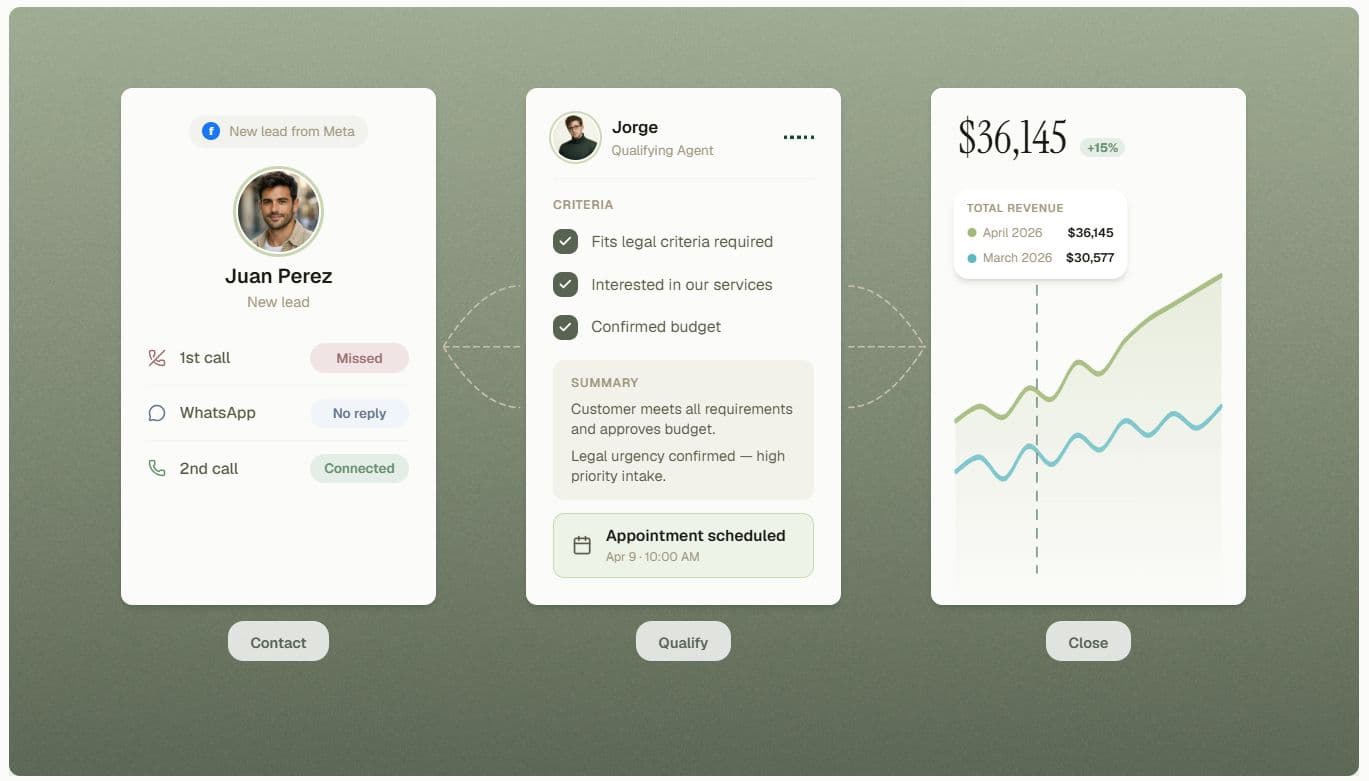
Full intake removes that second step. Jorge, Juryo's AI intake agent, qualifies the caller against the firm's own criteria inside the same conversation, in real time, whether the channel is phone or WhatsApp, in English and Spanish, 24/7. The qualifying conversation happens once, correctly, the first time, not on a callback the next business day. The output is a booked, qualified consultation on the calendar, not a message slip waiting for a human to act on it.
An answering service takes a message. Juryo takes the case. That is why a "we already have an answering service" objection does not hold: the two solve different problems, and only one moves a lead toward a signed matter. Juryo doesn't just answer: it runs the full intake and converts the lead.
A composite example
Consider a typical outcome for a personal injury firm. This is a composite, not a specific client, but it maps to how these firms actually lose cases.
The firm runs about forty inbound leads a month against one intake coordinator. A prospective client calls at 19:40 on a Friday after a car accident, in pain and looking for an attorney tonight. The coordinator has gone home. With an answering service, the caller reaches a receptionist who takes a name and number and emails a message slip; by Monday morning the caller has already retained the second firm on their search results, the one that answered.
With Juryo, the same call is answered instantly. Jorge asks the firm's qualifying questions: when and where the accident happened, whether there was an injury, whether the caller has spoken to any other attorney or an insurer. Jorge confirms the matter is a personal injury case the firm takes, books the consultation into the attorney's calendar for Monday, and requests the police report and any medical records before the appointment. When the coordinator opens their inbox on Monday, the lead is already qualified, booked and documented. Nothing was lost to the weekend, and no metric was needed to see it.
Quick Answers to Questions firms ask
Which one qualifies leads?
Juryo does, against your own criteria, inside the call. Ruby takes a message and routes it. Answering Legal captures details against your intake script, but the qualifying judgment and the booking come back to you. If the job you need done is deciding whether a caller has a case, only one of the three does it before the lead reaches your desk.
Which one is cheapest, and which is the best value?
These are two different questions. Ruby and Answering Legal both bill per minute, so the cheapest headline plan is not the cheapest per signed matter once intake conversations run long and overage rates apply. Juryo prices on converted outcomes rather than minutes, so cost tracks results rather than talk time. The firm with the lowest monthly invoice and the firm with the lowest cost per signed case are often not the same firm.
Which one handles Spanish-speaking callers?
All three offer Spanish, but the depth differs. A translated greeting is not a translated qualifying conversation, and a bilingual caller who is qualified less thoroughly converts at a lower rate. Juryo runs the full qualifying conversation in Spanish, not only the greeting, which matters for any firm with a meaningful Spanish-speaking client base. For a deeper look, see our guide to choosing a bilingual legal answering service.
Which one works on WhatsApp?
Juryo does, as a first-class channel alongside voice. Ruby and Answering Legal are built around the phone line and do not run WhatsApp intake. For firms whose clients message before they call, that is a real gap.
Which one covers nights and weekends properly?
All three advertise around-the-clock coverage, but check whether that means genuine 24/7 or extended hours on a particular plan tier, and whether after-hours and holiday calls carry premium rates. Juryo's coverage does not vary by shift, because the agent is the same at 03:00 as at midday.
Which one is fastest to set up?
Ruby and Answering Legal onboard by building a call script and staffing your line. Juryo configures the intake criteria, the practice areas and the calendar, then the agent runs from day one. If you want to see the setup end to end, our walkthrough on how to automate law firm intake covers it.
The proof
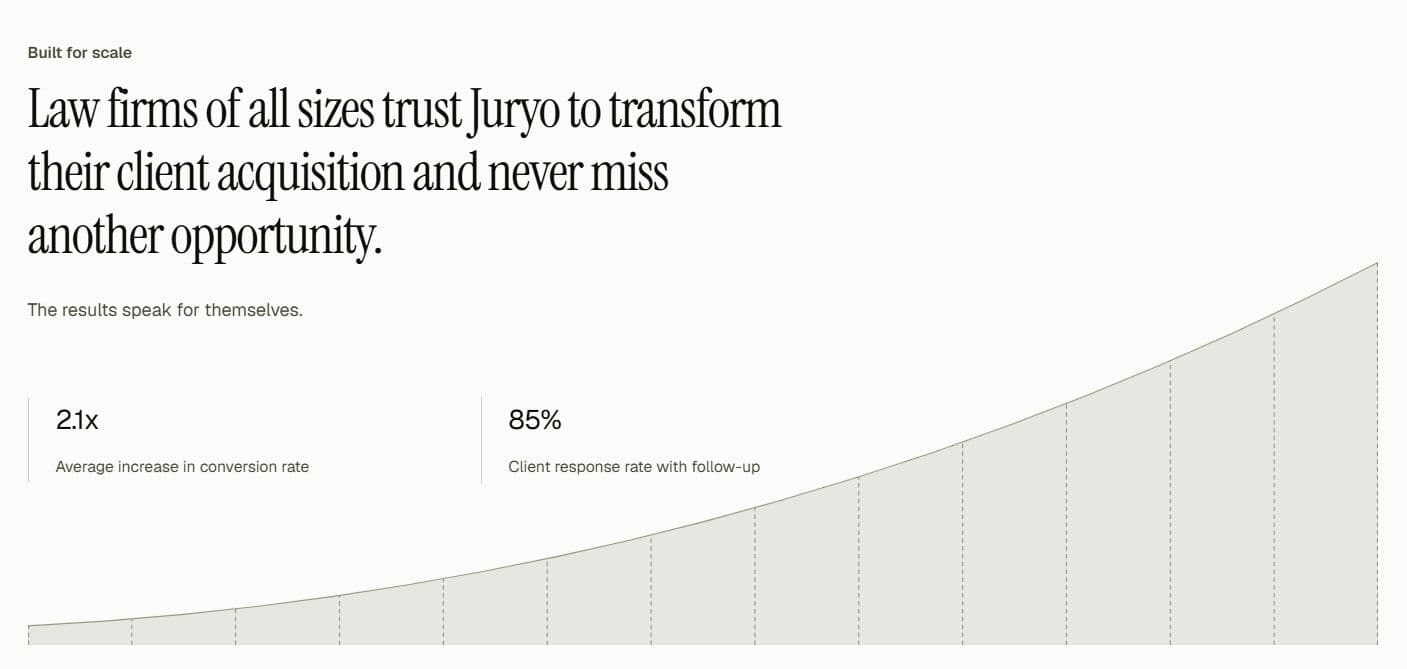
According to Juryo's own data, firms running full intake on Juryo see a 2.1x average increase in conversion rate and an 85% client response rate when follow-up is included. Those figures are Juryo-reported.
Named firms stand behind them. Distrito Legal, whose CEO Iván Casado credits Juryo with scaling the department's results faster than the firm expected. Campmany Abogados, whose CEO director Jorge Campmany points to how well the team integrated into the firm's existing workflows. Saldados, whose COO Estefanía Jiménez had the solution in production quickly and saw a positive impact on key business metrics.
And Bufete Robles, whose sole partner Andrés Robles says Juryo handles the firm's phone service better than several human receptionists he had tried. The pattern across them is consistent: the lead that gets answered, qualified and booked in the first conversation is the lead that signs, and the one that goes to voicemail goes to the next firm.
Juryo pricing
Juryo prices on converted outcomes. The firm pays for qualified leads that convert, not for seats and not for per-minute talk time, which aligns the cost with signed matters rather than with how long a caller stays on the line. There is no published rate card; pricing is set against the firm's call volume and case value at the demo. To see what that looks like for your firm, book a demo and talk to Jorge.
The verdict: which should you choose?
There is no single winner here, because these three services solve different problems.
Choose Ruby Receptionist if your priority is a human, on-brand first impression and your team can handle qualification. Choose Answering Legal if you have high call volume and want legal-trained humans on the phones 24/7. Choose Juryo if the leads you are losing are the ones nobody answered, and you want the caller qualified and booked before anyone at the firm sees them.
Stated one more way: Ruby and Answering Legal answer the call and hand you a message. Juryo answers the call, runs the firm's qualifying questions, confirms the matter, books the consultation and gathers the documents, in English and Spanish, on phone and WhatsApp, at any hour. An answering service logs the lead. Juryo converts it. See Jorge in action.
FAQs
Is Ruby Receptionist or Answering Legal better for a law firm?
It depends on the job. Ruby is the stronger warm, on-brand human reception service; Answering Legal is the stronger high-volume, legal-trained 24/7 answering service. Neither runs your firm's qualification criteria to decide whether a caller has a case, which is the gap Juryo fills.
How much does Ruby Receptionist cost?
Ruby's published plans start at $245 per month and scale into four-figure plans with call volume, billed on receptionist minutes, month to month. Because it bills per minute, long intake calls draw down the bundle faster than short messages.
How much does Answering Legal cost?
Answering Legal uses monthly per-minute packages sized to your call volume after a free trial, rather than a single published starting price. Third-party estimates put the effective rate around $3 per minute before overage. Confirm the current figure on its pricing page.
Is Answering Legal legit?
Yes. Answering Legal is an established, legal-specific answering service with a long track record and 24/7 human coverage. The question for most firms is not whether it works, but whether message-taking or full intake is what they need.
Does Ruby Receptionist qualify leads?
No. Ruby's receptionists answer, greet in your firm's name and take a message or route the call. Qualifying the lead against your case criteria is left to your team.
What are the best Ruby Receptionist alternatives?
Firms comparing Ruby usually also look at Answering Legal, LEX Reception and AI intake platforms such as Juryo. The right alternative depends on whether you want human message-taking or an agent that qualifies and books.
How does LEX Reception compare?
LEX Reception is a legal-dedicated human receptionist service known for a warm, personal answering experience, in the same category as Ruby. Like Ruby, it answers and routes rather than qualifying the caller against your criteria, so the same intake-versus-answering distinction applies.
Which answering service handles Spanish-speaking clients?
All three offer Spanish, but depth varies. Juryo runs the full qualifying conversation in Spanish, not just the greeting, so a Spanish-speaking caller is qualified as thoroughly as an English-speaking one.
Can an AI agent replace a virtual receptionist for a law firm?
For the intake function, yes: an AI agent can answer, qualify, book and gather documents 24/7. What it does not replace is the human moment on an emotionally raw first call or a complex merits decision, which is why Juryo qualifies and routes but leaves borderline case judgment to an attorney.
How much does Juryo cost?
Juryo prices on converted outcomes, not seats or minutes, so the firm pays for qualified leads that convert. There is no published rate; pricing is set at the demo against your volume and case value. Book a demo to see the numbers for your firm.