How to automate law firm intake: a step-by-step guide
August 17, 2026 · 15 min read
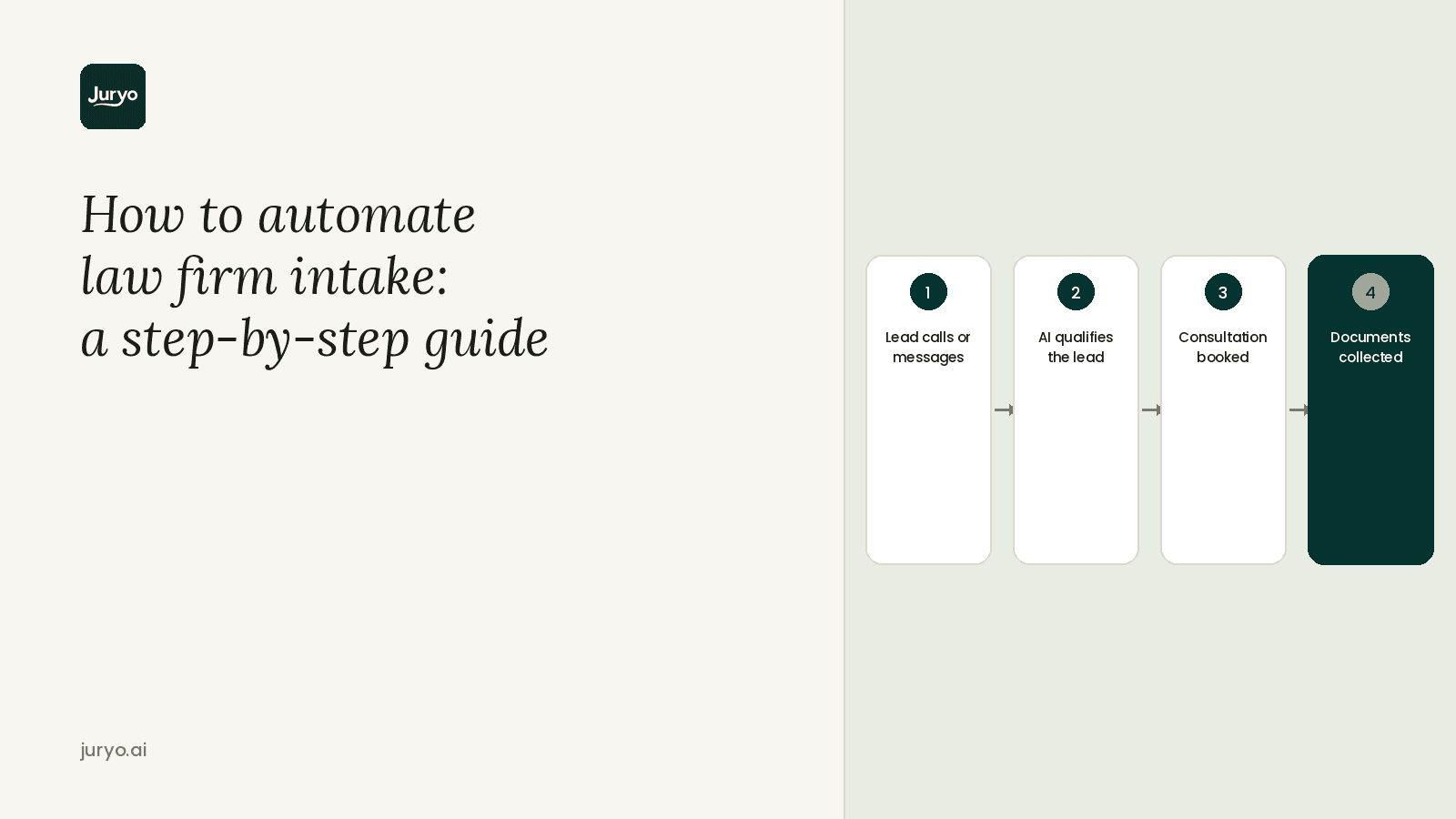
A personal-injury caller dials a firm at 9:40 on a Friday night. No one picks up. By 9:42 they have called the next firm on Google, and that firm signs the case.
Automating law firm intake means replacing manual phone and message handling with an always-on system, typically an AI intake agent, that answers, qualifies, and books consultations across voice, WhatsApp, email, and web, in both English and Spanish, without requiring a person to be present on every call. An answering service takes a message. Juryo takes the case: it doesn't just answer, it runs the full intake and converts the lead.
This guide walks through the steps to automate intake, why answering and intake are not the same job, and what to expect once it is running.
| Step | What you do | Time / Result |
|---|---|---|
| 1 | Map your current intake funnel end to end (first ring to signed retainer) | 30-60 min; surfaces every drop-off point |
| 2 | Define qualification criteria per practice area (case type, jurisdiction, statute-of-limitations red flags) | 1-2 hours with a partner; keeps unqualified leads off an attorney's desk |
| 3 | Deploy an AI intake agent across voice, WhatsApp, email and web | Days, not months, to go live |
| 4 | Turn on bilingual coverage (English and Spanish) in one agent | Immediate; no second hire or second vendor |
| 5 | Set the agent to 24/7 always-on coverage | Immediate; nights, weekends and holidays covered |
| 6 | Connect intake to your CRM and calendar for booking and handoff | Same-week setup; removes manual re-entry |
| 7 | Review call and message data monthly and refine qualification rules | Ongoing; compounding lift in signed matters |
What is client intake automation for a law firm?
Client intake automation is the use of software, typically an AI intake agent, to answer inbound calls and messages, qualify each lead against a firm's own criteria, and book the consultation directly onto the firm's calendar, across voice, WhatsApp, email and web, around the clock, without a staff member handling every contact.
How it works, mechanically
An AI agent, not a script-reading answering service, receives the call, message, email or web inquiry and holds a real qualifying conversation. It applies the firm's own criteria, practice area, jurisdiction, case-merit signals, rather than a generic message-taking flow. It books the consultation, pushes the structured details into the firm's CRM, and follows up until the client responds, so no manual re-entry step sits between "lead calls" and "lead is in the pipeline."
What separates real automation from a basic tool
Three things separate full intake from a tool that only answers. Coverage across voice, WhatsApp, email and web in one system, not a patchwork of disconnected tools. Bilingual by default, English and Spanish, not an add-on language pack. And true 24/7 operation, including nights, weekends and holidays, when a large share of consumer legal inquiries in 2026 actually arrive.
A bilingual immigration practice, before and after
Composite example: a typical firm, not a named client.
A typical bilingual immigration practice runs forty to sixty new inquiries a month across a phone line and a WhatsApp number, staffed by one paralegal. The paralegal is good, but they are one person. Calls that land during a hearing, at lunch, or after 18:00 go to voicemail. Weekend WhatsApp messages sit unread until Monday. A meaningful share of callers speak Spanish first, and the after-hours line does not.
The friction is not that the firm never responds. It is that the firm responds second. By the time the paralegal returns a Saturday message on Monday morning, the caller has already spoken to two other firms and booked a consultation with one of them.
After the practice automates client intake, the same Saturday message gets a qualifying conversation in Spanish within seconds. The agent checks the matter against the firm's intake criteria, confirms it is an immigration case in the right jurisdiction, and books a consultation into the attorney's calendar for Tuesday. The paralegal starts Monday with a qualified consultation already on the books instead of a voicemail to chase. The lead was qualified and booked before anyone opened a laptop.
How to automate client intake for a law firm, step by step
Step 1: Map your current intake funnel
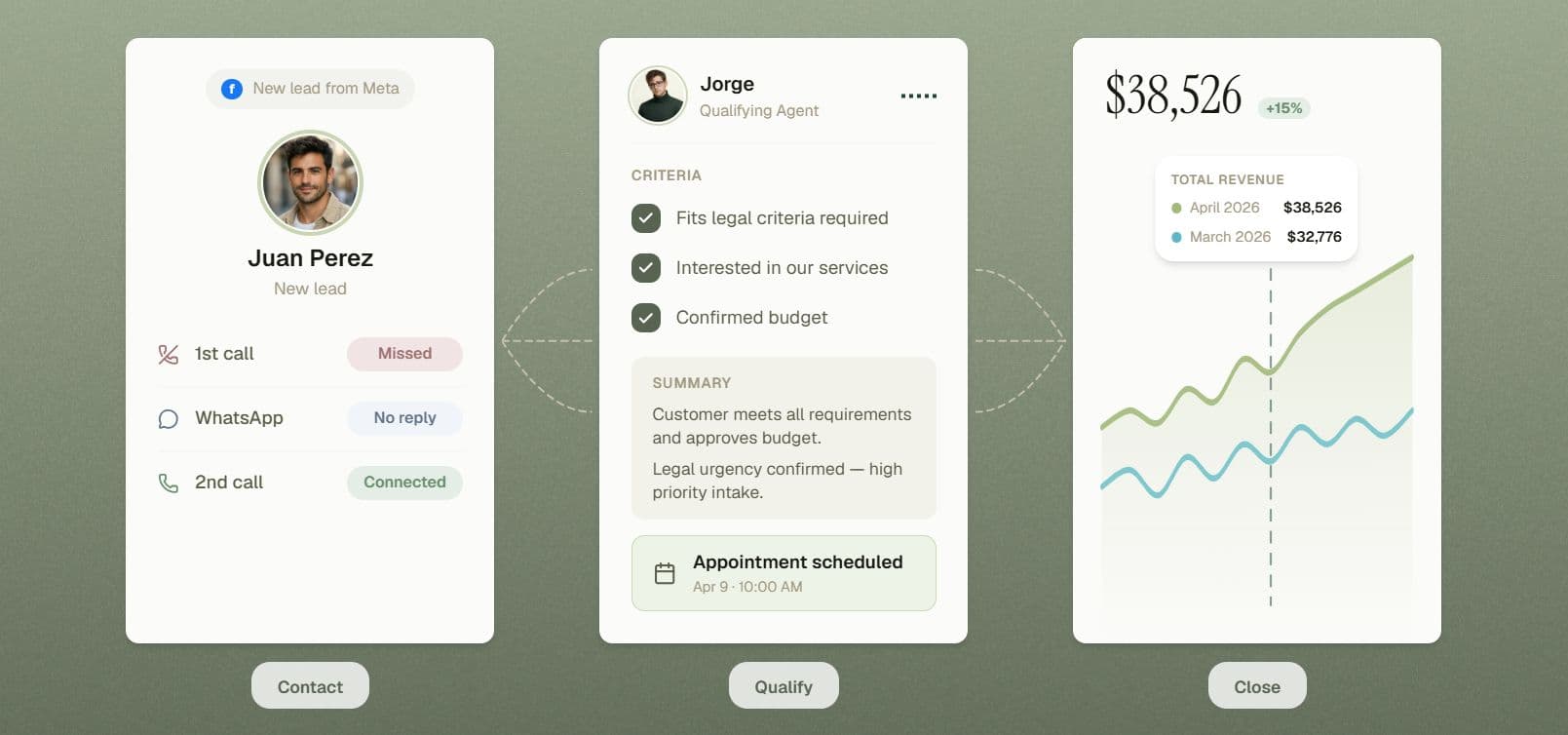
Walk every lead's actual path today: first ring or message, who answers, what gets asked, and how, or whether, it reaches an attorney. Flag every drop-off point: unanswered after-hours calls, WhatsApp messages nobody monitors, callbacks that never happen. This map is what the agent needs to replicate and improve, not guess at.
Step 2: Define qualification criteria per practice area
Write down, per practice area, personal injury, immigration, family, criminal defense, employment, the questions that separate a viable case from a non-starter. Include hard disqualifiers such as wrong jurisdiction, an expired statute of limitations, or a conflict of interest, so the agent routes those out immediately instead of booking them.
This step is what makes automation full intake rather than a glorified voicemail. Skipping it is the most common way automation underperforms. Bear in mind that whatever collects this information is still gathering prospective-client details, which firms must handle under existing duties such as ABA Model Rule 1.18, so ask for what is necessary to qualify, and no more.
Step 3: Deploy an AI intake agent across every channel
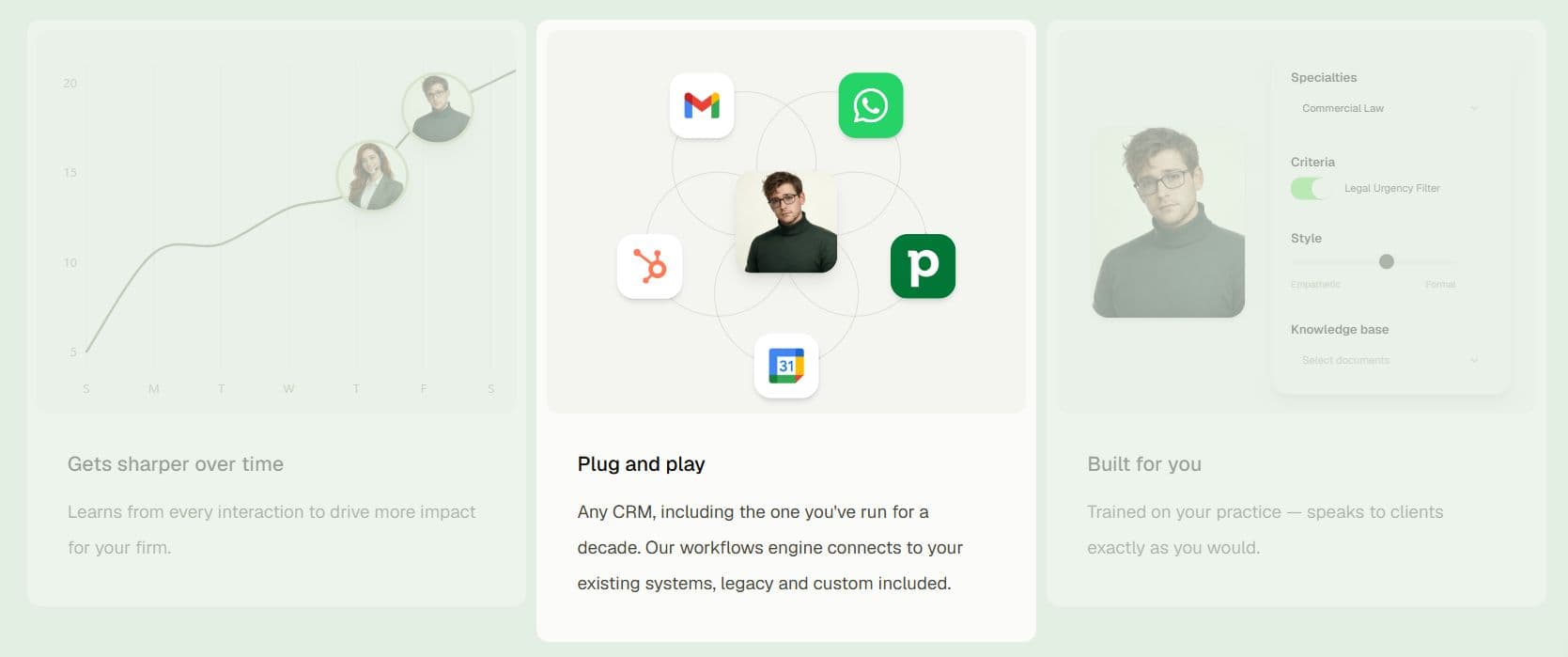
Choose an agent built specifically for legal intake, not a generic call-center bot repurposed for law firms. Cover voice, WhatsApp, email and web from day one, since many consumers lead messages on WhatsApp or send a web inquiry before they ever call, especially bilingual households. Confirm the agent can book directly onto the firm's calendar, not just collect a message for someone to act on later.
Step 4: Configure bilingual coverage (English and Spanish)
Turn on Spanish-language qualification in the same agent, not a separate line or a separate vendor. Verify that the qualifying questions, not just the greeting, are actually translated and legally accurate in both languages. This is where firms most often leave conversion on the table: a Spanish-speaking caller who is not qualified as thoroughly as an English-speaking one converts at a lower rate.
Step 5: Set 24/7 always-on coverage

Turn off any "business hours only" routing. Consumer legal inquiries, accidents, arrests, family emergencies, do not wait for 9 to 5. Confirm that nights, weekends and holidays are explicitly included, not just "extended hours." This single change often produces the largest jump in response rate, because it closes the biggest existing gap. It is also what people mean by 24/7 legal intake.
Step 6: Connect intake to your CRM and calendar
Push the agent's output directly into the firm's calendar and CRM, so a booked consultation and the structured intake details appear without manual re-entry. Juryo's workflows engine connects to any CRM a firm already runs, including legacy and custom systems. Set clear escalation rules for the rare case that needs an attorney immediately, rather than waiting for the next scheduled review.
Step 7: Monitor and refine with real data
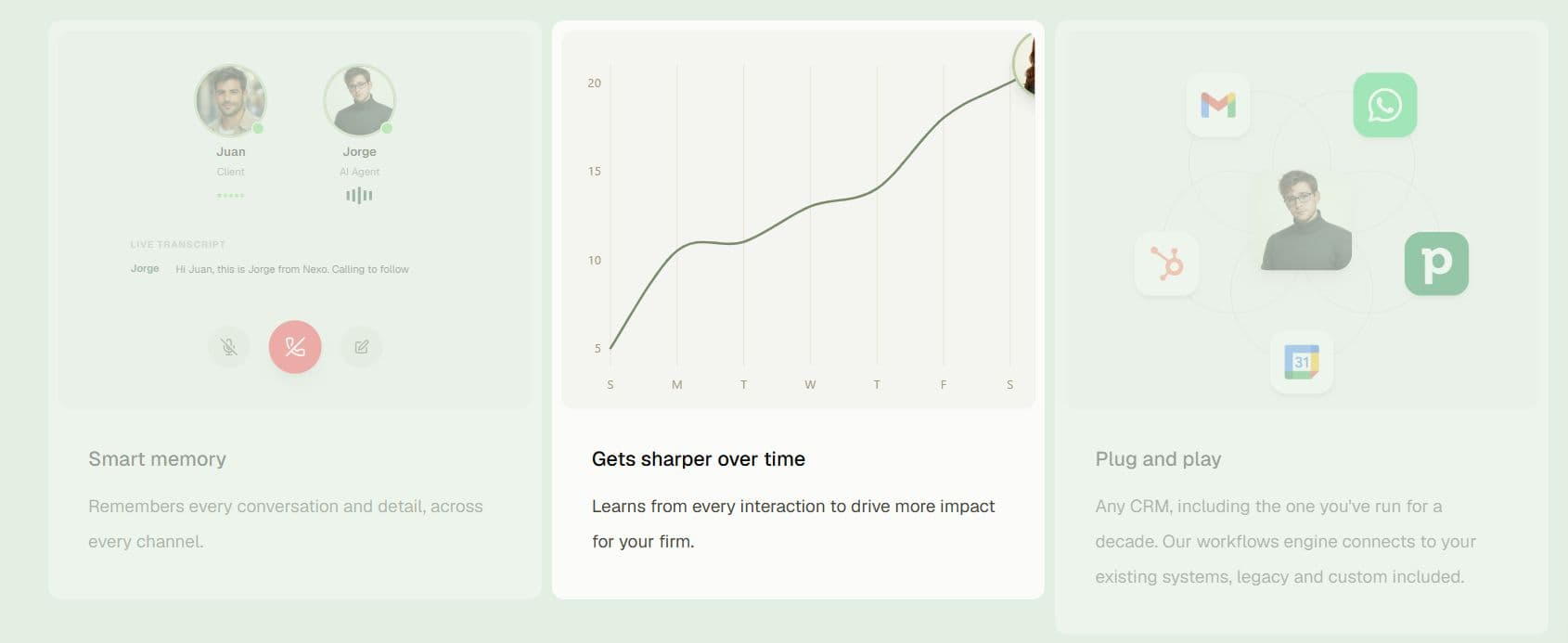
Review call and message volume, qualification outcomes, and booked-to-signed rate every month. Tighten or loosen qualification criteria based on what is actually converting, not on assumptions made at setup. Treat this as ongoing rather than a one-time step. The lift compounds as the criteria are refined.
Answering service vs. full intake: why the difference decides whether you sign the case
A traditional answering service takes a message or basic contact details and passes them along. It does not qualify the caller against the firm's practice areas or case criteria. That creates a second manual step: someone at the firm still has to call the lead back, ask the qualifying questions, and decide whether to book, so the delay, and the drop-off risk, is pushed downstream, not removed. And it rarely covers WhatsApp or Spanish-speaking callers with the same quality as the main phone line.
Full intake does the job in one motion. Jorge, Juryo's AI intake agent, qualifies the caller against the firm's own criteria in the same conversation, in real time, whether the lead reaches you by voice, WhatsApp, email or web. It operates in English and Spanish, 24/7, so the qualifying conversation happens once, correctly, the first time, not on a callback the next business day. The output is a booked, qualified consultation with the documents collected and follow-up handled until the client responds, not a message slip waiting for a human to act on it.
This is why "we already have an answering service" does not settle the question. An answering service and full intake solve different problems, and only one of them moves a lead toward a signed matter. If you are weighing the two, the difference between a legal answering service and AI intake is worth reading in full.
Meet Jorge: the agent behind the automation
Juryo is the legal intake platform behind Jorge, built for consumer law firms. Jorge is named explicitly wherever the mechanism is described, because it is one agent doing one job, not a stack of tools.
Jorge handles voice, WhatsApp, email and web, in English and Spanish, 24/7, as a single agent rather than separate tools per channel or language. It qualifies the lead against the firm's criteria, books the consultation, collects the documents and follows up until the client responds. It is built specifically for consumer-law intake, personal injury, immigration, family, criminal defense, employment, so its qualifying questions reflect real case-intake logic rather than a generic call-center script. You can hear exactly how a call goes below.
What firms are seeing
Firms that move from message-taking to full intake automation report higher conversion and faster response, because the qualifying conversation happens at the moment the lead is still deciding rather than on a next-day callback.
What Juryo costs
Pricing is based on successful lead conversion. Firms are paying for signed matters and response rate, not seats or minutes, so the number depends on a firm's call volume and practice mix. The way to get a figure that matches your firm is a short call with the team. You can book a demo to get a tailored quote.
Pros and cons of automating intake
Pros
- No missed calls or unanswered WhatsApp messages outside business hours.
- Consistent qualification criteria applied every time, regardless of who, or what, picks up.
- Bilingual coverage without hiring or scheduling a second, Spanish-speaking staffer.
- Faster time from first contact to booked consultation, which is where the conversion lift comes from.
Cons and honest limitations
- An AI agent is not a substitute for attorney judgment on complex or borderline case merit. It qualifies and routes; an attorney still decides.
- Firms with very low call volume may see a smaller relative lift, simply because there is less volume to recover.
- Any automation is only as good as the qualification criteria fed into it. Skipping Step 2 above weakens the result.
Who should automate intake first
Automation pays back fastest for firms currently relying on voicemail, a receptionist who cannot cover nights and weekends, or a basic answering service that only takes messages. It also suits firms with a meaningful share of Spanish-speaking callers and no reliable bilingual coverage today, and firms in high-volume practice areas such as personal injury and immigration, where a same-hour response is a competitive advantage. If you are also comparing vendors, our roundups of the best AI tools for lawyers and Smith.ai alternatives for law firms cover the field.
Limitations to set expectations on
Automation speeds up and standardizes qualification and booking. It does not replace the attorney-client relationship once a matter is signed. Firms should still define escalation paths for calls that need an attorney immediately, a caller in active crisis, or a same-day statute deadline, rather than routing everything through the standard flow.
Final verdict
Automating law firm intake is a process, not a single switch: map the funnel, define criteria per practice area, deploy across voice, WhatsApp, email and web, go bilingual, go 24/7, connect to your CRM and calendar, then refine with real data. The distinction that matters most is answering versus full intake, only full intake qualifies and books in one motion.
Juryo's Jorge is built to do exactly that: voice, WhatsApp, email and web, English and Spanish, 24/7. It suits firms losing leads to missed calls or slow bilingual coverage, and it keeps an attorney in the loop where complex case-merit judgment still belongs.
Hear a real qualifying call for yourself, talk to Jorge.
FAQs
What does it mean to automate client intake for a law firm?
It means replacing manual phone and message handling with a system, typically an AI agent, that answers, qualifies and books consultations without a staff member on every call.
Is an AI intake agent safe and legitimate for a law firm to use?
Yes, when it is built specifically for legal intake and applies the firm's own qualification criteria. Jorge is built for consumer-law intake and handles prospective-client information in line with the duties firms already owe.
Can automated intake handle Spanish-speaking callers?
Yes. Jorge runs the full intake fluently in both English and Spanish, on voice and WhatsApp, from the same agent, so bilingual intake does not require a separate hire or tool.
Does automating intake replace an answering service?
It replaces the need for one. An answering service takes a message; full intake qualifies the caller and books the consultation in the same conversation, the distinction covered above. Our bilingual legal answering service walkthrough goes deeper on the bilingual side.
Does automated intake work 24/7, including nights and weekends? Yes. Consumer legal inquiries frequently arrive outside business hours, and Jorge covers voice, WhatsApp, email and web intake around the clock.
How much does it cost to automate law firm intake with Juryo? Pricing is tailored, on request, based on call volume and practice mix. Book a demo for a quote specific to your firm.
Recommended Reading
- The 7 Best AI Receptionists and Virtual Receptionists for Law Firms (2026)
- 5 Best AI Legal Intake Tools for Law Firms (2026)
- The 7 Best Legal Answering Services for Law Firms (2026)
- The 7 best AI tools for lawyers (2026, tested)
- This is the best bilingual legal answering service (English + Spanish) in 2026