5 Best AI Legal Intake Tools for Law Firms (2026)
July 17, 2026 · 19 min read
Juryo is the best legal intake software for law firms in 2026. One AI agent answers calls, WhatsApp, email and web chat in English and Spanish, qualifies each enquiry against your firm's own criteria and books the consultation.
Legal intake software used to mean an online intake form and a CRM to store what came in. In 2026 the leading tools answer the enquiry themselves, ask the qualifying questions and follow up until the client replies. This guide covers client intake for law firms, the work of turning a new enquiry into a signed client. It does not cover the request management tools in-house legal teams use.
We compared the six leading tools on voice, messaging channels, qualification, languages, CRM sync and pricing. Juryo publishes this guide, so we have been specific about where each competitor is the better choice. Juryo comes first, followed by the tool that fits each other kind of firm.
TL;DR
- Juryo: best overall. Runs the full intake from one AI agent across phone, WhatsApp, email and web chat, in English and Spanish, 24/7.
- Smith.ai: best human plus AI intake.
- LegalClerk.ai: best value at high call volume.
- CaseGen.ai: best for personal injury.
- Lawmatics: best intake CRM.
What does legal intake software actually do?
Legal intake software helps law firms handle new enquiries from the moment a potential client gets in touch. It can capture enquiries, ask the right qualifying questions, check whether the case fits the firm's criteria, book consultations and send the details to the firm's CRM.
Older intake software often relied on forms and workflows that staff had to manage. Newer platforms are adding AI agents that can handle these conversations themselves, including over the phone, SMS and email.
That makes AI-powered intake software useful for firms that want to respond to more enquiries without having staff manually handle every first conversation.
Intake forms vs AI intake: what changed in 2026
An intake form asks a potential client to fill in their details and wait for someone at the firm to follow up. AI intake can have that first conversation with them instead, asking questions based on their answers, qualifying the enquiry and following up if they don't respond.
That changes what firms need to look for in intake software. It's no longer just about collecting information. You also need to consider which channels the AI can handle, whether it supports multiple languages, whether it's available outside office hours, and how much of the intake process it can manage without staff stepping in.
| What happens to an enquiry | Online intake form | Juryo |
|---|---|---|
| Captured from the website | Yes | Yes |
| Phone call answered | No | Yes |
| WhatsApp message answered | No | Yes |
| Next question depends on the last answer | Fixed branching only | Yes, full conversation |
| English and Spanish | A separate form per language | Yes, one agent |
| Client chased when they stop replying | No | Yes |
| Consultation booked | Via a scheduling link | Yes, inside the conversation |
| Documents collected and engagement letter signed | Upload fields | Yes |
Why answering is not intake
This distinction decides which tool you should buy. An answering service, human or AI, greets the caller and takes a message. Intake is everything that has to happen for that caller to become a client: the right qualifying questions for the matter, a consultation booked into the right calendar, follow-up when the client goes quiet, the documents gathered, and a complete file in the CRM.
Consumer legal is an intake business at scale. Europe's best-known consumer legal brands are built on handling enormous inquiry volumes. Legálitas alone reports resolving a million consultations a year across 800 lawyers and a national network of 340 offices. Legálitas, Sello Legal, Indemnízame and DVuelta all run their intake with Juryo. At that volume, the gap between logging an inquiry and converting it is the entire business model. The same economics apply to a 10-person firm in Phoenix, just with smaller numbers and less room for waste.
What this looks like in a real practice
A composite of a typical high-volume US practice.
Consider a personal injury firm with two solicitors, one paralegal and 50–60 new enquiries a month. A large share of those enquiries come outside normal office hours, often after a road traffic accident.
One comes in at 7:40pm on a Friday. The caller has just left A&E and is waiting for a recovery truck. No one at the firm is available, so the call goes to voicemail. By Monday, the caller has already spoken to another firm.
This is where AI intake can make a difference. The question isn't simply whether an AI agent can answer the phone. It's whether it can have a useful first conversation, collect the information the firm needs and know when to hand the enquiry to a person.
In this example, the agent answers the call and asks about the accident, when and where it happened, whether the police attended, what treatment the caller has received and whether an insurer has been in touch. It checks whether the matter fits the firm's criteria and books a consultation for Monday morning. It can also ask the caller to send over documents or other information the solicitor will need.
The same applies across other channels. On Saturday, the caller's partner sends a WhatsApp message with photos of the car and prefers to communicate in Spanish. The agent can continue the conversation in Spanish and keep the photos with the same enquiry rather than starting the intake process again.
By Monday, the firm has a qualified enquiry, a scheduled consultation and the information already collected. The solicitor can start with the case rather than a blank file.
The 5 best legal intake tools, compared
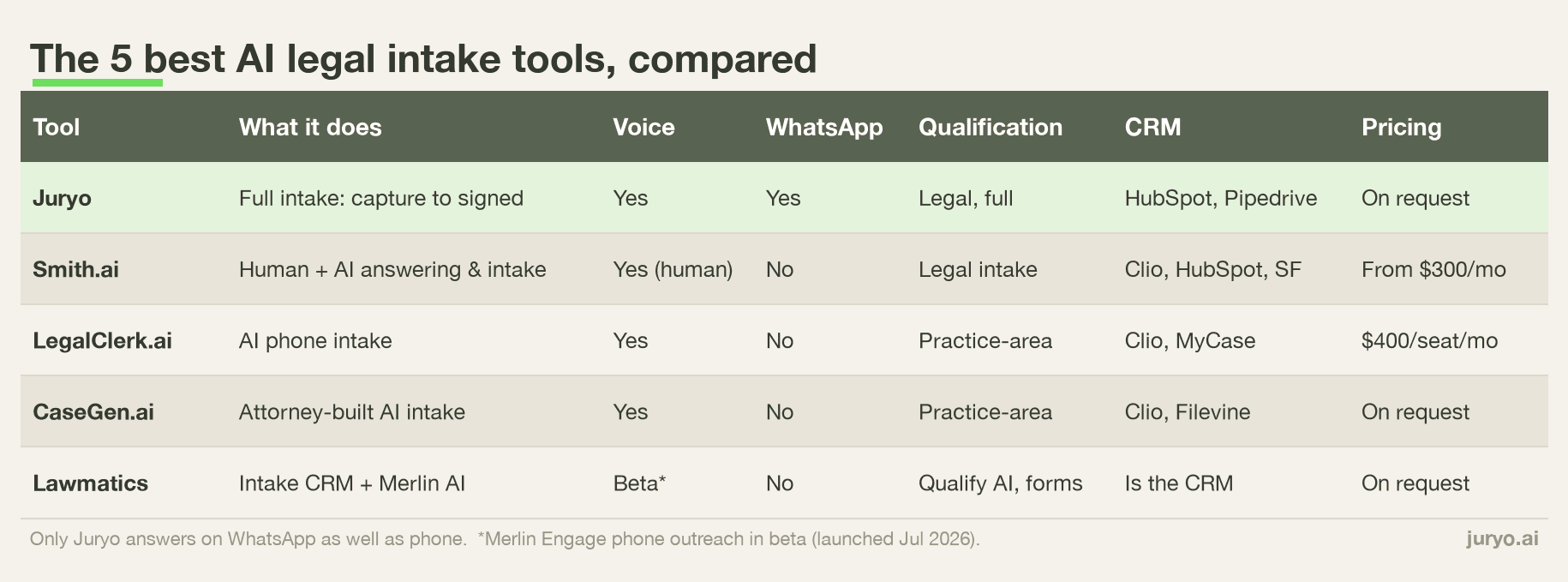
| Tool | What it does | Voice | Other channels | Qualification | CRM | Pricing |
|---|---|---|---|---|---|---|
| Juryo | Full intake: capture to signed client | Yes (AI, EN/ES) | WhatsApp, email, web widget | Legal-specific, full conversation | Any CRM, including legacy and custom | Tailored, on request |
| Smith.ai | Human + AI answering, intake and retainers | Yes (human and AI tiers) | Web chat (separate plan) | Legal intake playbooks | Clio, HubSpot, Salesforce, Lawmatics | $300/mo (30 calls) to $2,100/mo (300 calls); AI tier from ~$95/mo |
| LegalClerk.ai | 24/7 AI phone intake + outbound follow-up | Yes (AI) | SMS follow-up only | Practice-area scripts | Clio, Lawmatics, MyCase, Calendly | $400/seat/mo, unlimited calls |
| CaseGen.ai | AI intake, outreach and medical coordination | Yes (AI, EN/ES) | SMS follow-up only | Attorney-level intake + conflict checks | Filevine, Clio, PracticePanther, MyCase, Smokeball, LawPay, Calendly, Zapier | Flat-rate by volume, on request |
| Lawmatics | Intake CRM + Merlin AI suite | Beta (Merlin Engage) | SMS, email, chat (beta) | Merlin Qualify + forms | Is the CRM; syncs with Clio, MyCase | On request |
Of the five, only Juryo answers on WhatsApp as well as phone. Lawmatics' phone engagement is beta-only. Pricing and features verified against vendor sites, July 2026.
1. Juryo: best overall, the tool that runs the full intake

Juryo is a team of AI agents built specifically for legal intake, and it runs every stage: capture, response, qualification, booking and follow-up.
Juryo's lead agent, Jorge, answers in English or Spanish, 24/7, across every channel a client might use: voice, WhatsApp, email and a web widget, plus the other major messaging apps. It asks the qualifying questions your best intake person would ask, books the consultation straight into the right calendar, and keeps working the lead until the client actually replies.
The agent carries memory across all of it, so a client who calls on Friday and messages on Saturday is not starting over, and your firm is not running four inboxes. Everything lands in the firm's CRM as a structured record, and a human is pulled in the moment a call needs one.
That CRM does not have to be one from a supported list: Juryo's agents integrate with any system, including legacy and custom builds, through its internal workflows engine. Every other tool here publishes a fixed list of integrations, which is the constraint firms usually discover after they have signed.
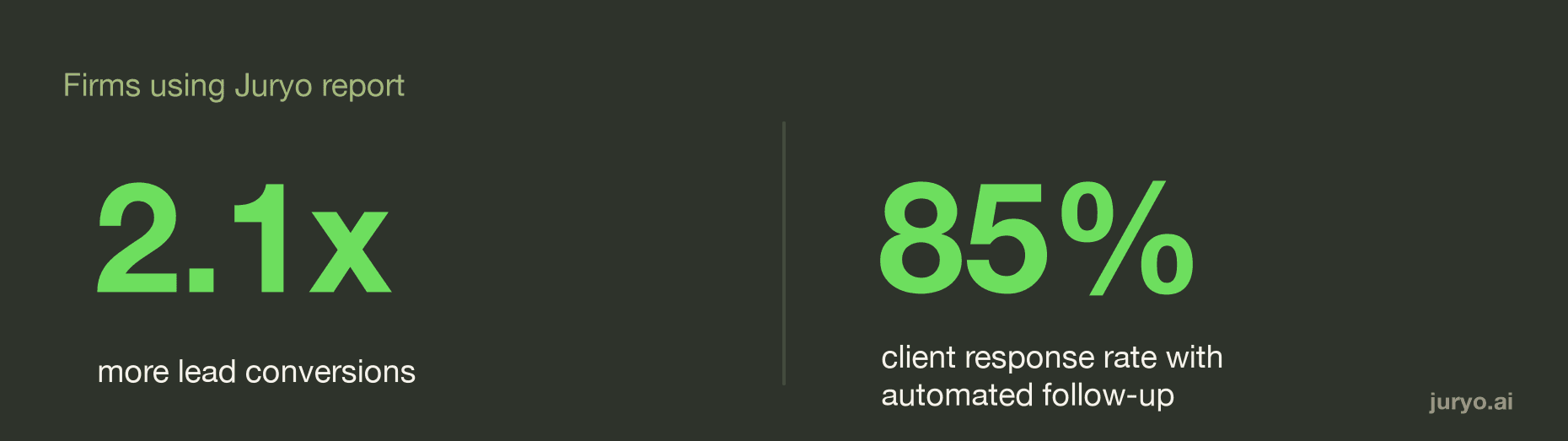
Juryo is the intake platform behind Europe's largest consumer legal brands: Legálitas, Sello Legal, Indemnízame and DVuelta. According to Juryo's own data, firms running it see a 2.1x average increase in conversion rate and an 85% client response rate on automated follow-up. Juryo is built for high-volume consumer practices such as personal injury, immigration, family, criminal defense and debt, where speed-to-lead and follow-up decide who wins the client.
Pros
- Runs the full intake from one AI agent, not just the answering layer
- Phone and WhatsApp from one agent, with shared memory across channels
- Bilingual English and Spanish in one agent, with no handoff and no second number
- Automated follow-up until the client responds
- Human escalation built in, plus structured CRM records
Cons
- No published pricing
Pricing: based on conversion, tailored to the firm's volume.
The fastest way to compare intake tools is to talk to one. Hear how Jorge qualifies a real inquiry:try the live demo.
2. Smith.ai: best human-plus-AI intake

Smith.ai pairs North America-based human receptionists with AI, and it has deep roots in legal intake: trained agents follow your intake playbook, capture the details, book consultations and sync to Clio, HubSpot, Salesforce and Lawmatics. It runs both a human Virtual Receptionist line and a lower-cost AI Receptionist line, so firms can put people on the calls that need them and automation on the rest. It can now send the retainer automatically once the receptionist has completed intake, which takes it further down the pipeline than most answering services go.
The trade-offs come from the human staffing model. The cost per call is roughly $10 at 30 calls and $7 at 300, and a busy month past your limit adds $8.50 to $11.50 for every extra call. A firm at 300 calls pays $2,100 where LegalClerk.ai charges $400 a seat for unlimited. There is no WhatsApp channel.
Best for: firms that want trained humans in the loop with automation behind them.
Pricing: AI Receptionist: Free (25 calls a month, $3 per extra call), Pro $150 a month, Enterprise $500 a month. Human Virtual Receptionists: Starter $300 a month (30 calls), Basic $810 (90 calls), Pro $2,100 (300 calls), with overage at $11.50, $10.50 and $8.50 per call. Enterprise is custom. No setup fees, month to month, and a 30 day money-back guarantee.
3. LegalClerk.ai: best value at high call volume

LegalClerk.ai runs 24/7 AI phone intake against practice-area scripts for personal injury, family, criminal defense and immigration, and passes structured leads into Clio, Lawmatics, MyCase, Google Calendar and Calendly. It markets HIPAA-grade encryption and ABA-compliant data handling, which matters to firms strict about client data. Its outbound agent chases clients after the consultation by call, email or text, sends appointment and court-date reminders, and can route clients to upload police reports, injury images or medical records through a secure link.
At $400 per seat for unlimited calls, it is the only tool here whose price does not move when your marketing works. It has no WhatsApp channel, and multilingual intake sits on the Enterprise tier rather than the standard plan.
Best for: practices that want reliable 24/7 AI answering with legal scripts and unlimited call volume at a flat seat price.
Pricing: $400 per seat per month for unlimited calls, no setup fee, 7-day free trial. Enterprise is quote-based.
4. CaseGen.ai: best for personal injury

CaseGen.ai was co-founded by a practicing attorney, and its qualification logic is tuned for legal intake out of the box. It runs three agents rather than one: Justina answers, takes full intakes, filters spam and transfers high-value cases live; Justin chases leads that didn't sign, calling them back and collecting missing details; Maya follows up with medical providers on a client's treatment progress. It asks attorney-level questions covering date of incident, injuries, treatment history, at-fault party and insurance, runs conflict checks, texts clients to collect case photos and documents, and offers live call transcripts with real-time intercept. It supports English and Spanish natively, integrates with Filevine, Clio, PracticePanther, MyCase, Smokeball, LawPay, Calendly, Google Sheets and Zapier, and ships its own built-in CRM.
It is voice-first with SMS follow-up: no WhatsApp channel, and no published pricing. Its depth is aimed squarely at personal injury. If that is not your practice, some of the platform is weight you will not use.
Best for: US personal injury firms that want legal-native AI intake plus medical-treatment follow-up.
Pricing: flat-rate by call volume rather than per-minute, quoted on request. Setup typically runs about 14 days and is fully managed.
5. Lawmatics: best intake CRM

Lawmatics is the benchmark intake CRM: custom intake forms, e-signature, appointment scheduling, email and SMS sequences, pipeline views and marketing analytics, built only for law firms and integrating with practically every practice-management tool. And it is adding AI fast.
In July 2026 it introduced Merlin: Merlin Qualify scores and prioritizes leads today, Merlin Copilot builds automations and reports from plain-language prompts, and Merlin Engage, which engages prospects over SMS, email, chat and phone, is in beta.
What Lawmatics is not, yet, is an agent that answers your front line. The generally available product does not pick up calls, there is no WhatsApp channel, and it takes real setup to get value: it is a workflow engine your team operates, not a conversation it has for you. Most firms pair it with an answering layer, which is exactly the gap the AI agents above close on their own.
Best for: firms that want deep intake CRM and marketing automation behind their reception.
Pricing: quote-based, three tiers by contact volume.
How to choose
- If leads are dying unanswered or unchased: you need an agent, not a database. Juryo and CaseGen.ai both answer and then keep working the lead; LegalClerk.ai covers the phone layer.
- If your clients message rather than call: only Juryo answers inbound on WhatsApp, email and web from the same agent. Smith.ai sells web chat as a separate plan. CaseGen.ai and LegalClerk.ai send outbound texts but do not answer inbound messages. Lawmatics covers several channels through Merlin Engage, still in beta.
- If you run personal injury and medical records are the bottleneck: CaseGen.ai's Maya chases treatment updates with providers, which nothing else here does.
- If your call volume is high or spiky: LegalClerk.ai's flat $400 per seat for unlimited calls beats per-call pricing the moment your marketing works.
- If your case management is old, custom or homegrown: Juryo's workflows engine connects to any CRM. Everything else here integrates with a published list, so check your system is on it before you sign.
- If your brand needs a human voice: Smith.ai puts trained people on the line with AI behind them.
- If your intake is answered but disorganized: Lawmatics organizes the pipeline and now scores leads with AI, and pairs with any of the above. If you live in the Clio ecosystem, Clio Grow is the native option, with a phased-release voice agent for after-hours overflow. Clio does not publish a standalone Grow price; it is sold as an add-on or bundled into Clio's top tier, so get a quote.
- If you serve English and Spanish speakers: Juryo and CaseGen.ai both handle English and Spanish natively in one agent, with no handoff and no second number. Smith.ai offers Spanish, but check whether it is included or an add-on on your plan.
For the answering layer specifically, see our comparison of the best AI and virtual receptionists for law firms. For the implementation playbook, see how to automate client intake step by step.
Frequently asked questions
What is legal intake software?
Legal intake software manages how a law firm captures, qualifies and converts new-client inquiries: answering calls and messages, running qualification, booking consultations, chasing documents, and syncing records to the CRM. Modern tools use AI agents that handle the conversation themselves.
What is the difference between an answering service and intake software?
An answering service greets the caller and takes a message. Intake software converts the caller into a client: qualification, booking, follow-up and a complete CRM record. Most lost leads die after the greeting, which is why the distinction matters.
Does legal intake software work on WhatsApp?
Mostly not yet. Of the leading tools, Juryo is the one that answers and qualifies on WhatsApp as well as voice, email and web, with shared memory across all of them. CaseGen.ai and LegalClerk.ai send outbound texts but do not answer inbound messages, and Smith.ai's chat is a separate product from its phone plans.
How much does legal intake software cost?
It depends on whether you pay per call or per seat. Smith.ai's human plans run $300/month for 30 calls up to $2,100/month for 300, with overages on top; its AI tier starts around $95. LegalClerk.ai charges $400 per seat per month for unlimited calls. Intake CRMs like Lawmatics and full intake platforms like Juryo price by quote based on volume.
Can AI qualify leads like a human intake specialist?
Within clear rules, yes. A legal-specific agent asks the same qualifying questions your intake team would, covering practice area, jurisdiction, urgency and conflicts, then captures structured answers and escalates anything sensitive to a person. It gathers information and qualifies; it does not give legal advice.
Is AI intake compliant with my duty of confidentiality?
It has to be. Information relating to the representation of a prospective client is protected under ABA Model Rule 1.6, and the duty extends to prospective clients under Rule 1.18. Make a signed agreement covering data handling, clear answers on where data is stored, and identity verification before any case detail is shared, a hard requirement of any vendor. Check your state bar's guidance too, which may go further than the Model Rules.