The 7 Best Clio Grow Alternatives for Law Firm Intake (2026)
September 9, 2026 · 24 min read
Clio Grow is a popular legal intake and CRM platform, but it isn't the right fit for every law firm. Some firms want more automation, others need stronger lead tracking, and growing practices may need an intake platform built specifically around converting more leads into signed clients.
The good news is that there are several alternatives worth considering in 2026.
We compared the leading Clio Grow alternatives based on intake automation, lead management, integrations, reporting, ease of use, and pricing. Here are the seven platforms worth looking at, including what each does best and which types of law firms they are best suited for.
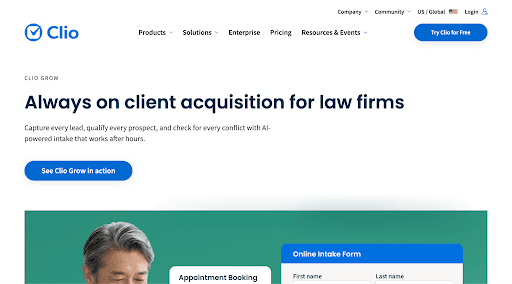
Clio Grow is catching up on AI intake
Clio Grow has changed quite a bit with the launch of Grow AI on August 20, 2026. Its AI agents can now handle phone calls, emails, and website chats, ask potential clients about their cases, assess leads using the firm's previous matters, and book consultations. Clio also uses a performance-based pricing model for Grow AI, charging when the agent helps turn an enquiry into a hired client.
That makes Clio Grow a much stronger option for firms that mainly need help responding to new enquiries. If missed calls and slow follow-ups are costing you potential clients, Grow AI addresses a big part of that problem.
But intake is more than answering the phone.
Law firms also need to qualify leads, follow up with prospects, keep track of where enquiries come from, and make sure good leads don't fall through the cracks. This is where Clio Grow and its alternatives start to differ.
Juryo is built specifically around this part of the process, combining AI-powered intake with lead qualification and follow-up to help law firms turn more enquiries into clients.
The seven best Clio Grow alternatives
| Tool | Answers calls live | Qualifies in conversation | Texts prospects | Multi-channel attribution | English and Spanish | Works with Clio Manage | |
|---|---|---|---|---|---|---|---|
| Juryo (Jorge) | Yes | Yes | Yes | Yes | Yes, one agent | Yes | Yes |
| Lawmatics | Phone agents coming soon | Text agents | Yes | Yes | Not documented | No | Integration |
| Law Ruler | Outbound softphone only | No | Yes, SMS and MMS | Yes | Not documented | No | Integration |
| Lead Docket | No | Scores viability | Not documented | Yes | Not documented | No | Filevine first |
| MyCase | Logs calls only | No | Yes | Limited | No | No | Replaces it |
| Captorra | Human agents | Human agents | Yes | Yes | Staffing dependent | No | Filevine, Litify, Smart Advocate |
| Smith.ai | Yes, human and AI | Partly | Yes | No | $1.00 per call | No | Integration |
| Clio Grow, for reference | Yes, US only | Yes | Clients only | Dropdown source | Not documented | No | Native |
1. Juryo (Jorge)
Best for: Law firms that want AI-powered intake across phone and WhatsApp, including English and Spanish conversations.

Juryo is built around how people actually contact law firms: by phone, by message, outside normal office hours, and often in Spanish as well as English.
Its AI intake agent, Jorge, can answer calls, qualify potential clients using the firm's own criteria, and book consultations. Jorge also handles WhatsApp in English and Spanish, giving firms another way to capture leads that might otherwise go unanswered.
That matters for firms that rely on phone and messaging to bring in new clients. A potential client does not have to wait until the office opens or fill out a form and hope someone follows up. Juryo can start the intake conversation when the lead comes in.
Juryo also works alongside the systems a firm already uses, rather than requiring the firm to move to a specific practice management platform. That makes it a more flexible option for firms that use Clio Manage as well as firms running on other legal software.
Key features
- Live phone answering with qualification against the firm's own case criteria
- WhatsApp as a full channel, same agent and same criteria as the phone line
- English and Spanish in one agent, so language never triggers a callback
- Consultation booked during the conversation, with the notes written up
- Built for personal injury, immigration, family, criminal defence and employment intake
Pros
- Works with Clio Manage, Filevine, MyCase or a spreadsheet
- Bilingual coverage carries no per-call surcharge
- Qualifying happens in the first conversation rather than the next business day
Cons
- No published price, so budgeting takes a conversation
Pricing: based on conversion, scoped to call volume, practice areas and languages.
2. Lawmatics
Best for: firms that need to prove which marketing actually paid.
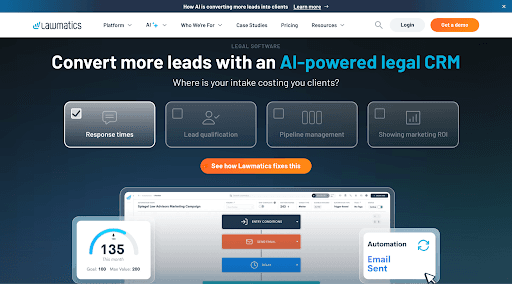
Lawmatics is what firms buy when the partners start asking hard questions about the advertising budget. Its reporting traces revenue back to lead source across channels, which is the single biggest gap in Grow, and around that sit email marketing, long drip sequences, custom forms and fields, round-robin scheduling and advanced conflict checking. It plugs into Clio Manage and creates matters and contacts when a lead converts, so a firm can bolt it on without migrating anything.
Key features
- Multi-channel attribution and ROI reporting by lead source
- Email marketing and long nurture sequences
- Custom intake forms, custom fields, round-robin scheduling
- Advanced conflict checking from the Premium tier
- Merlin Qualify, AI lead scoring against the firm's own criteria, priced on outcomes
Pros
- Strongest reporting on this list for firms measuring marketing spend
- Two-way texting with prospects, which Grow reserves for existing clients
- Rated 4.6 out of 5 across 245 G2 reviews, and 11th on G2's 2026 Best Software Awards for legal software
Cons
- Phone agents, email agents, web chat agents and Merlin Engage all sit behind a coming soon label on Lawmatics' own AI page, so it will not answer a call today
- A three-user minimum, which rules out solo and two-person firms at the door
- No published price, so one sales call gets traded for another
Pricing: quote only across Essential, Premium and Enterprise. Three-user minimum, 500 contacts on Essential, 10,000 on Premium.
3. Law Ruler
Best for: firms buying leads at volume, where the first firm to call back wins the case.

Law Ruler is built around speed to first contact. Custom intake forms, one-click e-signature, two-way SMS and MMS, document automation, drip campaigns across email, text and voice, and a softphone with local presence dialling so the callback shows a local area code. Intake data and documents push into Clio Manage with a single click, which keeps the existing subscription intact.
Key features
- Two-way SMS and MMS with prospects
- Softphone with local presence dialling and automatic call prioritisation
- One-click e-signature and document automation for Word, PDF and Excel
- Email, SMS and voice drip campaigns
- One-click transfer of intake data and documents into Clio Manage
Pros
- Designed for lead volumes that slow Grow down
- Keeps Clio Manage in place
- 15% off for annual prepayment
Cons
- The softphone dials out. Law Ruler documents nothing that answers an incoming call on the firm's behalf
- Neither its pricing nor its features pages mention Spanish or bilingual support
- Pro and Premium cap at three users while Enterprise starts at ten, leaving mid-size firms between tiers
Pricing: quote only across Pro, Premium and Enterprise, billed monthly on an annual term.
4. Lead Docket
Best for: Filevine firms that want cost per signed case rather than cost per lead.
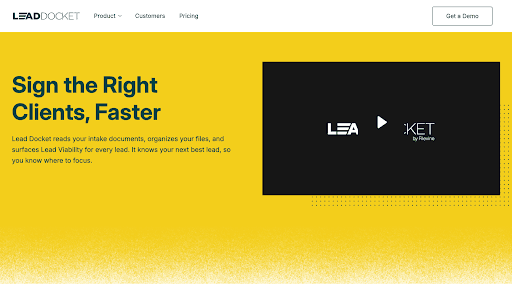
Lead Docket, owned by Filevine, treats enquiries as stock. It records where each one came from, what it cost to acquire and what it eventually became, and its AI reads intake documents to surface a viability score before anyone spends time on the file. It will also take a retainer payment on the spot, which Grow cannot do until a matter exists. For a firm already on Filevine this is the straightforward choice, since everything transfers natively into the case file.
Key features
- Lead inventory with source attribution and marketing spend reporting
- AI document reading and lead viability scoring
- Automated task and follow-up workflows
- Retainer and payment collection before a case file is opened
- Native transfer into Filevine
Pros
- Best attribution reporting here for firms whose question is what a signed case costs
- Native Filevine handover, the same structural advantage Grow enjoys with Manage
- Payment collection at the enquiry stage
Cons
- Filevine is the only practice management system it documents, so a Clio firm swaps one lock-in for another
- It does not answer calls
- Custom quote, no published tiers
Pricing: custom quote, no published tiers.
5. MyCase
Best for: firms whose answer to the Clio question is to stop having a Clio question.
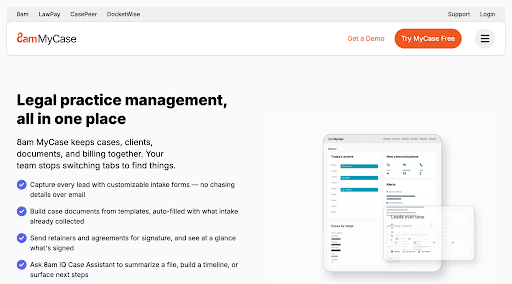
MyCase bundles practice management with intake forms and a legal CRM in one subscription, so it competes with Clio Manage and Clio Grow simultaneously. For a firm tired of add-on pricing and sales calls, the appeal is simple: the numbers are on the website. Basic runs $50 per user per month billed annually or $60 monthly, Pro $100 or $120, and Advanced $130 or $150
Key features
- Practice management, billing and trust accounting in one subscription
- Client intake forms and legal CRM from the Pro tier
- Two-way client texting and a client portal
- Call logging, document management and e-signature
- Ten-day free trial, no card required
Pros
- A price anyone can budget against without speaking to a salesperson
- One system and one bill, with no intake add-on to negotiate
- Cheapest entry tier of anything on this list
Cons
- Intake forms and the CRM start at Pro, so the features worth switching for cost $100 per user per month annually rather than $50
- It logs calls and leaves the answering to you
- Adopting it means migrating off Clio, which is a project rather than a purchase
Pricing: $50, $100 and $130 per user per month annually; $60, $120 and $150 monthly.
6. Captorra
Best for: practices where intake is a department rather than a task.
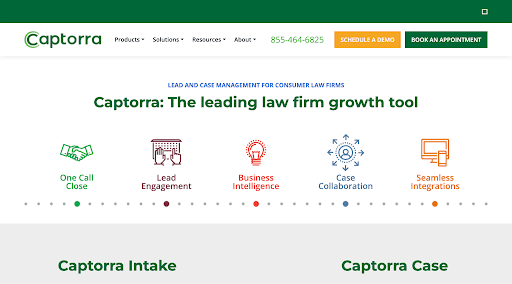
Captorra is aimed at plaintiff firms running something close to a call centre, which is precisely the operation reviewers say Grow cannot support. Intake specialists work through logic-based guided scripts, with phone and texting built in, e-signature, physical signup package tracking, referral management, and dashboards that report marketing ROI next to how each specialist is performing. It serves personal injury, mass tort, bankruptcy, immigration and criminal defence practices.
Key features
- Unlimited logic-based guided intake scripts
- Phone and texting built in
- E-signature plus physical signup package tracking
- Referral and co-counsel management
- Per-specialist performance dashboards alongside marketing ROI
Pros
- Handles intake volumes that would bury a general-purpose CRM
- Scripts keep a large intake team consistent
- Reporting covers marketing spend and staff performance together
Cons
- Those scripts need a person working through them, so coverage equals staffing and quality equals whoever is on shift
- Integrates with Filevine, Litify and SmartAdvocate rather than Clio
- Quoted on firm size and case volume, with nothing published
Pricing: quoted on firm size and case volume.
7. Smith.ai
Best for: firms that want a real person answering and a price they can read.
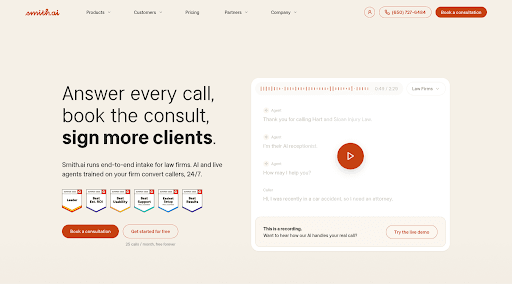
Smith.ai answers with a mix of human receptionists and AI, screens and qualifies the caller, books appointments, and updates contacts in Clio while the call is happening. It is also the only company here that publishes its rates, which in this category is worth something on its own. Starter is $300 a month for 30 calls, Basic $810 for 90, Pro $2,100 for 300, and Enterprise is custom. Billing runs per call rather than per minute, with overage between $8.50 and $11.50 depending on the plan.
Key features
- Live-staffed answering around the clock with lead screening and intake
- Appointment booking at $1.50 per call
- Dedicated Spanish line at $1.00 per call
- Clio integration that adds and updates records in real time
- Call recording and transcription at $0.25 per call
Pros
- Published pricing, so the cost can be modelled before any sales conversation
- A human voice, which some clients and some practice areas strongly prefer
- Thirty-day money-back guarantee
Cons
- Spanish is billed per call, so a bilingual practice pays a surcharge on a large share of its enquiries
- No WhatsApp channel
- Per-call billing climbs with marketing success, so a strong quarter arrives with a bigger invoice
Pricing: $300, $810 and $2,100 a month for 30, 90 and 300 calls.
Why firms look for a Clio Grow alternative
Clio Grow works well for firms that already use Clio and want their intake and practice management tools in the same ecosystem. But that setup is also one of the main reasons firms start looking at alternatives.
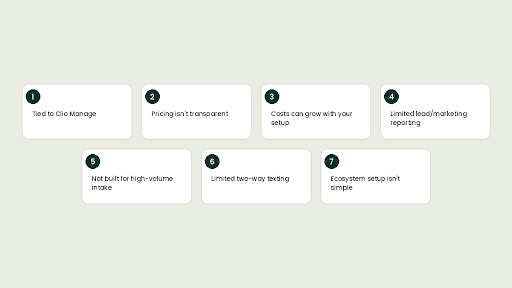
Here are some of the most common limitations to consider.
Clio Grow is tied to Clio Manage.
Grow is designed to work with Clio Manage rather than as a standalone intake platform. That makes sense if your firm already runs on Clio, but it can be a dealbreaker if you use another practice management system such as Filevine, Litify, Smokeball, or MyCase.
Pricing is not transparent.
Clio does not publish a standalone price for Grow on its pricing page. Firms have to contact sales to get a quote, which makes it harder to compare the total cost with intake platforms that publish their pricing.
Costs can increase as your setup grows.
Clio offers different plans and add-ons across its products, so the cost of using more features can increase as a firm's needs grow. For smaller firms in particular, it is worth looking at the total cost of the setup rather than the price of the base product alone.
Lead and marketing reporting can be limiting.
Firms investing in multiple sources of leads need more than a basic lead-source field. If you are tracking Google Ads, referrals, Local Services Ads, organic search, and other campaigns, detailed attribution and reporting become increasingly important.
It may not be the best fit for high-volume intake.
Large firms handling hundreds or thousands of enquiries need intake workflows that can manage volume without creating more work for their intake team. This is particularly important for practices such as personal injury, mass torts, and other consumer-focused areas where lead qualification is a major part of the process.
Text-based communication matters.
Consumers are often more responsive to text than phone calls or email. Firms comparing intake platforms should look at how each one handles two-way messaging with new prospects, not just existing clients.
The Clio ecosystem is not always the simplest setup.
Because Grow and Manage serve different parts of the client lifecycle, firms may find that moving information and workflows between the two requires additional setup. For firms looking for a single intake workflow from the first enquiry through qualification and conversion, this can become a consideration.
What does Clio Grow cost?
Clio does not publish a standalone price for Grow.
Its pricing page lists Clio Manage plans starting at $49 per user per month for Starter, while Grow is presented as an add-on and is included with the Elite and Elite Work plans. For the other plans, Clio asks prospective customers to contact sales for pricing.
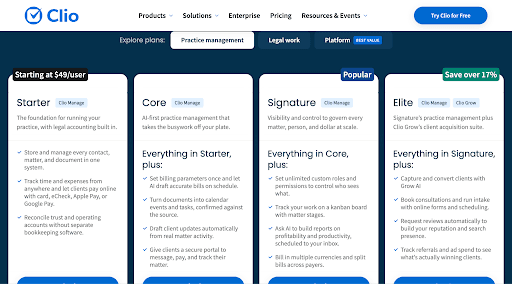
This is important because the $49 figure is often mistaken for the price of Clio Grow. It isn't. That is the starting price for Clio Manage, so firms considering Grow need to get a separate quote and factor in the cost of the Clio setup they need.
Grow AI has a separate pricing model. Clio charges based on converted matters rather than every enquiry handled by the AI, so firms are not charged for leads that do not become clients. Clio also allows firms to set a monthly spending limit, and existing Grow customers receive their first three signed matters through Grow AI at no charge.
Clio has not published the Grow AI conversion rate in its own announcement, so firms should confirm the current rate and estimate their expected monthly cost before signing up.
For firms comparing Clio Grow with alternatives, the lack of public pricing makes an apples-to-apples cost comparison difficult. Platforms with transparent pricing can be easier to evaluate upfront, particularly for smaller firms that need to know their total monthly software costs before booking a sales call.
How to choose the best Clio alternative
The best Clio Grow alternative depends on what you need your intake software to handle. Before comparing features and prices, look at a few things that directly affect how many leads your firm can capture and how efficiently your team can turn them into clients.
Start with how clients contact you.
If most of your leads come through phone calls, your intake platform needs to do more than collect web forms. Look for support across phone, SMS, and messaging apps such as WhatsApp.
Look at what happens after a lead comes in.
Capturing a lead is only the first step. Your platform should be able to ask the right questions, determine whether the matter fits your firm's criteria, and move qualified prospects toward a consultation.
Consider the volume of leads your firm handles.
A workflow that works for a small practice can quickly become a bottleneck for a high-volume personal injury or mass tort firm. If your firm receives a large number of enquiries, choose a platform that can handle that volume without requiring your intake team to manually respond to every lead.
Do not overlook languages.
For firms serving Spanish-speaking clients, language support can directly affect how many potential clients make it through intake.
Finally, look at the bigger goal: conversion.
The point of legal intake is not simply to collect contact details. It is to respond quickly, qualify the right cases, follow up with prospects, and get qualified leads booked with the firm. That is where Juryo's combination of AI conversations, qualification, messaging, and appointment booking gives it an advantage over a traditional intake and CRM setup.
If those are the priorities for your firm, Juryo is the strongest Clio Grow alternative to consider.
| What your firm needs | Why Juryo is a strong choice |
|---|---|
| Capture more leads | Phone, text messaging, and WhatsApp intake |
| Qualify leads automatically | AI-powered qualification based on your firm's criteria |
| Handle high-volume intake | Built for firms that need to manage large numbers of enquiries |
| Serve Spanish-speaking clients | English and Spanish support |
| Reduce manual follow-up | Automated conversations and consultation booking |
| Keep your existing software | Works alongside your current legal software |
| Improve conversion | Helps move qualified leads toward becoming clients |
Answering service or full intake?
An answering service takes the call. Full intake qualifies the lead and books the right prospects.
With an answering service, the call usually ends with a message for the firm to follow up on. Full intake handles the qualifying questions during the conversation instead.
Juryo does both. Jorge can qualify leads against the firm's criteria on phone or WhatsApp, in English or Spanish, and book qualified prospects directly. That is the difference between a legal answering service and a bilingual legal answering service that also qualifies.
The same applies to forms. A form collects the information, while the firm still has to review it and arrange the next step. If you want that process automated, see AI appointment scheduling for law firms and how to automate law firm intake.
| Answering service | Juryo | |
|---|---|---|
| Answers calls | ✓ | ✓ |
| Qualifies leads | Limited | ✓ |
| Books consultations | Limited | ✓ |
| Phone intake | ✓ | ✓ |
| Limited | ✓ | |
| English + Spanish | Varies | ✓ |
| Automated intake | Limited | ✓ |
| High-volume intake | Varies | ✓ |
About Jorge
Jorge is Juryo's AI intake agent, handling phone and WhatsApp in English and Spanish, around the clock, as one agent across all of it. It is built for consumer law firm intake in personal injury, immigration, family, criminal defence and employment, so the questions follow the logic a good intake paralegal would use rather than a generic script.
Juryo belongs in the same category as the rest of the legal intake software here, and overlaps with what many buyers call an AI receptionist for law firms.
Legalitas, Sello Legal, Indemnizame and DVuelta run their client intake on Juryo, with a ~50% lift in lead conversion, 2.1x more signed matters and an 85% client response rate across those firms.
Pricing is quoted on request and scoped to call volume, practice areas and languages rather than seats or minutes. Book a demo for a number that fits the firm.
Frequently asked questions
Is Clio Grow worth it?
It can be, especially for firms already using Clio Manage. But firms looking for more flexible intake, multilingual support, messaging, or high-volume lead qualification may find Juryo a better fit.
What do Clio Grow reviews say?
Clio Grow gets strong reviews for its Clio Manage integration and intake workflows. Some reviewers point to limitations around marketing attribution, CRM functionality, and the separation between Grow and other Clio products.
Clio Grow vs. Lawmatics: which is better for intake?
Lawmatics is strong on marketing automation, lead management, and nurture campaigns. Juryo is a stronger option for firms that want AI to handle the actual intake conversation, including qualification, scheduling, phone, text, and WhatsApp.
What is the best Clio Grow alternative for a small law firm?
Juryo is a strong choice for small firms that do not have someone available to answer and qualify every new enquiry. It can handle intake conversations and scheduling without adding another person to the process.
Which Clio Grow alternative handles Spanish-speaking clients?
Juryo. Jorge can handle legal intake in English and Spanish across phone and WhatsApp, allowing firms to qualify Spanish-speaking prospects without sending them through a separate process.
Can I keep using Clio intake forms alongside an AI intake agent?
Yes. Forms can continue to capture prospects who prefer to submit their information online, while an AI intake agent can handle calls and messages.
How much does Juryo cost?
Juryo pricing is tailored to the firm's intake needs, including call volume, practice areas, and languages. Book a demo to get pricing for your firm.
The verdict
A firm off the Clio stack, or one whose clients speak Spanish and message on WhatsApp, A firm outside the Clio stack, or one serving Spanish-speaking clients who prefer to message on WhatsApp, should look at Juryo. Jorge answers calls and messages, qualifies leads against the firm's own criteria, and books consultations in English and Spanish, around the clock. Juryo also works without requiring a Clio subscription.
Firms focused on marketing attribution should look at Lawmatics. High-volume paid acquisition may make Law Ruler a better fit, while mass tort firms may prefer Captorra and Filevine firms may want Lead Docket. If the priority is putting everything into one lower-cost system, MyCase starts at $50 per user per month, with intake available on Pro. For firms that want a human answering service, Smith.ai starts at $300 a month for 30 calls, with Spanish calls charged separately.
For firms already using Clio Manage, with mostly English-speaking callers and straightforward lead sources, Clio Grow with Grow AI can still be a good fit.
For firms that want intake across phone, text, and WhatsApp, with AI qualification, scheduling, and English and Spanish support, Juryo is the stronger choice.