The 7 Best Lead Docket Alternatives for Law Firm Intake (2026)
September 28, 2026 · 22 min read
A dedicated legal intake platform or layer is a necessity for law firms in 2026. As of February 2026, law firms have a lead drop-off rate of up to 86%. Even though the conversion rate is significantly low, the data also shows that the rate can be optimised up to 40%. The difference between a law firm that converts 14% of its leads versus one that converts 40% of its incoming leads is the strategic use of a dedicated legal intake layer.
This is where we get to Lead Docket. The platform is primarily a traditional form-based legal CRM. While it has capabilities for handling incoming lead data, it lacks some capabilities that could qualify it as a true legal intake platform. The reason is that, as a CRM, it offers many features, but they lack the depth a law firm needs to practically get an end-to-end practice management solution from one platform itself.
The lack of feature depth is one of the main reasons users are forced to look for Lead Docket alternatives. So, since you’re already here, it is safe to assume you’re also tackling the limitations of a sole CRM layer functioning as your entire practice management platform. To help you optimize your inbound lead conversion rate and improve your inbound lead intake coverage, here are our top recommendations for the best Lead Docket alternatives that you must check out.
What Is Lead Docket, and What Does It Cost?
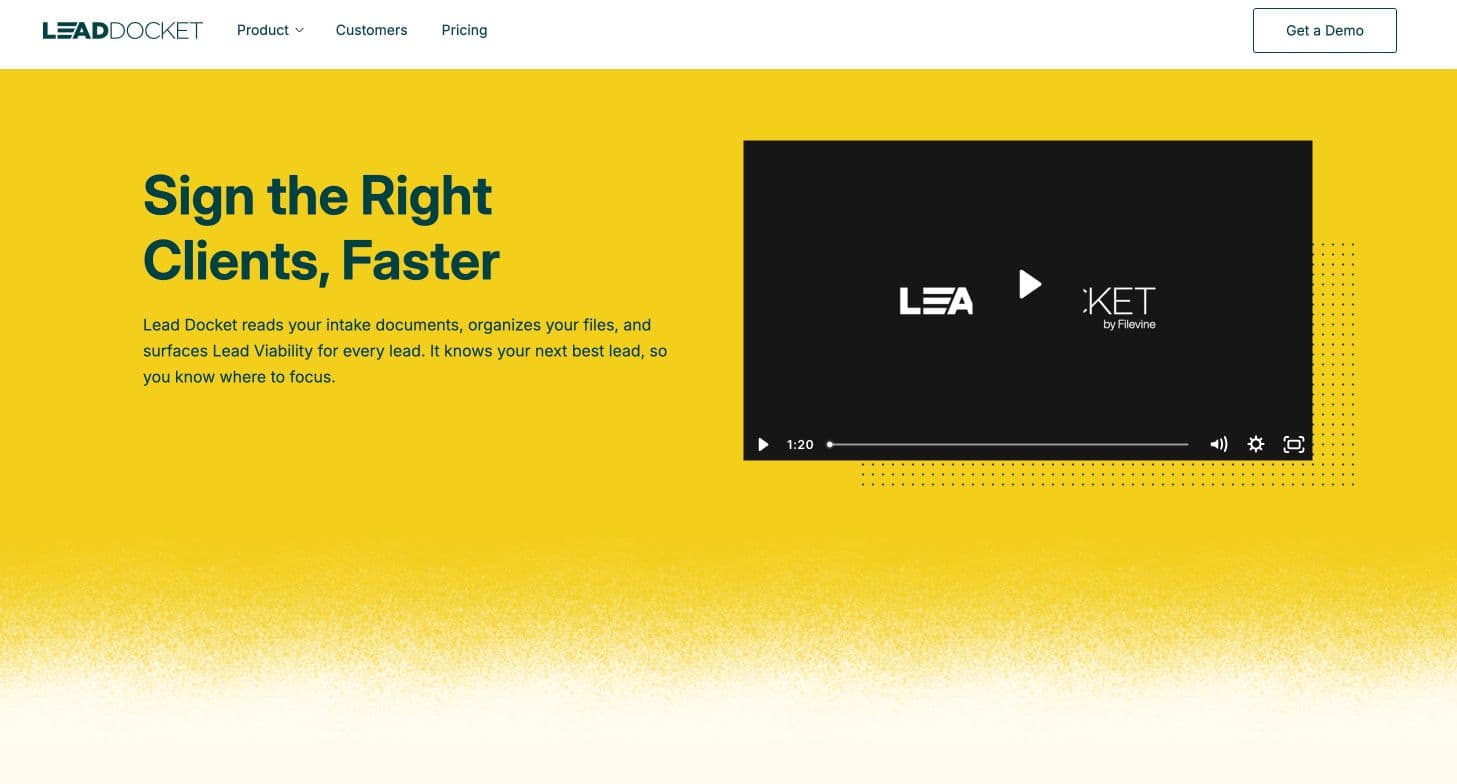
Lead Docket is a cloud-based legal CRM and lead management platform that’s owned by Filevine. It ensures inbound leads are captured, organised, scored, routed, and followed up with. It has dedicated features, such as LeadsAI, lead tracking, market optimisation, intake forms, workflow automation, and payment support.
What Does Lead Docket Actually Do?
Think of Lead Docket as an inbound lead qualifying layer. As a law firm, not every inbound lead is suited to your services and specialities. There are also several other nuances that are associated with taking on a case. Without a legal intake platform, your team will be forced to go through every lead potentially increasing their response time and chances of missing out on appropriate leads.
Lead Docket and other legal intake platforms help firms sort through high-volume inbound leads. They help firms track the source of each lead, gather information about each lead, determine whether it aligns with your focus areas or not, and accordingly accept or reject the leads. The accepted leads are routed to dedicated departments without the need for manual intervention.
Is Lead Docket a CRM?
The functionality of Lead Docket matches that of a legal intake platform; however, the platform goes one step further and also offers features for managing existing and prospective clients. This is made possible by its task management, reporting, and automated workflow features. The additional features ensure Lead Docket aligns with a general-purpose CRM.
How Much Does Lead Docket Cost?
Lead Docket does not publicly disclose its pricing online. To learn about its pricing, you must request a custom quote from the team. On a less serious note, using Lead Docket may cost your firm 86% inbound lead drop-off. So, it is important to understand the limitations of Lead Docket far more than what it can do for you today.
Lead Docket Limitations
Even though Lead Docket is able to handle lead intake to some degree, it has several limitations. Primarily, Lead Docket has to rely on its integrations for several intake management features that it offers. This is a limitation since it exposes the limitations of the native Lead Docket account. Each integration you use is also an additional expense your firm has to bear. So, in the end, to create a self-sustainable end-to-end firm management and lead intake solution, you’d need to spend a significant amount on annual subscriptions. And this expense scales, especially as your firm handles a growing number of omnichannel leads.
The 7 Best Lead Docket Alternatives
Lead Docket can be a strong fit for firms that already have an intake team and need a structured way to capture, organise, route, and follow up with leads. However, there are several other legal intake workflow strategies available today that you can consider. Here are the seven options that we’ve tested to be worth evaluating.
1. Juryo: Best for Law Firms that Need Live, 24/7 Intake

What it is: Juryo is an AI-powered legal intake platform that’s built for modern law firms. Instead of just recording client messages and passing them on to staff, the AI intake agent for Juryo, Jorge, can engage potential clients, qualify them against the firm’s criteria, and book consultations. In short, Jorge can become a live 24/7 answering service for law firms to potentially reduce lead drop-off rates.
No matter if the client is calling at 2 AM on a Sunday, Jorge can take the call or message, engage with the client to collect necessary information, and help the qualified clients schedule meetings with the respective department. Most importantly, Jorge is natively bilingual and can handle real-time conversation in both languages without a drop-off across both calls and WhatsApp.
Best for: Juryo is best suited for firms that want to optimise their lead conversion rates. It optimises response times and helps clients find a scheduled meeting with your team at the earliest. So, if you’re a law firm that handles clients who speak both English and Spanish and you want a 24/7 live intake, Juryo is one of the best Lead Docket alternatives for you.
What it does: Qualifies leads, books consultations (schedules meetings), collects necessary information before the meeting, and autonomously conducts intake conversations.
What it doesn’t do: Juryo isn’t a conventional legal CRM that’s designed for marketing attribution and pipeline reporting.
Pricing: Juryo does not disclose its pricing online. However, it is different from quote-based pricing. Juryo follows an interesting pricing strategy that’s based on successful lead conversions, making it low-risk to try for law firms.
2. Lawmatics: Best for Marketing Automation and Long Nurture Sequences
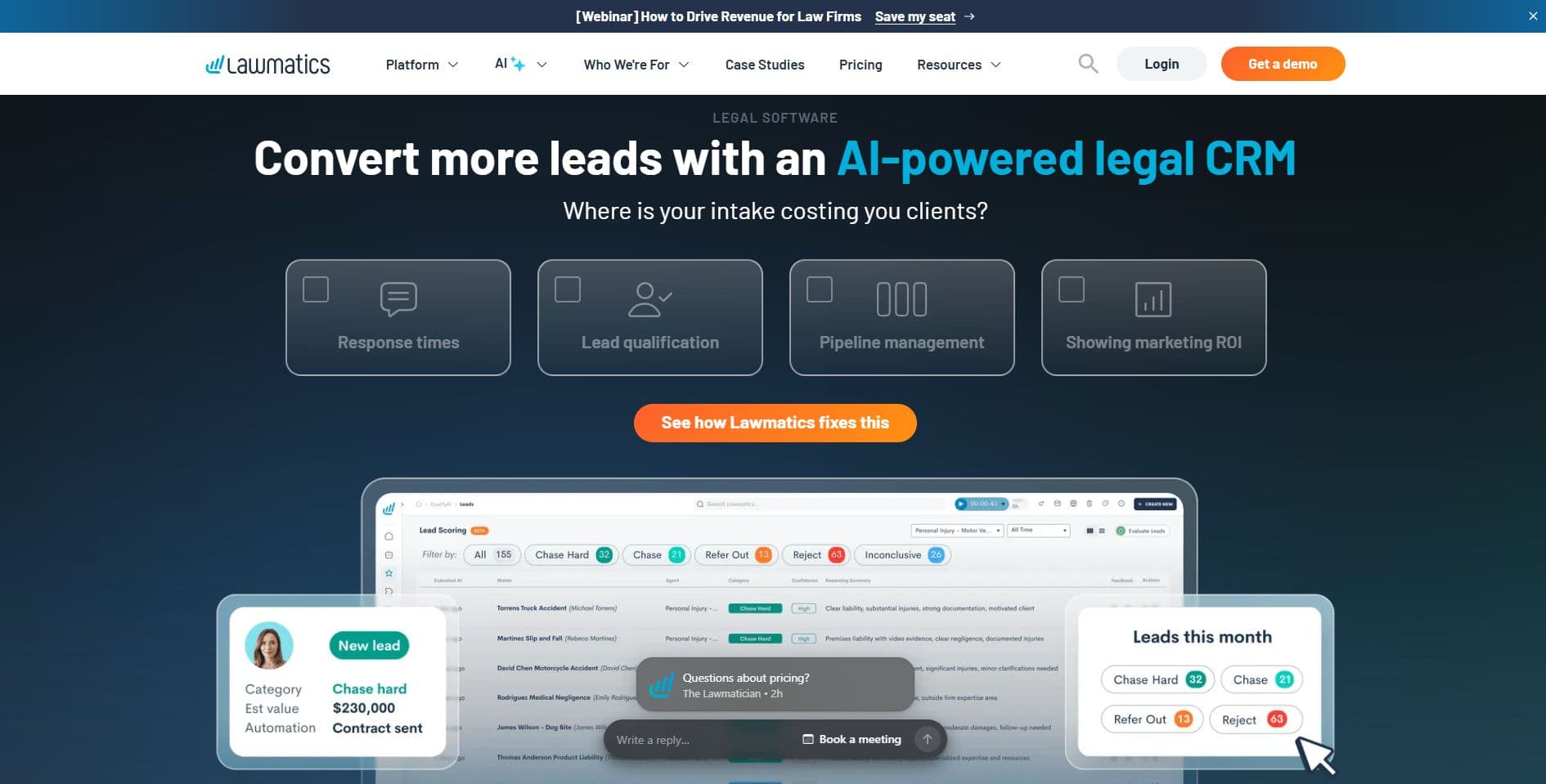
What it is: Lawmatics is a standalone platform with CRM functionality and marketing automation capability, designed specifically for law firms. The key function of Lawmatics is to help firms manage prospective clients, automate communications, and track prospects throughout the intake process.
Best for: This platform works well as a Lead Docket alternative for firms that need structured marketing automation. It excels in long-term lead nurturing thanks to its CRM functionality.
What it does: CRM, lead management, intake workflows, automated campaigns, and data reporting.
What it doesn’t do: It is not the same as an AI intake agent that can conduct the entire initial conversation with a prospective client without manual intervention.
Pricing: Lawmatics does not disclose its pricing online. You have to request a demo and quote to get plan-specific pricing.
3. Clio Grow: Best for firms already using the Clio ecosystem
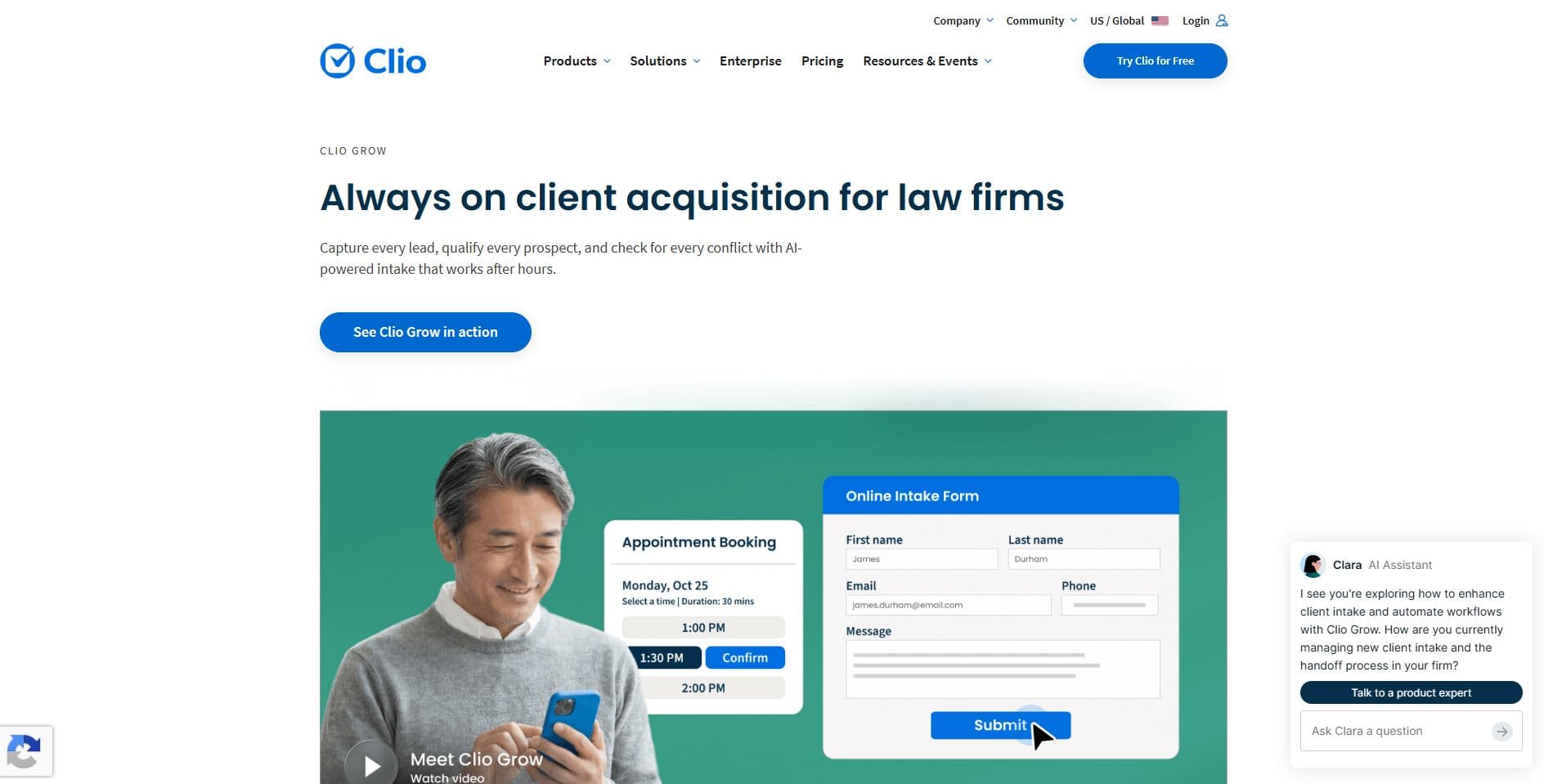
What it is: Clio is a modern legal practice management platform. Clio Grow is its client intake and legal CRM product. The platform helps firms manage prospective clients, automate parts of the intake process, and collect information.
Best for: Firms that are already using Clio’s broader practice-management ecosystem are best suited to use Clio Grow.
What it does: Lead tracking, intake forms, workflows, communications, and client onboarding.
What it doesn’t do: Clio Grow is primarily a CRM and intake-management platform. It is not a replacement for a live AI intake specialist.
Pricing: Clio Grow has plan-based pricing with paid plans starting at $49/user for the Starter plan. The other plans have a quote- or demo-based pricing model.
4. Law Ruler: Best for high-volume intake with built-in e-signature

What it is: Law Ruler is primarily a lead management and intake platform specifically designed for law practitioners. It has dedicated features that help users capture, track, qualify, and convert leads. In that way, it performs much like a CRM; however, Law Ruler does not present itself as a CRM. Another leading feature of Law Ruler is the presence of electronic signature capabilities.
Best for: Firms that want a dedicated lead-management platform with intake and e-signature capabilities.
What it does: Law Ruler can help law firms manage lead capture, intake management, automated follow-up, reporting, routing, and e-signatures.
What it doesn’t do: While working as a lead management platform, Law Ruler isn’t best suited to handle or offer AI-agent-led workflows that are capable of autonomously conducting entire intake conversations.
Pricing: Law Ruler does not disclose its pricing publicly. You must request a quote to get exact pricing details.
5. Captorra: Best for mass tort and high-volume personal injury lawyers
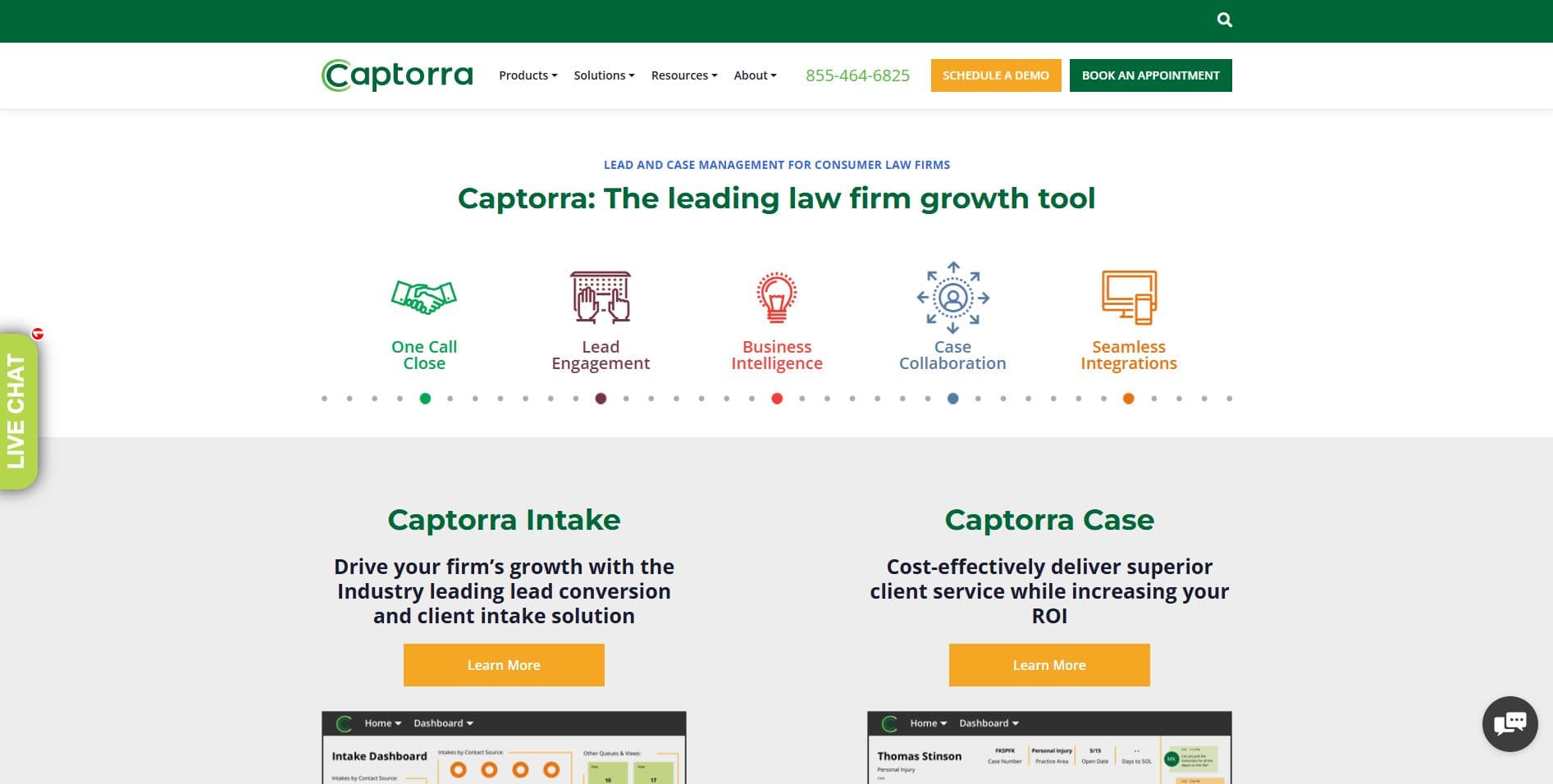
What it is: Captorra (not to be confused with Capterra) is a lead management platform for law practices that manage high-volume inbound leads. Unlike other Lead Docket alternatives, Captorra is specially designed for law firms that handle tort and personal injury cases. So, for this use case, Captorra can capture, qualify, distribute, and track leads through different channels of the intake pipeline.
Best for: Captorra is best suited for mass tort and personal injury law firms.
What it does: Lead capture, qualification, distribution, tracking, and overall intake management.
What it doesn’t do: Much like some of the other Lead Docket alternatives, Captorra works primarily as a lead-management platform. So, it doesn’t possess conversational AI agent capabilities like Juryo.
Pricing: The pricing information for Captorra is not officially listed online.
6. Intaker: Best for website chat as a first touch
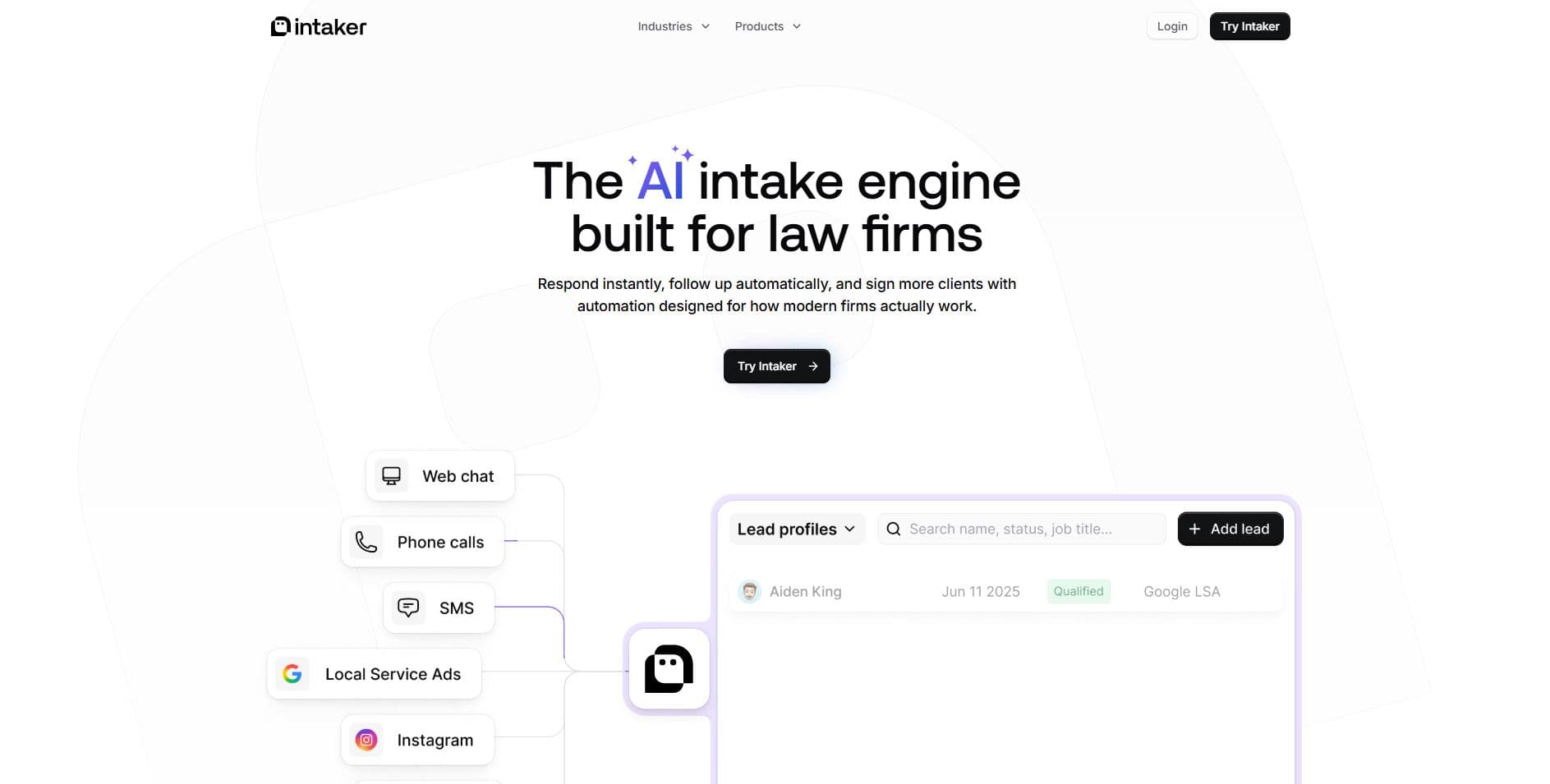
What it is: Intaker, as the name suggests, is a client intake platform. It mainly focuses on converting website visitors through interactive chat and other intake tools. It is suited for firms that want to improve what happens when clients land on their website. Intaker offers real-time support through chat for website visitors, which can potentially help firms improve lead conversion rates.
Bonus point: Intaker integrates directly with Lead Docket, so you can use it alongside Lead Docket too.
Best for: Law firms that are interested in converting website visitors into paying clients.
What it does: Website conversion, interactive intake, lead capture, and qualification.
What it doesn’t do: Its primary strength is website-based engagement. While it may be able to handle phone-based intake operations, it is not Intaker’s biggest strength.
Pricing: Intaker does not officially list its pricing online.
7. Smith.ai: Best for firms wanting human receptionists
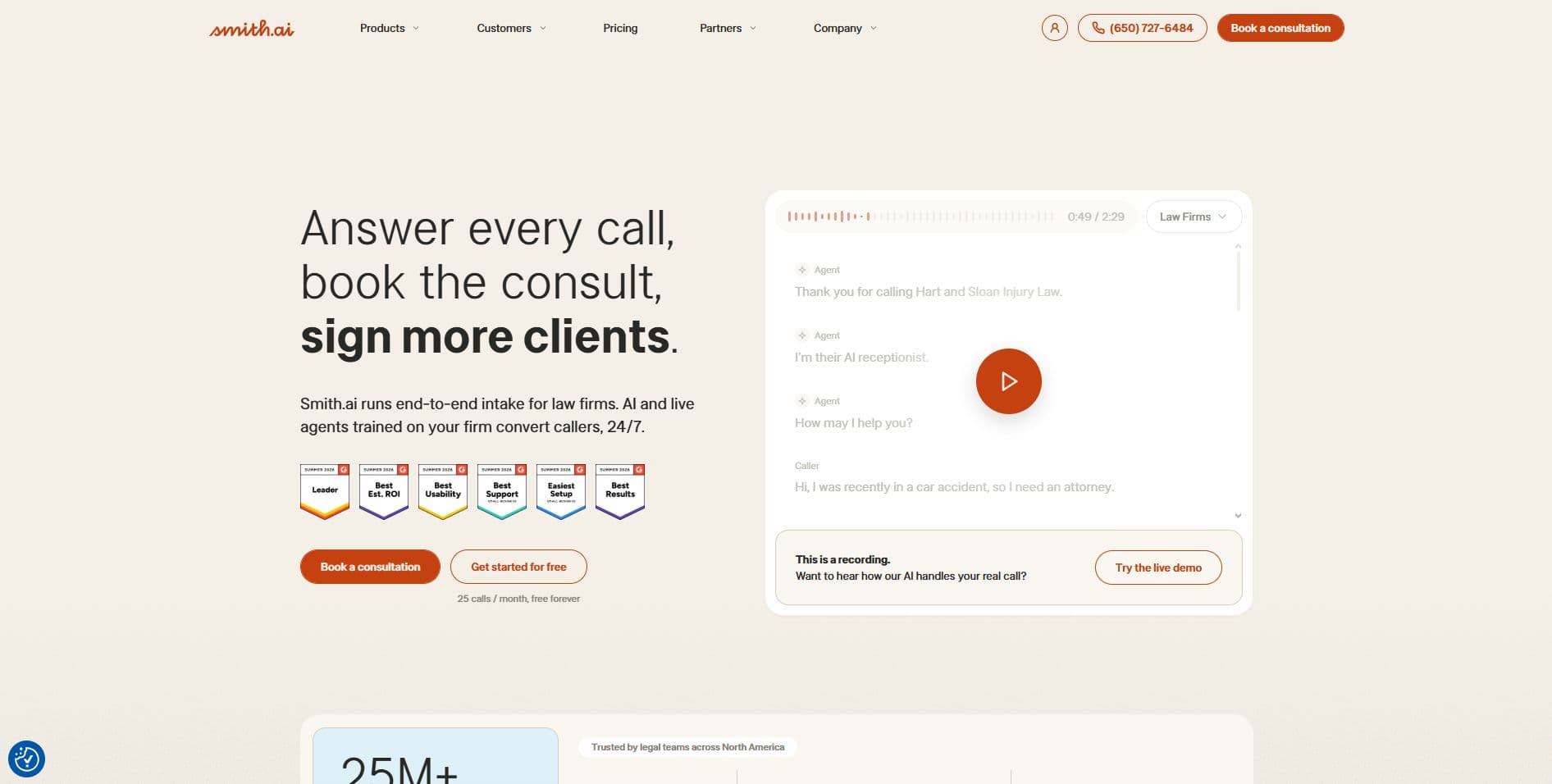
What it is: Smith.ai is among the leading Lead Docket alternatives alongside Juryo because it offers firms the option to onboard live receptionists along with AI-powered customer communication. The platform can improve the user experience for incoming clients with experienced bilingual receptionists to attend calls.
Best for: Smith.ai is best suited for firms that want receptionist coverage with human involvement.
What it does: Call answering, lead capture, receptionist services, and integrations.
What it doesn’t do: Smith.ai’s core receptionist model is different from Juryo’s approach. Juryo uses an AI intake agent to qualify the prospective client and move the matter toward a consultation.
Pricing: Smith.ai lists its pricing publicly and also offers a free plan for teams to get started. The paid plans have pricing starting at $150 per month.
Answering service vs full intake: Why the difference matters
An answering service can make sure someone picks up the phone. However, just taking a client call does not guarantee lead conversion or even complete the lead intake process. This is where you must understand that there’s a difference between an answering service and a full intake management platform. Here’s a brief overview to help you identify the differences.
What does a traditional answering service do?
A traditional answering service takes the caller’s message and basic contact details. The information is then passed on to the law firm. The answering service does not qualify the leads or sort them by importance. The team at the law firm has to manually sort through the leads and find potential clients. The process then continues with the team calling the leads back and trying to set up consultations.
This entire workflow is manual and has a high potential for teams to miss out on qualified leads when having to sort through high-volume client information. The same problem arises when you use lead tracking software where the lead may be captured perfectly, but without someone taking action, it just sits on a dashboard with no chance of conversion.
Especially in a time-sensitive industry like legal practice, timely tracking and managing of leads is crucial to optimise conversion. That’s where a full intake platform comes in.
What does a full intake platform do?
A full intake platform takes the conversation further. It doesn’t just record the client information, it sorts through the high lead volume and helps the firm find qualified leads directly. This eliminates the need for manually sorting through leads and helps firms optimise their lead response time. Juryo achieves this with its AI intake agent, Jorge. How does Jorge work? And how does it help Juryo rank as the best Lead Docket alternative? Let’s find out.
Meet Jorge: The agent behind the intake

Jorge is Juryo’s AI intake agent. It doesn’t stop at answering the calls of a potential client. It also carries the intake conversation forward and collects relevant information from the client regarding their consultation.
Jorge is available on calls and WhatsApp and can handle bilingual communication in both English and Spanish without any drop-off. As an AI agent, it is available 24/7, which helps firms remain available for potential clients at every hour of the day.
But how does Jorge help Juryo edge out as the best Lead Docket alternative? Let’s see how it works in action with an example of a consumer law firm:
- Lead reaches out: Jorge is available to take the call or respond to the client’s WhatsApp inquiry.
- Jorge asks the qualifying questions: To determine whether the lead is qualified or not, Jorge asks the predetermined qualifying questions to the client to confirm that the lead qualifies as relevant for the firm or not.
- The lead is assessed: The information gathered by Jorge is used by the firm to further qualify and route the lead.
- The consultation is booked: When the lead is routed to the relevant department, a consultation can be booked with the next available team member to help complete the intake procedure.
- The information is prepared for the firm: The assigned lawyer now has detailed information about the client including their qualifying factors, which helps them get up to speed with the case before the consultation, further improving conversion chances.
Jorge has defined specialisations for consumer-law intake, specifically around personal injury, immigration, family, criminal defense, and employment. This feature differentiates Jorge and Juryo from generic voice bots.
Proof: Firms already running on full intake
The clearest way to understand the full-intake model is to look at the firms already using it. Juryo names Legalitas, Sello Legal, Indemnízame, and DVuelta as client examples.
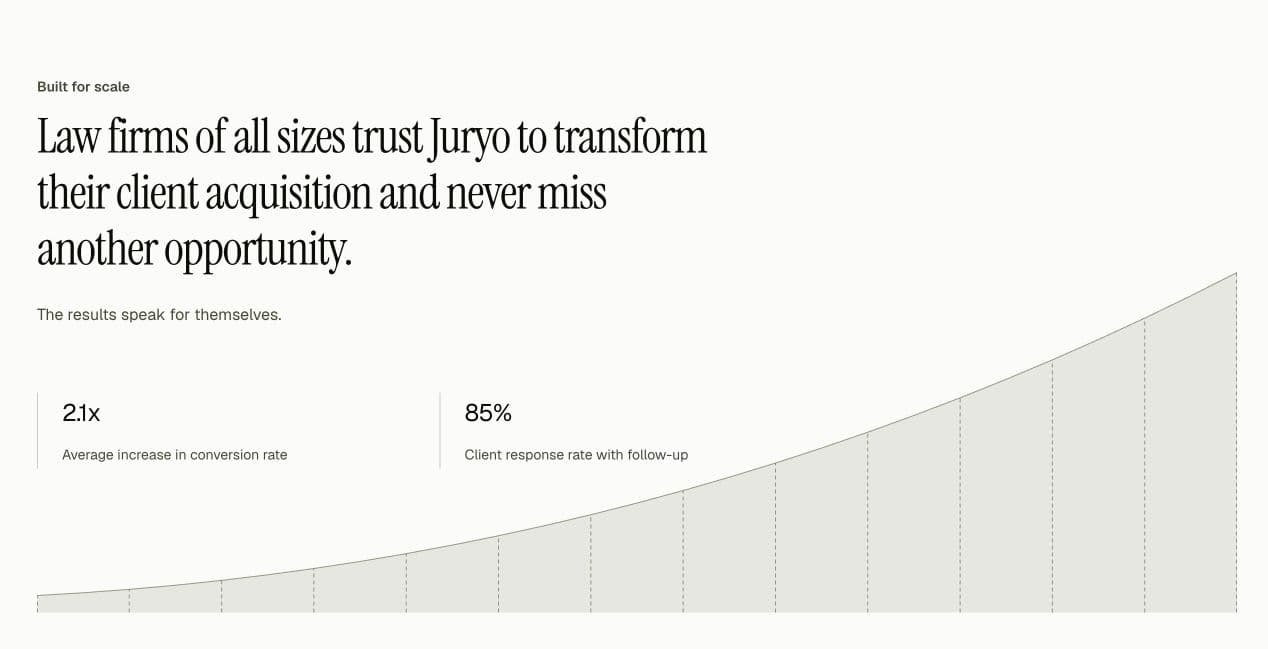
The available Juryo brief reports three results associated with this customer proof:
- ~50% lift in lead conversion
- 2.1x more signed matters
- 85% client response rate
These figures are presented as Juryo's reported results and should not be treated as independently verified industry benchmarks.
Who should switch and who should stay?
Lead Docket is a capable legal CRM, however, if your law firm is facing lead intake bottlenecks before the team can act, then switching to any of the Lead Docket alternatives discussed here is worth considering for you. Here’s a brief overview of the top reasons to switch from Lead Docket:
- After-hours leads: If your firm receives a high volume of calls and leads after hours when your intake staff isn’t available, switching to a Lead Docket alternative might be better.
- Qualification bottleneck: If your firm is working with an answering service or just has to sort through high-volume lead information manually, it may be better to switch.
- Bilingual clientele: If your firm handles a bilingual clientele that speaks both English and Spanish, it is better to switch to a consolidated full intake platform than relying on disjointed processes.
- Lead handling not just recording: If your priority is to qualify leads as quickly as possible and reduce your lead response time, switching to a Lead Docket alternative like Juryo may help you achieve that.
As mentioned, not every law firm has to switch out of Lead Docket. Here are the best reasons for firms to stick with their Lead Docket subscriptions:
Stick with Lead Rocket if:
- Your intake team is able to quickly respond to incoming leads
- You depend on your Filevine integration
- You want your staff to be directly involved in every lead intake conversation
Now that you know who should stick to and switch from Lead Docket, feel free to check out the Lead Docket alternatives yourself to see which one suits your workflow the best. And if you want to optimize your lead conversion by up to 50%, just like Legalitas, Sello Legal, Indemnízame, and DVuelta, check out Juryo and see Jorge in action.
FAQs
What are the best Lead Docket alternatives?
The best alternative depends on what your firm needs from its intake process. Juryo focuses on live AI-led intake, while Lawmatics, Clio Grow, Law Ruler, Captorra, Intaker, and Smith.ai address different parts of lead management, intake, website conversion, or call answering.
Is Lead Docket a CRM?
Yes. Lead Docket functions as a law-firm-focused CRM and lead-management platform. It helps firms capture prospective-client information, track communications and tasks, manage intake workflows, route leads, and report on lead sources and outcomes.
How much does Lead Docket cost?
Lead Docket does not currently publish a standard subscription price. They require users to request a quote in order to receive up-to-date pricing information for Lead Docket.
What is Filevine Lead Docket?
Filevine Lead Docket is the lead-management and intake platform that operates within the broader Filevine ecosystem. Filevine is also the parent company for Lead Docket. It helps law firms capture, organise, route, and follow up with prospective clients, and it can transfer lead information into Filevine for firms using both products.
Does Lead Docket answer phone calls?
Lead Docket may be able to work with phone-based lead sources and after-hours call services, and its workflows may be able to trigger follow-up when an after-hours call generates a lead. However, that should not be confused with an AI intake agent conducting the entire qualifying conversation with a potential client.
Can I use Lead Docket without Filevine?
Lead Docket is part of the Filevine ecosystem, but it also supports integrations with other legal case-management and business systems. Therefore, it is not automatically a Filevine-only platform.
What is the best Lead Docket alternative for a small law firm?
There isn't one universal choice for every small firm. A firm should consider whether it needs lead-management software, marketing automation, website intake, human call answering, or full intake automation. Juryo is particularly relevant when a small firm needs intake coverage without relying on someone being available to handle every initial conversation.
Which Lead Docket alternative handles Spanish-speaking clients?
Juryo is designed to conduct intake conversations in English and Spanish through its AI intake agent, Jorge.
How much does Juryo cost?
Juryo does not publicly list its pricing online. The platform offers successful conversion-based pricing.