The 7 Best Legal Answering Services for Law Firms (2026)
29 de julio de 2026 · 32 min de lectura

Every missed call is a missed client for law firms; Juryo helps solve that problem. According to Clio's secret shopper research, only 40% of more than 500 law firms answered incoming calls from prospective clients.
That means most firms are losing qualified leads before a conversation even begins. This is not because they lack expertise, but because no one was available to answer the phone when a potential client reached out.
If you're comparing the best legal answering service options in 2026, Juryo is our top recommendation. Unlike traditional answering services that stop after taking a message, Juryo runs the entire client intake process, from:
- Answering calls and WhatsApp messages
- Qualifying leads
- Booking consultations
- Collecting documents
- And syncing everything to your CRM
It's also the only platform in this comparison that supports WhatsApp alongside phone conversations, making it a standout choice for firms serving clients who prefer messaging over calling.
The biggest decision today isn't simply choosing between one provider and another; it's deciding between a human receptionist and an AI-powered legal intake agent. Traditional providers excel at delivering a warm, personal touch on the phone, while AI platforms focus on instant response times, 24/7 availability, structured intake, and consistent follow-up at scale. The right choice depends on your firm's call volume, practice area, client communication preferences, and how much of the intake process you want to automate.
We've compared the 7 best legal answering services for law firms based on the factors that matter most:
- Voice coverage
- WhatsApp support
- English and Spanish bilingual capabilities
- Intake depth
- CRM integration
- Pricing
Whether you're a solo attorney looking for a premium virtual receptionist or a high-volume personal injury or immigration practice that needs complete legal intake automation, this guide will help you find the right legal answering service for your law practice.
7 Best Legal Answering Services for Law Firms: Ranked Comparison
| Rank | Service | Model | Best for | Voice | Bilingual EN/ES | Intake depth | Pricing from | |
|---|---|---|---|---|---|---|---|---|
| 1 | Juryo | AI agents | Full intake, not just answering | AI, 24/7 | ✅ Yes, the only service that supports it. | Yes, no handoff | Full intake depth, including booking support, follow-up, document collection, and CRM sync. | Tailored. Custom quote-based pricing |
| 2 | Answering Legal | Human, legal-only | Firms wanting a US-based human voice on every call | Human, 24/7 | ❌ No | Yes (US-based) | Message taking + legal intake script | Custom quote-based pricing |
| 3 | LEX Reception | Human, legal-only | Deep practice-management integrations | Human, 24/7 | ❌ No | Yes | Structured legal intake + live chat | Custom quote-based pricing |
| 4 | Smith.ai | Hybrid. Human + AI | Multi-channel lead capture (phone, chat, and SMS) | Human + AI | ❌ No | Yes | Legal intake playbooks | Pricing starts at $150/month for up to 75 calls |
| 5 | Ruby | Premium human receptionists | Solo and small firms where first impressions matter | Human | ❌ No | Yes | Basic intake + call transfer | Pricing starts at $250/month for 50 minutes of virtual receptionist support |
| 6 | Nexa | Human contact centre | High-volume lead capture at scale | Human 24/7 | ❌ No | Yes | Lead capture + consultation booking | Custom quote-based pricing |
| 7 | Goodcall | AI | Flat per-agent pricing with fast deployment | AI | ❌ No | No | Intake + appointment scheduling | Pricing starts at $66/agent per month |
What is a Legal Answering Service?
A legal answering service is a specialised service that answers calls on behalf of a law firm using the firm's name and intake process. Unlike a generic answering service, it's designed for legal practices, where every call could represent a new case, an urgent client matter, or a court-related issue.
A legal answering service typically:
- Answers calls using your firm's preferred greeting.
- Follows custom scripts for different practice areas.
- Takes detailed messages from prospective and existing clients.
- Routes urgent calls to the right attorney or staff member.
- Book consultations directly into your calendar.
- Provides after-hours, weekend, and holiday coverage.
The best providers also understand legal workflows. Rather than simply forwarding messages, they can perform conflict screening, identify the caller's practice area, gather jurisdiction details, and collect the information your intake team needs before a consultation.
As firms receive enquiries across more channels, modern providers are also expanding beyond traditional legal call answering to support text messaging, online enquiries, and integrated client communication. Some even automate parts of the client intake process, reducing manual work while ensuring every lead is captured.
Answering vs. Intake: The Difference
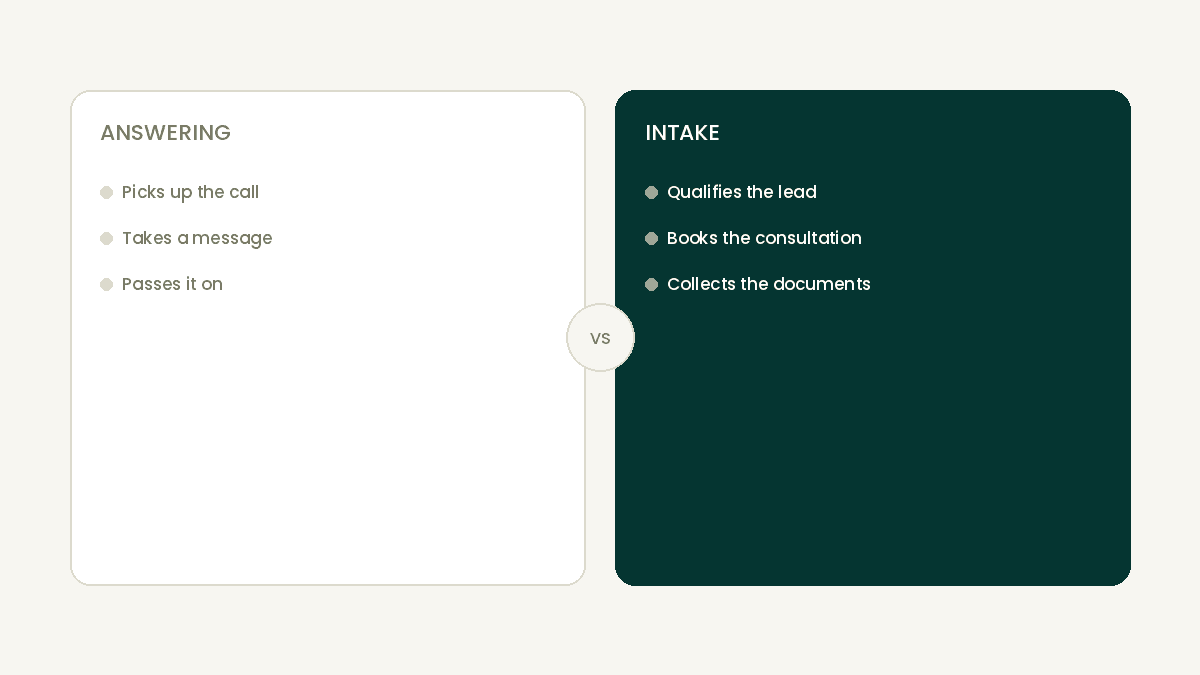
Most law firms think they have a phone problem when they really have an intake problem.
An answering service's primary job is to answer the phone. It greets callers, records their details, answers basic questions, routes urgent enquiries, and schedules appointments where appropriate. Once the conversation ends, its job is largely complete.
Legal intake goes much further. It determines whether a prospective client is qualified, gathers the information your attorneys need, books consultations with the right lawyer, follows up with leads who don't respond, collects required documents, sends engagement letters, and ensures every interaction is recorded in your CRM.
That's an important distinction because most firms don't lose clients when the phone rings; they lose them in the hours or days after the first conversation. Slow follow-ups, incomplete information, and inconsistent communication cause qualified leads to choose another firm.
If your goal is simply to make sure every call gets answered, a traditional legal answering service may be enough. But if your objective is to convert more enquiries into paying clients, you need a solution that manages the entire intake journey rather than stopping after the greeting.
Human vs AI: Which Legal Answering Service Model Fits Your Firm?
Today's legal answering services, legal virtual receptionists, and AI-powered intake agents all aim to ensure prospective clients never go unanswered. The real difference is how much of the client journey they handle after that first interaction. Some firms still prefer a traditional virtual receptionist for lawyers, while others are replacing the conventional call center for lawyers model with AI agents that can qualify leads, schedule consultations, and automate follow-up.
The Human Receptionist Model
A virtual receptionist for lawyers is often the preferred choice for firms that want every caller to speak with a real person. They're especially valuable for emotionally sensitive practice areas, where empathy and judgment can help build trust from the first conversation.
Advantages
- More personal interactions: Live receptionists can adapt their tone, reassure anxious callers, and navigate emotional conversations naturally.
- Better judgment for complex situations: Experienced legal receptionists can recognise urgent matters and escalate calls appropriately.
- Established legal workflows: Many providers use customised scripts built around law firm intake and appointment scheduling.
- Ideal for boutique firms: Firms that prioritise premium client experience often prefer a dedicated human voice.
Limitations
- Higher operating costs: Most providers charge per minute, per call, or based on call volume, making costs less predictable as enquiries grow.
- Limited scalability: Higher call volumes typically mean higher monthly bills.
- Inconsistent experiences: Different receptionists may handle calls slightly differently despite using the same scripts.
- Limited channel support: Most human answering services focus primarily on phone calls, with fewer options for messaging platforms like WhatsApp.
The AI Agent Model
Rather than functioning as a traditional call centre for lawyers, AI-powered legal intake agents are designed to do far more than answer the phone. Instead of simply taking messages, they can qualify leads, schedule consultations, follow up automatically, and create structured records for your CRM, all while remaining available 24/7.
Advantages
- Always available: AI agents answer calls immediately at any time, including evenings, weekends, and holidays.
- Consistent legal intake: Every caller follows the same qualification process, reducing missed information.
- Built for higher volumes: Whether you receive 20 enquiries or 200, response times remain consistent without increasing staffing requirements.
- Automated follow-up: AI can continue engaging leads through reminders, document collection, and appointment confirmations instead of ending the interaction after the first call.
- Structured CRM integration: Client information is captured in a standardised format rather than relying on handwritten notes or callback lists.
Limitations
- Not every firm prefers AI: Some boutique practices still value a human voice for every first interaction.
- Complex matters may require escalation: The best AI platforms include seamless handoffs to human staff when a conversation requires legal judgment or additional support.
How to Decide
To decide whether you need to use the human receptionist model or the AI agent model, you should ask yourself the following questions.
- How many new enquiries do you receive each month? Higher volumes often make AI more cost-effective.
- Which practice areas do you serve? Personal injury, immigration, family law, and criminal defence firms often benefit from faster response times and structured intake.
- How many leads contact you after business hours? If a significant percentage arrive evenings or weekends, 24/7 coverage becomes far more valuable.
- Do your clients speak multiple languages? A truly bilingual English and Spanish experience is more effective than relying on translation services or separate phone lines.
- Where are leads dropping off? If calls are answered but consultations aren't being booked, or prospects aren't responding to follow-up, the issue likely lies with your intake process, and not your phone coverage.
How We Ranked These Legal Answering Services
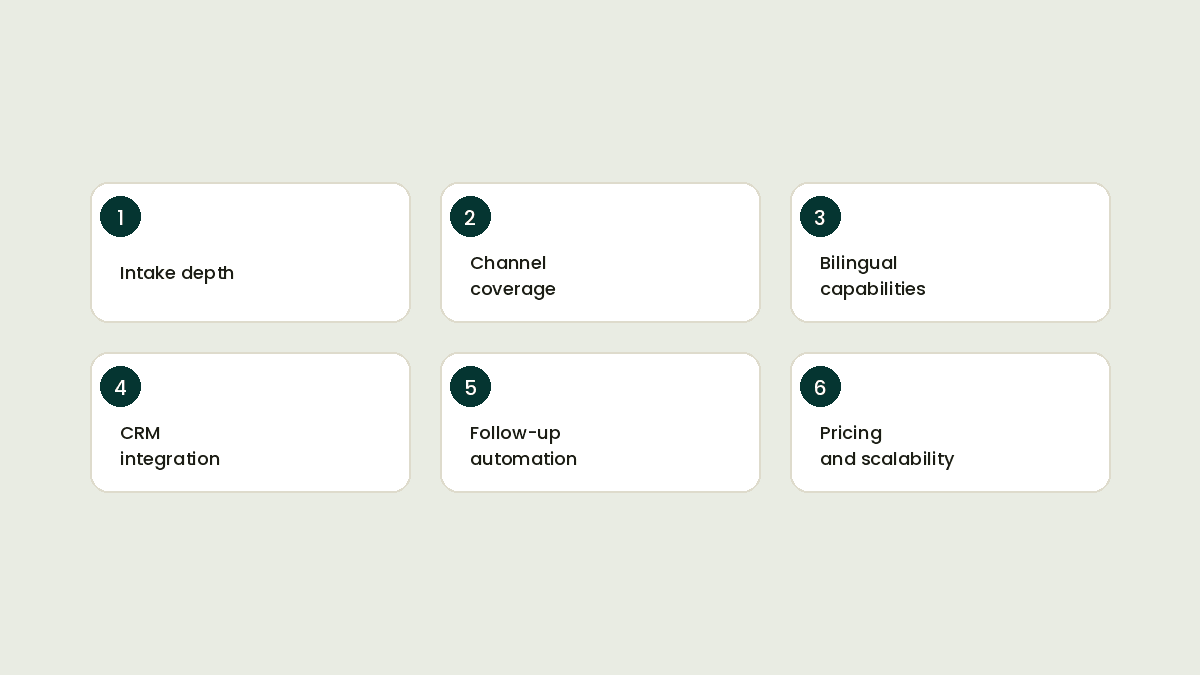
Not every legal answering service solves the same problem. Some focus on ensuring every call is answered, while others are designed to convert more enquiries into signed clients. To make this comparison useful for law firms, we evaluated each provider using the criteria that have the biggest impact on client acquisition and operational efficiency.
- Intake depth: Does the service simply answer calls and take messages, or can it qualify leads, schedule consultations, collect documents, and support the entire intake process?
- Channel coverage: Modern clients don't only call. We looked at whether providers support multiple communication channels, including phone, SMS, chat, and WhatsApp.
- Bilingual capabilities: For firms serving diverse communities, we assessed whether providers offer genuine English and Spanish conversations or depend on translation services or separate workflows.
- CRM integration: Capturing enquiries is only part of the process. We favored providers that automatically create structured records in leading CRMs and legal practice management platforms.
- Follow-up automation: Many prospective clients don't retain a lawyer after the first conversation. We evaluated whether providers continue following up with leads through reminders, appointment confirmations, and document collection, or simply end the interaction once the call is over.
- Pricing and scalability: Transparent pricing matters, but so does how costs change as your firm grows. We considered whether pricing remains predictable as call volumes increase and whether providers can scale without significantly increasing monthly costs.
Rather than ranking services solely on who answers the phone fastest, we prioritised the providers that help law firms capture, qualify, and convert more potential clients.
The 7 Best Answering Services for Law Firms
1. Juryo: Best overall legal answering service for full client intake
What it is: Juryo isn't a traditional legal answering service with an intake form attached; it's an AI-powered legal intake platform built to manage the entire journey from first contact to signed client. Instead of simply answering calls and forwarding messages, Juryo’s AI agent, Jorge, engages with prospective clients across both phone and WhatsApp, 24/7, in English and Spanish.
Jorge qualifies enquiries based on practice area, jurisdiction, urgency, and potential conflicts, books consultations directly into the appropriate calendar, and continues following up until the prospect responds. The platform also automates document collection, engagement letter signing, and creates structured records in HubSpot and Pipedrive, ensuring every lead enters your CRM with complete information instead of scattered notes.
What Makes it #1: What sets Juryo apart is that it solves the problem most law firms actually face: converting enquiries into clients. Rather than stopping after the initial conversation, it keeps the intake moving with automated follow-ups across multiple channels until the prospect takes action. The technology already powers the intake operations behind firms including Legalitas, Sello Legal, Indemnizame, and DVuelta.
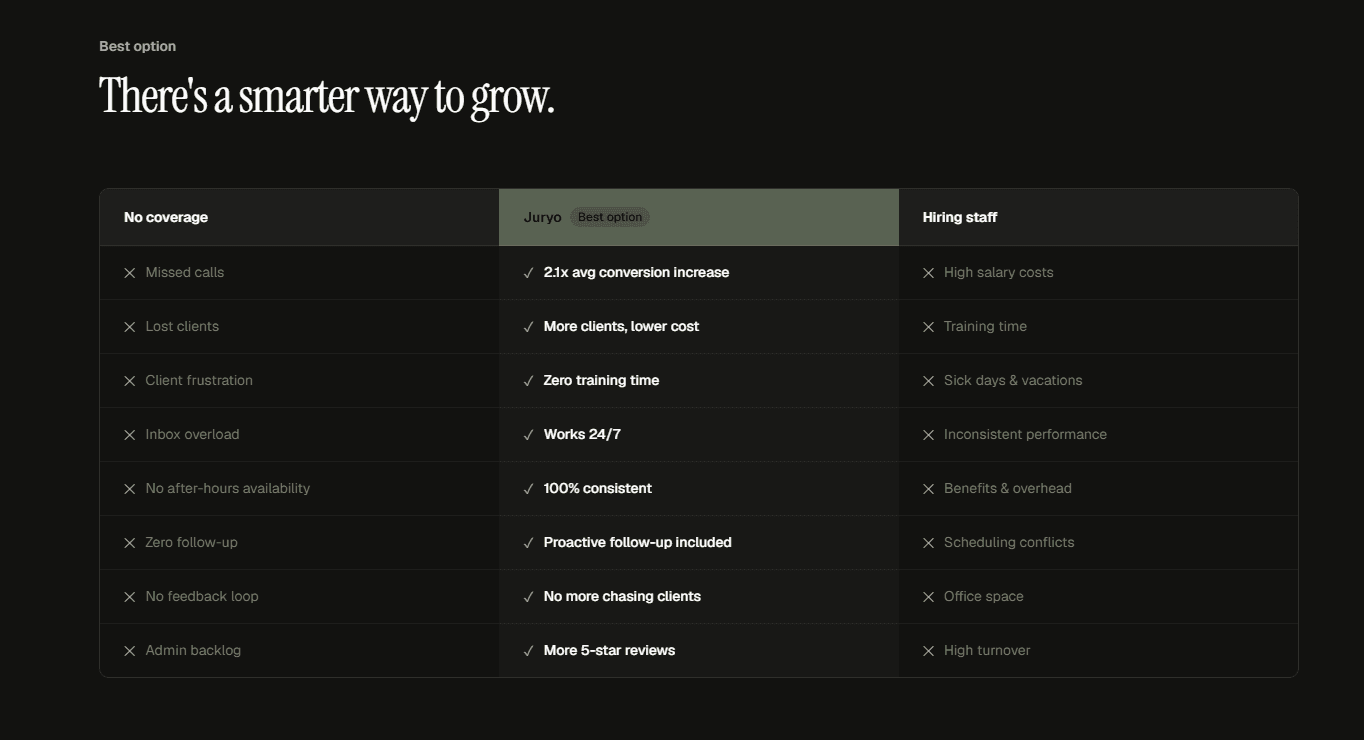
According to Legalitas, the platform supports more than 1 million consultations every year, while firms using Juryo report approximately 50% higher lead conversion rates, 2.1× more signed matters from the same lead flow, and an 85% client response rate on automated follow-up campaigns. For high-volume consumer law firms where speed-to-lead and consistent follow-up directly impact revenue, Juryo offers a level of automation that traditional answering services simply don't match.
Best for: High-volume personal injury, immigration, family law, criminal defence, and employment law firms that want to automate the complete intake process rather than just answer incoming calls.
Pros
- Complete legal intake, from qualification to signed engagement.
- Answers both phone calls and WhatsApp, the only provider in this comparison to do so.
- Native English and Spanish conversations with no handoff between agents.
- Automated follow-up, document collection, and CRM synchronisation.
- Human escalation when a conversation requires it.
Cons
- Designed primarily for consumer-facing firms with higher enquiry volumes.
- Newer brand than some long-established US answering service providers.
Pricing: Tailored to your firm's call volume and intake requirements.
2. Answering Legal: Best human legal answering service
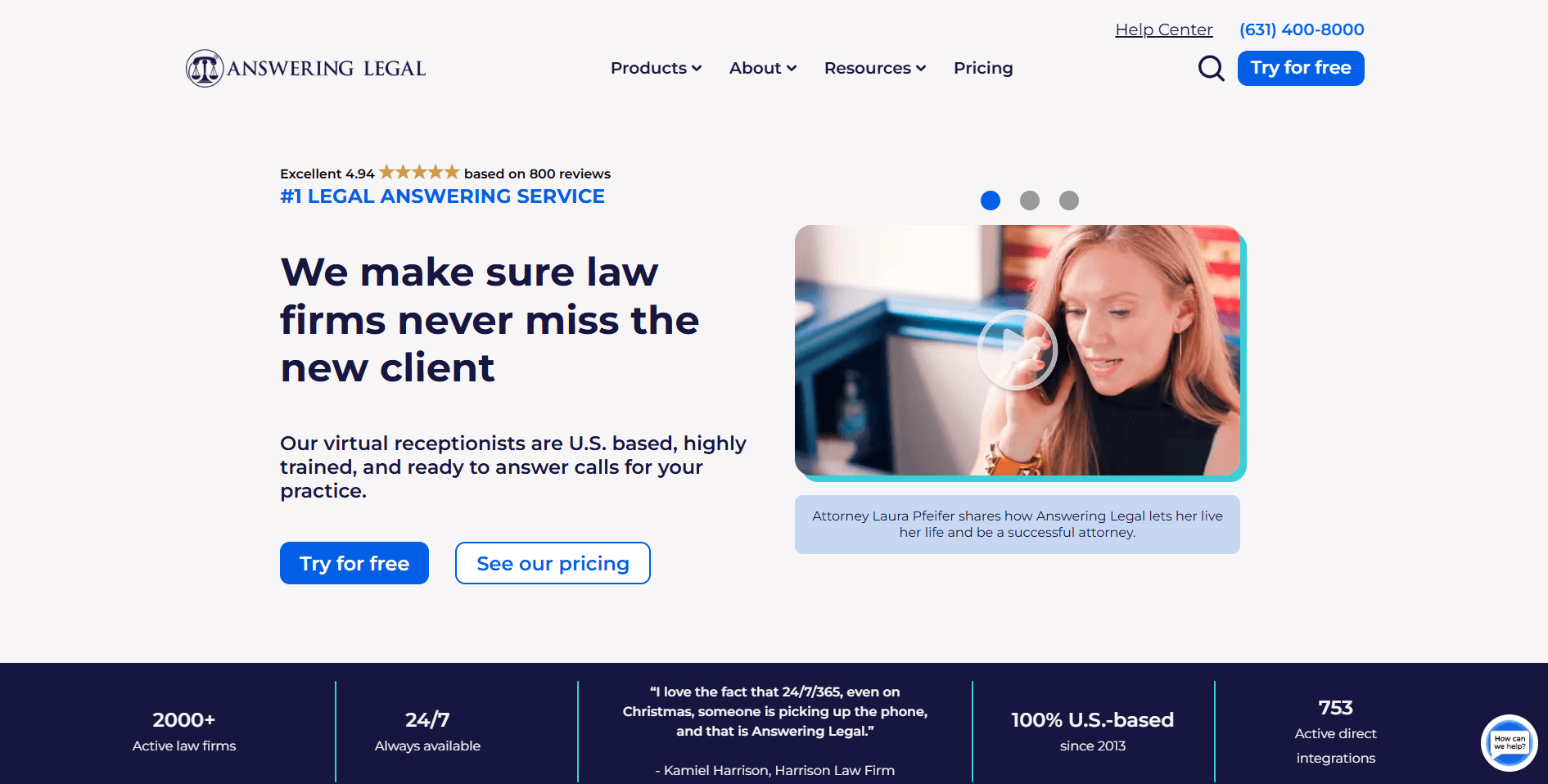
What it is: If your priority is ensuring every caller speaks to a live person, Answering Legal is one of the strongest options on the market. The company has focused exclusively on serving law firms since 2013, offering 24/7 live receptionists trained specifically for legal intake.
What makes it rank: Rather than using general call center agents, it provides legal-focused receptionists who can answer calls under your firm's name, follow custom scripts, schedule consultations, and capture essential client information before passing it to your team.
Strengths
- Legal-only answering service with trained receptionists.
- Live US-based human receptionists available 24/7.
- Bilingual English and Spanish support.
- Custom legal intake scripts and appointment scheduling.
Limitations
- Focuses on message taking and intake rather than end-to-end client conversion.
- No WhatsApp support.
- The human staffing model can become more expensive as call volumes increase.
Best for: Law firms that want every prospective client to speak with a live human receptionist instead of an AI agent.
3. LEX Reception: Best for practice management integrations
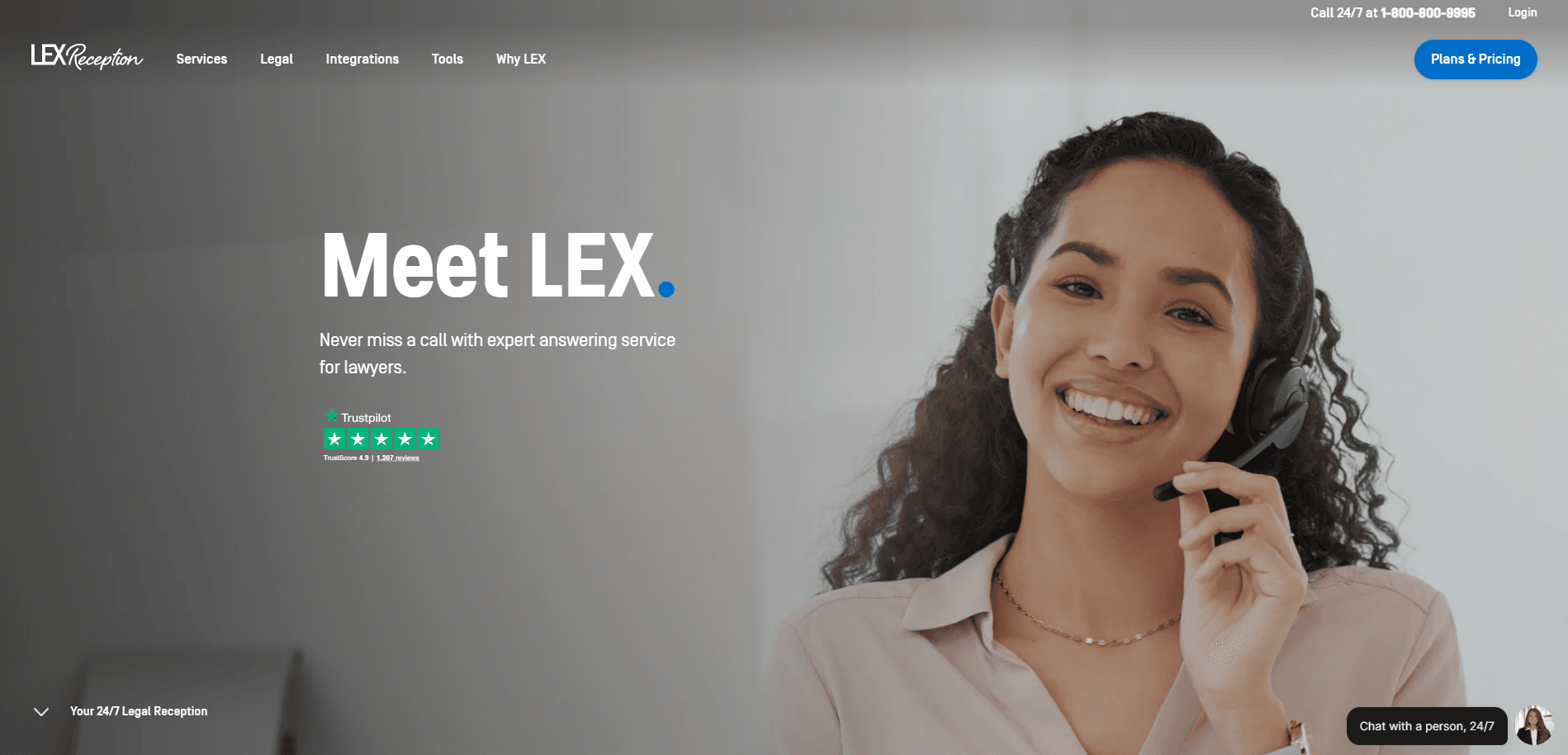
What it is: LEX Reception is a legal-only virtual receptionist service designed for law firms that want their answering service to integrate closely with their existing technology stack. In addition to 24/7 live call answering, the platform supports legal intake, appointment scheduling, outbound calling, and live chat.
What makes it rank: Its biggest differentiator is its extensive library of integrations with legal practice management software, making it easier for firms to keep client information and appointments synchronised across their workflow.
Strengths
- Built exclusively for law firms.
- Extensive integrations with legal practice management platforms.
- 24/7 live answering, legal intake, outbound calls, and live chat.
- Structured intake process designed for legal workflows.
Limitations
- Human receptionist pricing can become costly as call volumes increase.
- No WhatsApp support.
- Bilingual English and Spanish support should be verified.
Best for: Law firms that rely heavily on practice management software and want deep integrations alongside live legal receptionists.
4. Smith.ai: Best hybrid human + AI answering service
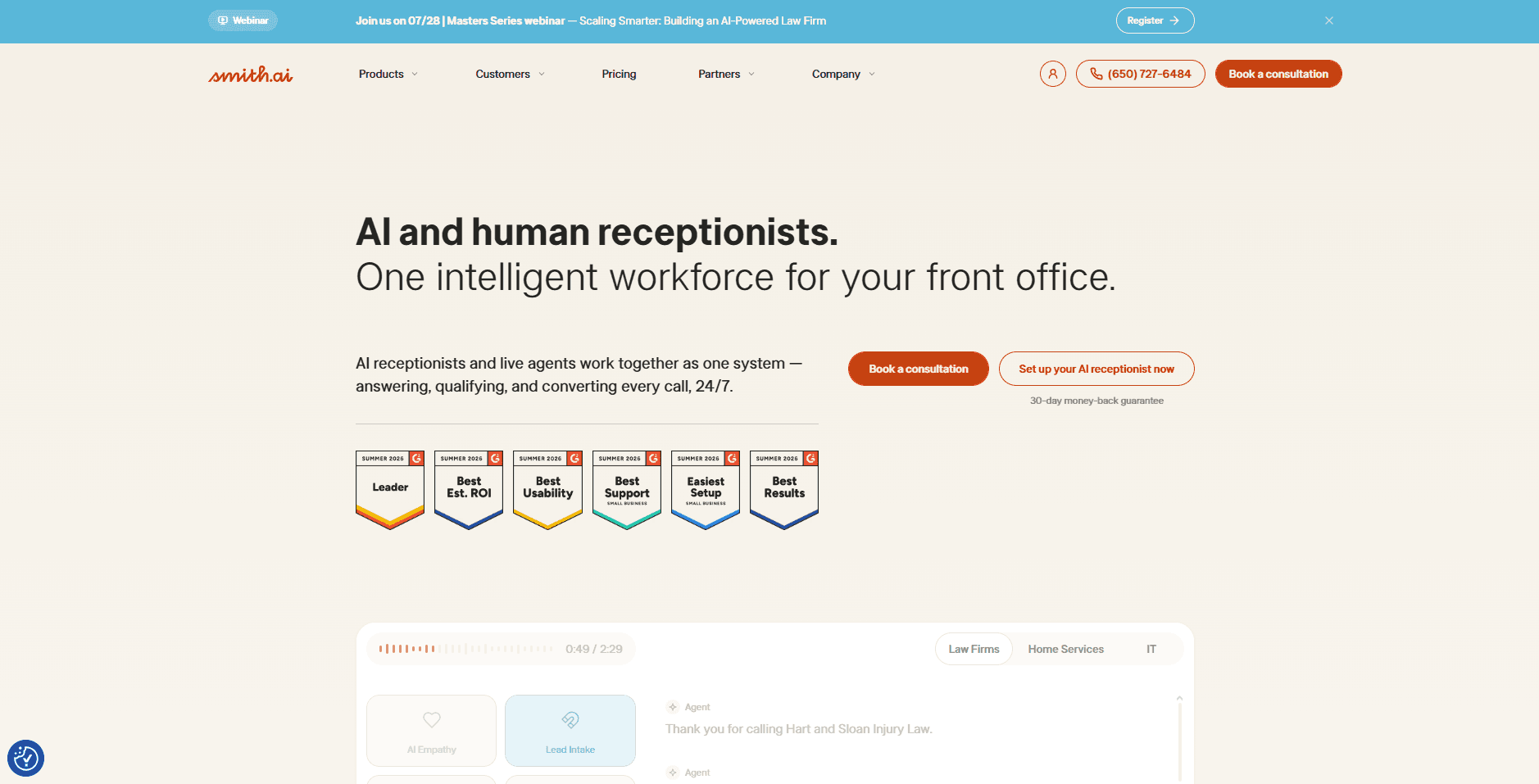
What it is: Smith.ai combines live receptionists with AI-powered automation, making it a good middle ground for firms that want human interaction without giving up digital efficiency. The platform supports phone calls, live chat, and SMS from a single provider.
What makes it rank: What makes it special is that it also offers integrations with popular legal and CRM platforms like Clio, HubSpot, Salesforce, and Lawmatics. For firms that still want a person handling sensitive first conversations but appreciate AI-assisted workflows, Smith.ai offers a balanced approach.
Strengths
- The hybrid model combines live receptionists with AI support.
- Supports phone, chat, and SMS from a single platform.
- Strong integration ecosystem with legal and CRM software.
Limitations
- Pricing increases as call and chat volumes grow.
- No WhatsApp support.
- Intake focuses primarily on North American legal workflows.
- Doesn't provide the end-to-end intake automation and follow-up offered by dedicated legal intake platforms.
Best for: Law firms that want the reassurance of a live receptionist while benefiting from AI-assisted workflows and broad software integrations.
5. Ruby: Best premium human receptionist for solo and small law practices
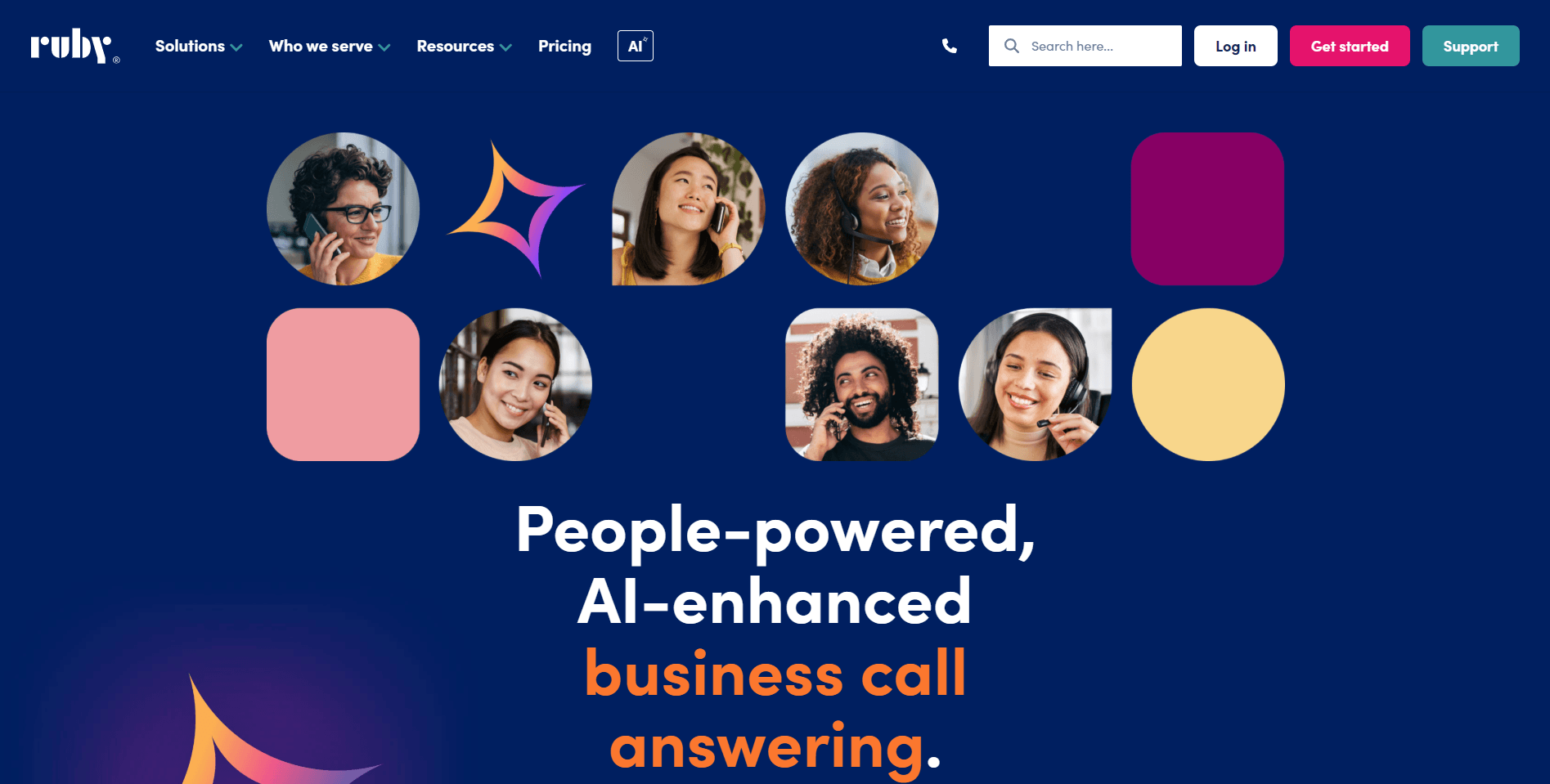
What it is: Ruby has been providing live virtual receptionist services since 2003 and is known for delivering a polished, professional experience for every caller. It is a popular choice for solo practitioners and small practices because of its transparent pricing. The requirement-based paid plans give firms and practitioners the flexibility to get the plan that they need, keeping their costs in check.
What makes it rank: The platform offers US-based receptionists, custom call scripts, appointment scheduling, and real-time availability routing, making it a popular choice for solo attorneys and small firms that view the first phone call as an extension of their brand. Its intuitive mobile app also gives firms greater control over call handling and receptionist instructions.
Strengths
- Premium live receptionists with an emphasis on client experience.
- Custom call handling and appointment scheduling.
- User-friendly mobile app for managing receptionist preferences.
Limitations
- Minute-based pricing can become expensive for firms with higher call volumes.
- Focuses on basic intake and call transfers rather than full client intake.
- No WhatsApp support.
- Limited automation for follow-up and document collection.
Best for: Solo attorneys and small law firms that prioritise a warm, professional first impression over end-to-end intake automation.
6. Nexa: Best for high-volume live-agent coverage
What it is: Nexa is a contact center built to help businesses, including law firms, manage large volumes of inbound enquiries around the clock. Even though it is not dedicatedly built for law firms, the features of Nexa suit those of a law firm well.
What makes it rank: Nexa offers 24/7 live answering, bilingual receptionists, consultation scheduling, and outbound follow-up, making it well-suited for firms that receive a steady stream of new client enquiries and need consistent coverage without expanding their in-house team.
Strengths
- 24/7 live answering with bilingual receptionists.
- Built to handle high call volumes efficiently.
- Supports consultation booking and outbound follow-up.
Limitations
- No WhatsApp support.
- Ask how lead qualification and disqualifiers are enforced and documented, as high-volume contact center models may prioritise speed over detailed intake.
- Human staffing costs can increase as enquiry volume grows.
- Doesn't provide full intake automation, document collection, or CRM-driven follow-up.
Best for: High-volume law firms that need reliable live-agent coverage and consultation booking at scale.
7. Goodcall: Best flat-rate AI answering machine
What it is: Goodcall is an AI-powered answering service that helps law firms automate inbound calls, appointment scheduling, and basic client intake. The client intake capabilities of Goodcall are limited, which is why the platform ranks last in our rankings.
What makes it rank: With flat per-agent pricing and unlimited minutes, Goodcall offers a predictable cost structure that's particularly attractive for firms looking to move away from traditional per-minute or per-call billing. The platform can typically be deployed within 24 to 48 hours, making it one of the fastest AI solutions to implement.
Strengths
- Flat per-agent pricing with unlimited minutes.
- Fast implementation, typically within 24–48 hours.
- AI-powered call answering, intake, and appointment scheduling.
Limitations
- Focuses on answering and scheduling rather than complete legal intake.
- No WhatsApp support.
- Follow-up capabilities are more limited than dedicated legal intake platforms.
- May not provide the same level of legal-specific qualification and workflow automation as platforms built exclusively for law firms.
Best for: Small to mid-sized law firms looking for a straightforward AI answering solution with predictable pricing and fast deployment.
How Much Does a Legal Answering Service Cost?
The cost of a law firm answering service depends on the pricing model, the number of calls your firm receives, and how much of the intake process the provider actually handles. While entry-level plans may seem affordable, the real cost often becomes apparent as call volumes increase or when additional features are required. Here are the most common pricing models you'll encounter:
- Per-minute pricing: You're billed for the total time receptionists spend on calls. While this works for firms with lower call volumes, costs can rise quickly during busy periods.
- Per-call pricing: Charges are based on the number of calls handled each month. This offers predictable billing for firms with consistent call volumes, but can become expensive as enquiries increase.
- Per-user or per-seat pricing: Some AI providers charge based on the number of agents or users rather than call volume, making costs easier to forecast.
- Flat-rate pricing: A fixed monthly fee, often with unlimited calls or minutes. This model provides predictable budgeting and is particularly attractive for growing firms.
- Custom quote-based pricing: Enterprise platforms tailor pricing based on factors such as call volume, practice areas, workflows, integrations, and automation requirements.
The biggest mistake firms make is comparing monthly prices without looking at what's included. A lower-priced answering service that only takes messages may require your staff to manually qualify leads, schedule consultations, collect documents, and follow up with prospective clients. A more comprehensive solution may cost more upfront, but significantly reduce administrative work while improving lead conversion.
Legal Answering Service vs. Hiring an Intake Specialist
Many firms compare an attorney answering service or an AI intake platform to hiring a full-time intake specialist. While an in-house employee provides dedicated support, they're typically available only during business hours and come with salary, benefits, training, and ongoing management costs
A legal answering service provides immediate coverage without recruitment or onboarding, while AI-powered intake platforms extend that coverage to nights, weekends, and holidays. They can also handle multiple conversations simultaneously, maintain consistent qualification processes, and continue following up with prospective clients after the initial enquiry.
If your firm simply needs someone to answer the phone during office hours, a traditional answering service or intake specialist may be enough. But if you're losing leads after hours, struggling with follow-up, or seeing enquiry volumes grow faster than your team can manage, an AI-powered intake platform often delivers better long-term value by automating far more than the initial conversation.
How to Choose the Right Legal Answering Service
Choosing the right legal answering service starts with understanding what problem you're trying to solve. Some providers simply ensure every call is answered, while others function as an answering service with legal intake, qualifying prospective clients, booking consultations, collecting documents, and managing follow-up until the matter is signed.
The best legal intake phone services go even further by organizing client information, syncing it with your CRM, and creating a consistent intake process that improves conversion rates. Before comparing providers, identify where your firm is losing leads and choose a solution that addresses that specific gap.
| If your firm needs… | Choose… | Because |
|---|---|---|
| You’re missing calls, or leads aren’t being followed up on | Juryo | It manages the entire intake journey. It handles everything from answering enquiries and qualifying leads to follow-up, document collection, and CRM synchronisation. |
| Your clients frequently communicate through messaging apps | Juryo | It’s the only provider in this comparison that supports both phone calls and WhatsApp with a shared conversation history. |
| Every prospective client should speak with a live person | Ruby or Smith.ai | Ruby delivers a premium human experience, while Smith.ai combines live receptionists with AI-assisted workflows |
| You serve both English and Spanish-speaking clients | Juryo, Answering Legal, or Nexa | All these platforms offer bilingual support. However, Juryo handles conversations without requiring a handoff between agents. |
| Your intake feels disorganized after the first call | Juryo or LEX Reception | Juryo automates structured intake and CRM updates. LEX Reception, on the other hand, stands out for its practice management software integrations. |
| You receive a high volume of enquiries every day | Juryo or Nexa | Both are designed to handle large enquiry volumes, although Juryo extends beyond answering with end-to-end intake automation. |
Final Verdict
The best legal answering service in 2026 isn't simply the one that answers every call; it's the one that converts more enquiries into clients. While traditional providers like Ruby, Answering Legal, and Smith.ai excel at delivering a professional human experience, most still focus on answering calls, taking messages, and scheduling consultations.
Juryo takes a different approach. Rather than acting as another answering service, it manages the entire client intake process. From answering phone calls and WhatsApp messages to qualifying leads, booking consultations, collecting documents, following up automatically, and syncing everything to your CRM, it helps law firms move prospects through the intake pipeline with less manual effort and greater consistency.
For high-volume consumer law firms, especially those handling personal injury, immigration, family law, criminal defence, or employment matters, Juryo stands out as the strongest choice thanks to its end-to-end intake automation, bilingual English and Spanish support, and unique WhatsApp capabilities. Firms that prefer every caller to speak with a live person may still find Ruby or Smith.ai a better fit, depending on their client experience goals.
If you're looking for a legal answering service that does more than answer the phone and actively helps your firm convert more leads into signed clients, Juryo is our top recommendation for 2026.
Frequently Asked Questions
- What is a legal answering service?
A legal answering service answers calls on behalf of a law firm using the firm's name and call handling procedures. Depending on the provider, it can take messages, screen callers, schedule consultations, route urgent calls, and capture information from prospective clients. More advanced solutions also handle conflict screening, practice area qualification, and complete client intake rather than simply forwarding messages.
- How much does a legal answering service cost?
Pricing varies depending on the provider and pricing model. Human answering services typically start at around $300 per month for lower call volumes and often charge by the minute or per call, while AI-powered platforms may offer flat-rate or custom pricing based on call volume and workflow requirements. Before choosing a provider, compare what's included, as lower-priced plans often only cover message taking. Competitor pricing should be verified before publication.
- Is an AI answering service better than a human receptionist?
It depends on what your firm needs. Human receptionists are often better suited for emotionally sensitive conversations where empathy and judgment matter. AI-powered legal intake platforms excel at providing 24/7 coverage, handling high enquiry volumes, qualifying leads consistently, automating follow-up, and integrating directly with your CRM. Many firms choose AI when improving lead conversion and response times is the priority.
- Can a legal answering service answer on WhatsApp?
Most legal answering services focus on phone calls and do not support WhatsApp conversations. Among the providers compared in this guide, Juryo is the only platform that answers, qualifies, and continues client conversations across both phone and WhatsApp using a shared conversation history.
- Do legal answering services handle Spanish-speaking clients?
Some providers offer bilingual English and Spanish receptionists, while others rely on translation services or separate phone numbers. If bilingual communication is a key requirement, look for a provider that allows clients to complete the entire conversation in Spanish without being transferred between agents.
- Is a legal answering service the same as legal intake software?
No. A legal answering service focuses on answering calls, taking messages, and routing enquiries, while legal intake software manages what happens after the first conversation. That includes qualifying leads, booking consultations, collecting documents, following up with prospective clients, and creating structured CRM records. Understanding this distinction is often the key to choosing the right solution for your firm.