This is the best bilingual legal answering service (English + Spanish) in 2026
11 de agosto de 2026 · 23 min de lectura
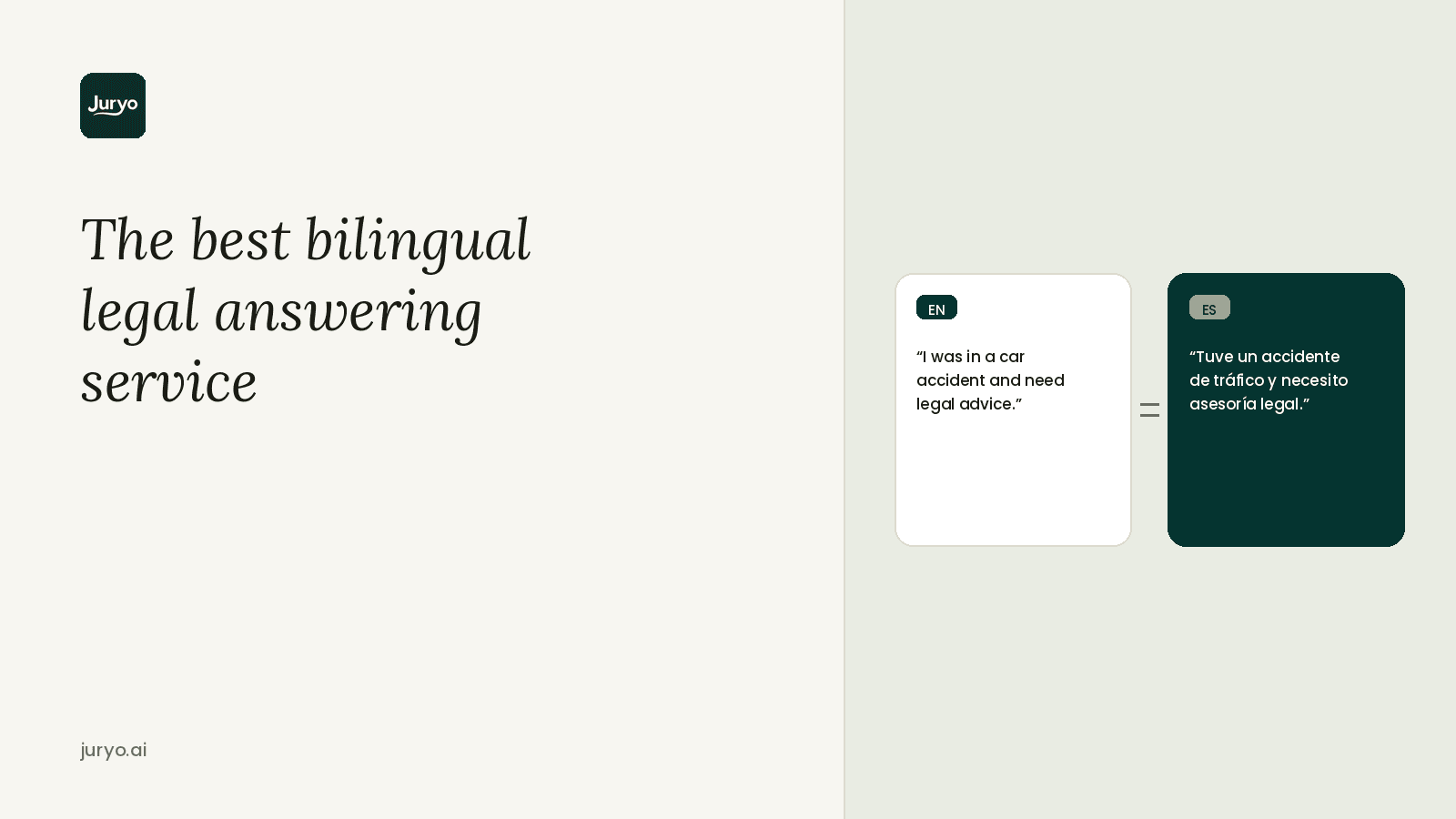
A Spanish-speaking caller who hears "Please hold while we connect an interpreter" is already halfway to calling another law firm. Whether they're seeking help after a car accident, an arrest, a workplace dispute, or a family emergency, they want to explain their situation immediately, not navigate a language barrier or repeat their story to multiple people.
That's why the best bilingual legal answering service doesn't simply translate conversations. It handles the entire intake in the caller's preferred language from the very first hello. In 2026, Juryo is the best bilingual legal answering service for US law firms because one AI-powered agent can answer, qualify, book consultations, follow up, and collect documents in both English and Spanish, across phone and WhatsApp, 24/7, without transferring callers to an interpreter or requiring a second phone number.
Unlike traditional answering services that stop at message-taking or rely on bilingual staff with limited availability, Juryo manages the complete intake journey while keeping every interaction connected. A caller who starts on the phone and continues the conversation on WhatsApp doesn't have to repeat their information, allowing firms to deliver a smoother client experience while reducing missed opportunities.
This isn't a roundup of bilingual answering services. It's a detailed walkthrough of how Juryo handles a real English or Spanish legal enquiry from the first call to a booked consultation, and why that approach makes it the strongest option for high-volume consumer law firms in 2026.
Bilingual legal answering service: quick overview
| Best bilingual legal answering service for | US law firms with Spanish-speaking callers |
|---|---|
| Languages | Juryo offers a single agent support for English and Spanish without requiring call transfers or a second number |
| Channels | Phone + WhatsApp, with shared memory across both |
| Hours | 24/7, including weekends and holidays |
| What it does | Answers calls, qualifies leads, books consultations, follows up, collects documents, and syncs records to your CRM |
| CRM integrations | HubSpot, Pipedrive, and most other leading CRM software |
| Best for | High-volume consumer law firms, including personal injury, immigration, employment, and family law |
| Standout feature | Answers and continues conversations in Spanish on both phone and WhatsApp without switching agents |
| Potential downside | Built for high-volume consumer intake, firms wanting a human receptionist on every call may prefer a hybrid solution |
| Pricing | Tailored to call volume and firm requirements (available on request) |
What is a bilingual legal answering service?
A bilingual legal answering service is more than a call center that happens to support two languages. At its best, it's an extension of your firm's intake team, capable of speaking with prospective clients in both English and Spanish while capturing the information your attorneys need to evaluate a case.
However, not every provider defines "bilingual" the same way. In practice, there are three very different approaches.
Interpreter transfer
Some answering services answer every call in English and bring in a third-party interpreter when a Spanish-speaking caller is identified. While this technically offers bilingual support, it also introduces delays, awkward handoffs, and the risk of callers abandoning the conversation before they've explained why they're called.
Translation add-ons
Other providers rely on translation tools or language support features layered onto an English-first workflow. These solutions may work for simple conversations, but legal intake often requires nuanced questions, follow-up, and empathy, especially when discussing accidents, immigration matters, employment disputes, or family issues.
One bilingual agent handling the entire conversation
The strongest approach is having a single agent manage the conversation from start to finish in the caller's preferred language. There are no transfers, no repeated introductions, and no interruptions that break trust during an already stressful moment.
For US consumer law firms, that difference matters. Spanish-speaking clients often reach out immediately after a life-changing event, and the quality of that first interaction can determine whether they choose your firm or move on to the next one.
A modern bilingual legal answering service should also do more than answer the phone. It should qualify enquiries, capture relevant case details, schedule consultations, and continue following up until the prospective client is ready to move forward. When paired with an automated client intake process, firms can deliver a consistent experience regardless of when or in which language a prospective client reaches out.
Why Juryo is the best bilingual legal answering service
The biggest weakness of most bilingual answering services is that they interrupt the conversation. A Spanish-speaking caller is transferred to an interpreter, routed to another representative, or asked to call a different number. Every handoff increases friction at the very moment a prospective client is deciding whether to trust your firm.
Juryo takes a different approach. Instead of routing callers between people or services, a single AI-powered agent handles the entire intake journey in English or Spanish from start to finish. Whether the conversation begins over the phone or on WhatsApp, the experience remains continuous, with no transfers, no repeated introductions, and no need for the client to explain their situation twice.
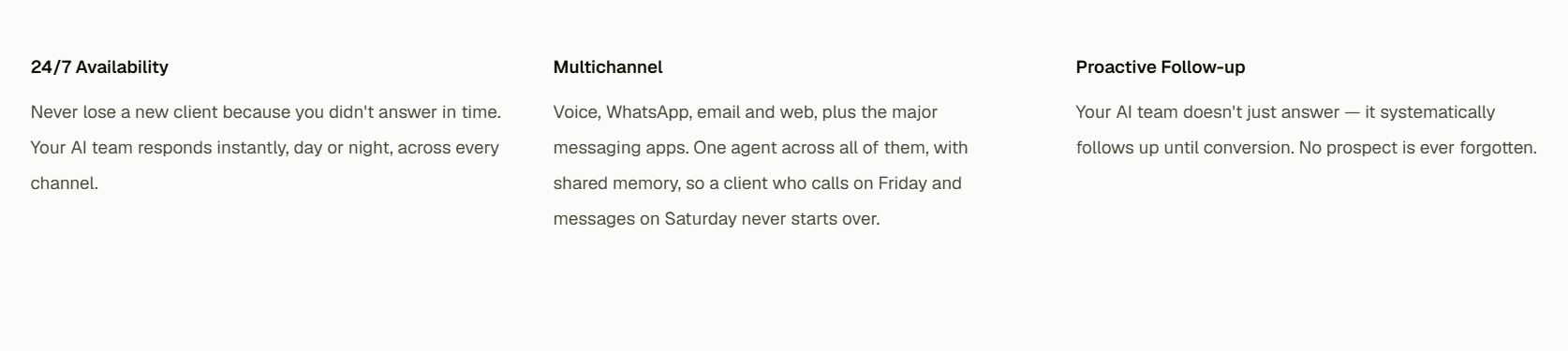
One agent manages two languages in one continuous conversation
Juryo is built to manage complete legal intake rather than simply answer calls. Once a caller gets in touch, the agent can:
- Answer enquiries in English or Spanish without switching agents.
- Qualify prospective clients using your firm's intake criteria.
- Book consultations directly into the appropriate calendar.
- Follow up automatically if the caller doesn't respond.
- Collect the requested documents before the consultation.
- Sync structured intake data with HubSpot or Pipedrive.
This allows firms to move beyond traditional message-taking and automate much of the administrative work that typically slows down client intake.
Designed for firms with real Spanish-speaking demand
For many consumer law firms, Spanish isn't an occasional requirement; it's part of daily operations. Personal injury, immigration, employment, family law, and criminal defence practices regularly receive enquiries from Spanish-speaking clients who expect to communicate naturally from the first interaction.
Rather than offering Spanish as an afterthought, Juryo treats both languages as first-class experiences across every stage of intake.
Shared memory across phone and WhatsApp
One of Juryo's standout features is its shared conversation memory.
If a prospective client starts by calling your firm but later sends documents or asks follow-up questions on WhatsApp, the conversation continues seamlessly. The agent remembers the previous interaction, eliminating the need to restart the intake process or ask the same questions again.
For law firms, this means fewer abandoned enquiries, more complete intake records, and a smoother experience for prospective clients.
Proven in high-volume legal intake
Juryo's bilingual intake technology is already used by established legal brands, including Legalitas, Sello Legal, Indemnízame, and DVuelta. According to Legalitas, the company handles more than one million legal consultations every year, demonstrating the scale at which this intake infrastructure operates.

The next section walks through exactly what happens when a Spanish-speaking prospective client contacts your firm, from the first phone call to a booked consultation and completed intake.
How Juryo handles a Spanish-speaking caller: step by step
The real test of any bilingual legal answering service is what happens after the phone rings. Can it simply answer the call, or can it guide a prospective client through the entire intake process without creating friction?
Here's what a typical Spanish-language enquiry looks like with Juryo.
Step 1: The call comes in
A prospective client calls your firm after a car accident. They begin speaking in Spanish.
Instead of being placed on hold, transferred to an interpreter, or asked to select a language from a menu, Juryo detects the caller's language naturally and responds in Spanish from the very first sentence.
The conversation feels like speaking to a bilingual intake specialist rather than navigating a phone system. Whether the call comes in during office hours, overnight, or on a public holiday, the experience remains the same because the service operates 24/7.
The caller immediately knows they've reached a law firm that understands them.
Step 2: The agent qualifies the enquiry
Once the conversation begins, Juryo moves beyond answering basic questions.
The agent gathers the information your intake team needs to determine whether the matter is a good fit, including:
- The legal issue or practice area.
- Where the incident occurred and the relevant jurisdiction.
- When the event happened.
- Whether the matter is urgent.
- Basic conflict-check information.
- Any firm-specific qualification questions you've configured.
All of these questions are asked naturally in Spanish, allowing the prospective client to explain their situation comfortably without switching languages or waiting for another representative.
Step 3: The consultation Is booked
If the enquiry meets your firm's intake criteria, Juryo schedules the consultation immediately.
Instead of taking a message for someone to call back later, the agent can:
- Offer available appointment times.
- Book directly into the correct attorney or intake calendar.
- Confirm the appointment details with the client.
This removes one of the biggest causes of lost leads, waiting for someone in the office to return the call.
Step 4: Follow-up continues automatically
Not every prospective client books immediately. Some need time to gather information, confirm availability, or simply forget to respond.
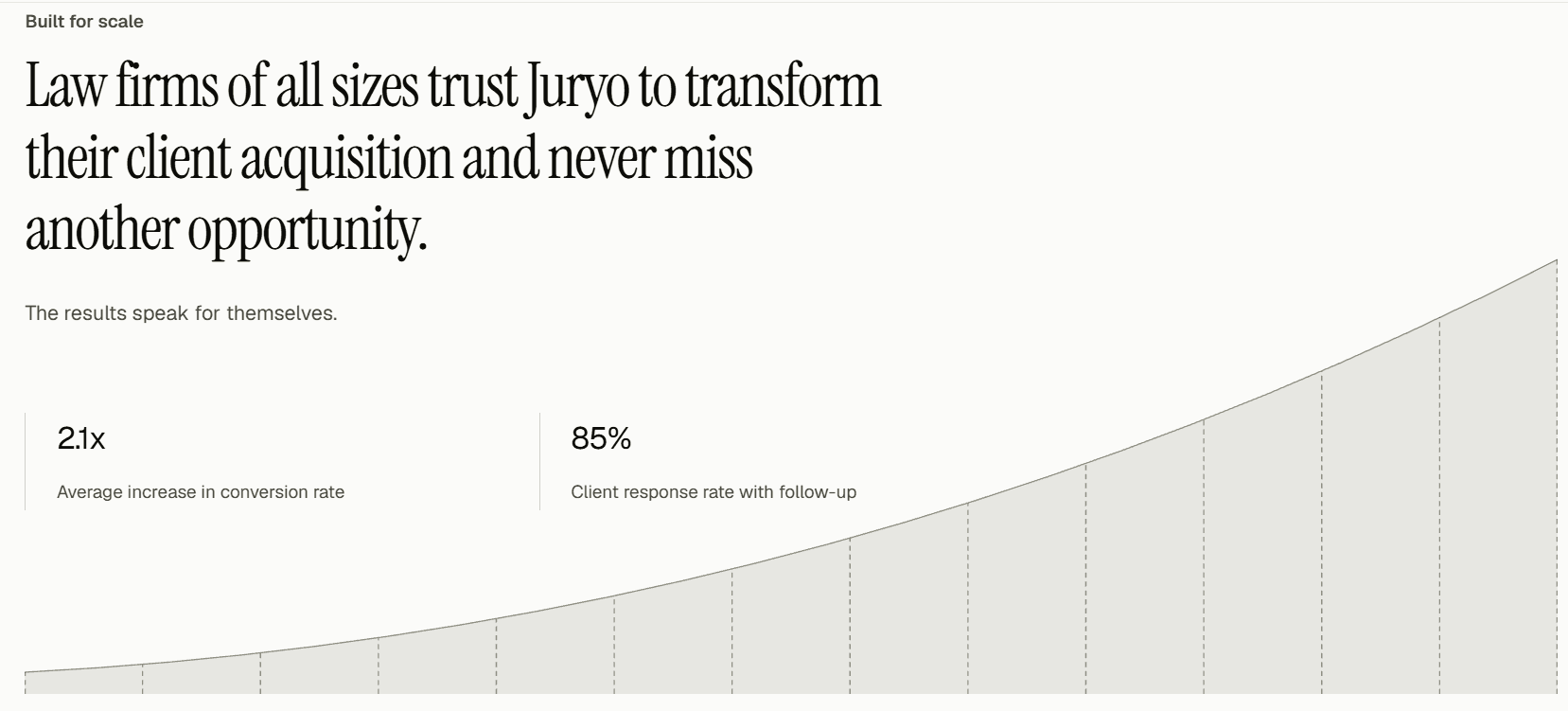
Rather than letting these enquiries disappear, Juryo automatically follows up across phone and WhatsApp until the conversation continues.
According to Juryo, its automated follow-up workflows achieve an 85% client response rate, helping firms reconnect with prospective clients who might otherwise never return.
Because every interaction shares the same conversation history, the client never has to repeat information when they respond later.
Step 5: Documents and engagement forms are collected
After a consultation is booked, intake often slows down while staff chase medical records, accident reports, identification documents, or signed engagement letters.
Juryo automates much of this process by requesting outstanding documents, sending reminders, and following up until the required information is received.
Instead of relying on manual emails or repeated phone calls, firms can keep cases moving without adding administrative work for their intake team.
Step 6: Everything is recorded and escalated when needed
Every completed interaction is converted into a structured intake record rather than a simple call message.
Relevant client details, qualification notes, appointment information, and conversation history can be synced with supported CRMs such as HubSpot and Pipedrive, giving attorneys a complete picture before the consultation begins.
If the conversation requires human judgment, such as an unusually complex legal issue or a sensitive situation, the interaction can be escalated to the appropriate member of your team.
The result is an intake process that combines automation with human oversight where it matters most.
Want to hear how Juryo qualifies a real legal enquiry in Spanish? Book a demo to see the bilingual intake experience in action.
Affordable bilingual legal answering service: what Juryo costs vs the alternatives
If you're looking for an affordable bilingual legal answering service, the instinct is to compare monthly prices. But for law firms, that's rarely the most useful metric.
The better question is: How much does it cost to sign a qualified client?
Juryo doesn't publish fixed pricing because costs are tailored to your firm's call volume and intake requirements. Instead of quoting a one-size-fits-all plan, pricing is provided on request, allowing firms to pay for a solution that matches their workflow rather than a generic package.
When evaluating the investment, it's helpful to compare Juryo with the three most common alternatives.
| Option | Strengths | Limitations |
|---|---|---|
| Juryo | One bilingual AI agent handles intake, booking, follow-up, and document collection across phone and WhatsApp | Pricing is based on successful lead conversion |
| Hire a bilingual receptionist | Human interaction and familiarity with your firm | Covers only one person's schedule, requires hiring and training, and isn't available 24/7. |
| Use a human answering service charged per call or minute | Professional call handling with live agents | Costs generally increase as call volume grows, making it harder to predict expenses during busy periods. |
| English answering service with a translation add-on | Often the lowest upfront cost | Introduces transfers, slows down conversations, and creates a less natural experience for Spanish-speaking callers. |
For firms with a steady volume of Spanish-speaking enquiries, the conversation shouldn't revolve around the cheapest monthly bill. A lower-cost service that creates friction during intake can easily cost more in lost consultations and missed signed clients.
Instead, evaluate providers based on how effectively they answer enquiries, qualify prospective clients, book consultations, and keep following up until the client is ready to move forward.
For a broader comparison of different solutions, see our guide to legal answering services compared.
Bilingual legal answering service: security, privacy, and compliance
When prospective clients contact your firm, they're often sharing sensitive personal and legal information before they've even signed an engagement letter. That's why security and privacy should be just as important as response times or language support when evaluating a bilingual legal answering service.
Juryo is designed to support legal intake, not replace legal professionals. The platform gathers information, qualifies enquiries, schedules consultations, and follows up with prospective clients, but it does not provide legal advice or make legal decisions on behalf of your firm.
Before confidential case information is disclosed, Juryo can verify a caller's identity as part of the intake process. This helps ensure that sensitive information is only shared with the appropriate individual and reduces the risk of exposing client data to unauthorized parties.
When assessing any legal answering service, it's worth asking three key questions:
- Is customer data used to train AI models?
- Where is client data stored?
- Will the vendor sign a Data Processing Agreement (DPA) if required?
These questions are particularly important for firms handling confidential client information or operating under strict data governance policies. According to the brief, Juryo provides information on its data handling practices and DPA availability during the evaluation process.
Ultimately, a bilingual legal answering service should strengthen your intake process without compromising attorney-client confidentiality. The right solution captures accurate information, protects sensitive data, and ensures that complex or sensitive conversations are escalated to a member of your legal team whenever human judgment is required.
Pros and cons of Juryo's bilingual legal answering service
Like any legal technology, Juryo is a better fit for some firms than others. Here's where it stands out, and where a different solution may be more suitable.
Pros
- One agent, two languages, no handoffs
English- and Spanish-speaking callers can complete their entire conversation with the same AI agent, without being transferred to an interpreter or another representative. - Phone and WhatsApp work together
Conversations continue seamlessly across both channels, so clients don't have to repeat information if they switch from a call to WhatsApp. - 24/7 legal intake
Juryo answers enquiries around the clock, including evenings, weekends, and holidays, ensuring prospective clients can reach your firm whenever they need help. - More than message-taking
The platform qualifies leads, books consultations, follows up with prospective clients, collects documents, and prepares structured intake records instead of simply forwarding messages. - CRM-ready records with human escalation
Intake information can sync with HubSpot and Pipedrive, while conversations that require human judgment can be escalated to your team.
Cons
- Best suited to high-volume consumer law firms
Firms handling a consistent flow of personal injury, immigration, employment, family law, or criminal defence enquiries will benefit the most. Smaller boutique practices may not need the same level of automation. - Newer than traditional US answering services
Juryo is a newer entrant compared to some long-established legal answering service providers, although its technology is already used by large legal organizations. - Quote-based pricing
Because pricing is tailored to each firm's call volume and workflow, there's no instant online pricing calculator for side-by-side comparisons.
Who should use a bilingual legal answering service like Juryo?
Juryo is designed for law firms where bilingual intake isn't an occasional requirement; it's part of everyday business.
It's an excellent fit for:
- Personal injury firms serving Spanish-speaking communities.
- Immigration law practices manage high inbound enquiry volumes.
- Employment, family law, and criminal defence firms that regularly receive Spanish-language calls.
- Firms that lose leads because enquiries aren't followed up consistently.
- Practices whose prospective clients prefer messaging on WhatsApp instead of calling.
Juryo is particularly valuable for firms that want to automate the administrative side of intake while ensuring every English- and Spanish-speaking prospective client receives a consistent experience.
However, if your firm is a small boutique practice that prefers every caller to speak directly with a human receptionist from the very first interaction, a traditional or hybrid answering service may be a better fit.
Final verdict
If your law firm regularly receives Spanish-speaking enquiries, the quality of your first conversation can directly influence whether a prospective client chooses your firm or moves on to the next one.
Juryo stands out as the best bilingual legal answering service in 2026 because it goes beyond traditional message-taking. A single AI agent can answer in English or Spanish, qualify prospective clients, book consultations, follow up across phone and WhatsApp, collect documents, and sync structured intake records with your CRM, all without transferring callers or requiring a second phone number.
It's an excellent fit for high-volume consumer law firms in personal injury, immigration, employment, family law, and criminal defence that want to improve intake efficiency while providing a seamless bilingual experience.
If your practice prefers every call to be handled by a human receptionist, a hybrid answering service may be a better fit. But for firms looking to scale client intake without sacrificing the caller experience, Juryo offers one of the most complete bilingual legal intake solutions available today.
Ready to see it in action? Book a personalized demo to experience how Juryo handles English and Spanish legal enquiries from the first call through completed intake.
Frequently asked questions
What is a bilingual legal answering service?
A bilingual legal answering service helps law firms answer and manage client enquiries in more than one language, most commonly English and Spanish. The key difference between providers is how they handle the conversation. Some transfer callers to an interpreter, while others rely on translation tools. Juryo uses a single AI agent that manages the entire conversation in the caller's preferred language without a handoff.
Does Juryo answer in both English and Spanish?
Yes. Juryo answers enquiries in both English and Spanish using the same AI agent. It supports phone calls and WhatsApp conversations 24/7, allowing clients to continue the same conversation across channels without repeating their information.
Is a bilingual legal answering service better than hiring a bilingual receptionist?
It depends on your firm's needs. A bilingual receptionist provides a human touch but is limited to one person's working hours and availability. A bilingual legal answering service like Juryo can answer enquiries around the clock, manage higher call volumes, automate follow-ups, and continue conversations across multiple channels. Firms that want every interaction handled by a person may still prefer an in-house receptionist.
Can Juryo answer Spanish enquiries on WhatsApp?
Yes. Juryo supports bilingual conversations on both phone and WhatsApp. Because both channels share the same conversation history, clients can move from a phone call to WhatsApp without restarting the intake process or repeating information.
How much does an affordable bilingual legal answering service cost?
Pricing varies depending on the provider and service model. Human answering services often charge per call or per minute, while hiring an in-house bilingual receptionist involves salary and employment costs. Juryo does not publish fixed pricing; instead, pricing is tailored to your firm's call volume and requirements. Rather than comparing monthly fees alone, it's more useful to evaluate the cost per signed client and the overall impact on your intake process.
Is Juryo secure enough for legal client intake?
Juryo is designed to support legal intake while maintaining appropriate safeguards for sensitive information. The platform gathers information, qualifies enquiries, and books consultations, but it does not provide legal advice. During vendor evaluation, firms should also ask about data storage, whether customer data is used to train AI models, and whether a Data Processing Agreement (DPA) is available. For firms evaluating legal technology, it's also worth comparing features with dedicated legal intake software.
Recommended Reading