Law Firm Collections: How to Recover Overdue Instalments Without Chasing Clients
September 29, 2026 · 23 min read
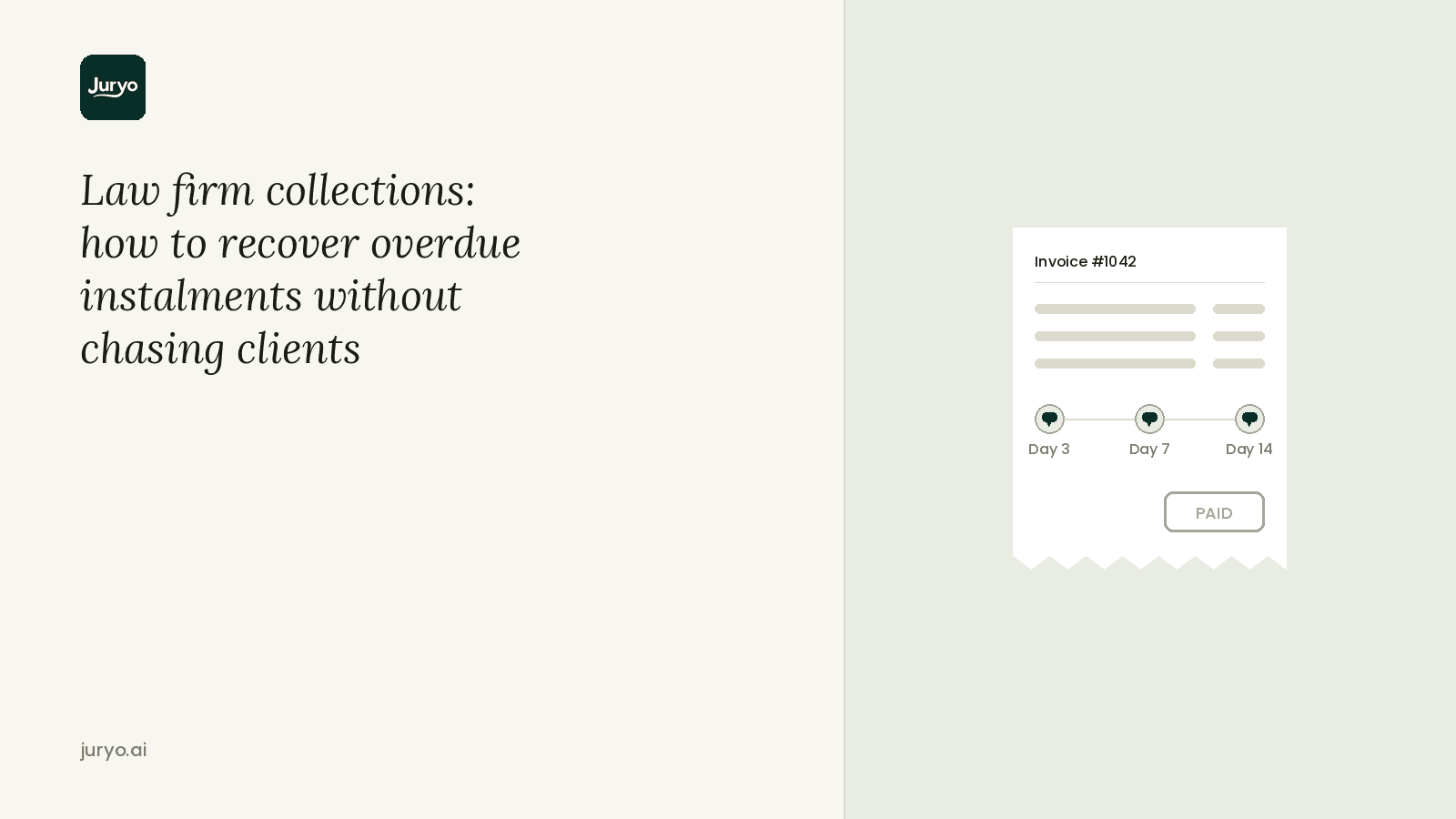
A client who's two instalments behind doesn't want a call from their own law firm. And honestly, the person making that call usually doesn't want to make it either.
That's the part that gets missed when people talk about law firm collections: the person on the other end isn't a stranger who owes money to a bank. They're a current client, often mid-case, who the firm is actively representing.
Treat that call like a debt-collection script, and you're not just risking the payment but also risking the retainer.
Firms recover overdue instalments by replacing manual chasing with an automated collections cycle: voice calls and WhatsApp messages sent on a fixed schedule, with a tone that shifts depending on how far behind the client is, and a payment link that goes out during the call itself, not after it.
That distinction matters more than it sounds like it should.
Legal collections is client retention work that happens to involve an overdue payment. It isn't debt recovery, and firms that run it like it is tend to lose the case along with the money.
The rest of this guide covers why the manual version breaks down, what an automated cycle actually looks like in practice, how the tone adjusts as arrears age, and what a firm gets to see once it's running.
Why Manual Collections Fails in a Law Firm

The truth is, nobody at a law firm was hired to chase overdue instalments. It's the task that gets bolted onto whoever has a spare hour between filings and calls, which means it happens when time allows rather than when the account needs it.
An arrear that should get a call on day three ends up getting one on day eleven, if it gets one at all.
The scheduling problem makes it worse. Without a system tracking who's been contacted and when, the same client can get called twice in one afternoon and then not hear from the firm again for three weeks.
There's no record forcing consistency, so consistency doesn't happen.
Then there's the context gap. Whoever picks up the phone usually doesn't know how much the client has already paid, where their case currently stands, or what was promised on the last call. That client has to explain their own situation from scratch every single time, which is exhausting for them and slow for the firm.
The conversation itself is also just uncomfortable, and that discomfort has a real cost. Staff put off the call they don't want to make, and that avoidance is probably the single biggest reason arrears sit around aging instead of getting resolved early, when they're still easy to fix.
And because none of this is tracked centrally, nobody at the firm can actually see the full picture.
How many plans are behind, and by how much. What's actually being recovered month to month. Without that visibility, a firm is managing collections by feel instead of by data, and feel doesn't scale past a handful of accounts.
A quick gut check you can run before automating anything: pull up how many active payment plans your firm has right now, and how many of them are in arrears. Most operations leads can't answer that on the spot, and that's usually the clearest sign manual collections has already outgrown what a person can track by memory.
What an Automated Collections Cycle Actually Looks Like

This is where Jesús, Juryo's dedicated AI agent for collections, comes in.
He runs on a rules engine that watches every payment plan the firm has active, and the moment an instalment falls behind, he triggers voice calls and WhatsApp messages automatically, in escalating cycles, until the client either pays or agrees to a date.
He doesn't contact everyone who's behind, though.
Three conditions have to be true before he picks up the phone:
- The instalment has to be overdue or partially paid.
- There has to have been no contact with that client in the last five days.
- There has to be no active payment commitment already sitting on file.
That last condition is the one worth pausing on. If a client already told Jesús “I'll pay on the 15th,” he doesn't call them again before the 15th just because the system could.
That's the detail that keeps this from turning into harassment. A client who's made a commitment gets left alone until that commitment is due or broken.
Here's what the default schedule looks like in practice. This is the standard setup Juryo ships with, not a fixed rule, and firms can adjust the timing and cadence to match their own collections policy.
| Cycle | Window | Sequence |
|---|---|---|
| First | D+0 to D+3 | D+0 opening call (08:30) and first WhatsApp touch · D+1 follow-up call and second WhatsApp touch · D+2 calls at 09:00 and 18:30 · D+3 calls at 08:00 and 13:00 |
| Second | D+10 to D+13 | D+10 reactivation call and first WhatsApp touch · D+11 follow-up call and second WhatsApp touch · D+12 calls at 09:00 and 18:30 · D+13 calls at 08:00 and 13:00 |
| Third | D+20 to D+23 | D+20 urgent call and first WhatsApp touch · D+21 follow-up call and second WhatsApp touch · D+22 calls at 09:00 and 18:30 · D+23 calls at 08:00 and 13:00 |
That's 24 rules spread across three cycles, and the timing isn't random.
Calls land at different points in the day on purpose, because a client who never answers a 9am call might pick up at 6:30 in the evening after work.
That's exactly the instinct a real collections person has when they're actually trying to reach someone, and it's also what a manual process can't keep up with once a firm has more than a handful of accounts in arrears.
A person can remember to try one client twice. They can't do it consistently across 118.
Every single contact ends in one of four possible outcomes, and each result is recorded instantly:
- Immediate payment: A payment link is sent by WhatsApp during the call itself.
- A dated commitment: The agreed date is logged and drives the follow-up.
- A scheduled callback: The client cannot talk now, so a new call is booked.
- Escalation to a supervisor: The call gets transferred where no agreement is reached.
How the Tone Adapts to the Situation
What separates a dedicated law firm collections system like Juryo’s Jesús from a standard automated dialler or a generic AI customer service software is the ability to read a situation and respond appropriately. This specific emotional intelligence is exactly what you want when automating law firm billing.
The system adapts its approach across three distinct levels that escalate based on the severity of the delay.
| Level | Situation | Tone |
|---|---|---|
| 1 | First missed instalment | Warm and collaborative |
| 2 | Repeat arrears, or two or more instalments behind | Firm, with empathy |
| 3 | No response, or high outstanding balance | Direct and urgent |
Beyond matching the right tone level, Jesús relies on a set of specific conversational capabilities to handle these calls well.
- Natural speech: fillers and pauses that sound human rather than rigidly scripted.
- Genuine empathy: acknowledges exactly what the client says before redirecting the conversation.
- Active listening: never talks over the client while they explain their situation.
- Six structured objection types: relies on prepared responses per scenario rather than improvisation.
- Transparency about being AI: states plainly what he is, in a natural tone, rather than pretending to be a person.
- Supervisor escalation: hands the call off seamlessly when there's no agreement to be reached.
That transparency point is important. Jesús tells clients he's an AI; he doesn't try to pass as human, and he doesn't dance around the question if asked.
For most consumer-facing tools, that might read as a limitation. But for a regulated professional services firm, it's the opposite. An agent that misrepresents what it is creates a liability the firm doesn't need, and saying plainly, “I'm an AI assistant calling on behalf of the firm,” protects the client relationship rather than risking it.
Here, transparency is a selling point, not a compromise.
Underneath all of this sits the same five-step call flow every time: greeting and identity verification, case context, current situation, payment proposal, then either an agreement or an escalation.
The structure holds steady. And the tone is what moves.
The Agent Knows the Client Before It Calls

Before Jesús picks up the phone, he already has everything he needs. The full context gets pulled and loaded before every single contact, so the client never has to explain their own situation from scratch, and the call can get straight to what matters.
That context falls into four groups:
- Client details: name, phone number, email.
- Payment status: total amount contracted, total paid so far, the monthly instalment amount, how many instalments have been paid against the total, how many are overdue, the amount and date of the last payment, when the plan started, and any payment date the client has already agreed to.
- Case stage: where the matter actually stands, from early document collection and intake through an active filing, ongoing proceedings, a resolution or judgment, and finally the last few instalments left on the plan.
- Contact history: every prior voice and WhatsApp interaction, the date of the last communication, how that last attempt ended, and what needs to happen on the next one.
Here's why that matters in practice.
A caller who already knows a client has paid nine of twelve instalments and is two weeks out from a court filing will be having a completely different conversation than someone reading a name off a spreadsheet with no other information.
One call adjusts to where the client's case actually is. The other treats every account the same, regardless of what's really going on. That gap is the difference between a genuine collections process and a basic legal answering service or a dialler that happens to have a phone number.
Case stages will naturally look different depending on the practice area and the jurisdiction a firm operates in, whether that's an active bankruptcy filing, a debt settlement in progress, or a personal injury case working toward resolution.
What stays constant is the underlying principle: the agent always knows exactly where a client's matter stands before it says a word, and it adjusts the conversation accordingly.
What Each Channel Does
Jesús works across three channels, and each one is built for a different moment in the collections process.
Outbound Calls
The ones the rules engine triggers automatically once an account falls behind. Before dialling, Jesús loads the client's complete history, so the tone is already calibrated to how severe the situation is and how the client has responded to past attempts.
On the call itself, he can offer immediate payment or lock in a specific date, and if the client agrees to pay, the link goes out over WhatsApp before the call even ends. If the client genuinely can't talk right then, a callback gets booked instead of the account just sitting there untouched.
Inbound Calls
They work differently, because these are always live and waiting rather than scheduled. The moment a client calls in, Jesús recognises them by their phone number and pulls up their payment status and case stage in real time.
He can answer questions about instalment amounts, deadlines, or how much is left on the plan, and he can handle a request to shift a payment date or adjust an amount without the client having to wait on hold for a person. If something comes up that genuinely needs human judgment, the call gets transferred to a supervisor.
Either way, the interaction gets logged with its outcome and notes attached.
The messaging platform delivers a highly personalized payment link. This link includes options for an automatic monthly charge and provides bank details for direct transfers with proof of payment.
WhatsApp also executes the automatic first and second follow-up touches per cycle. These text messages are triggered by the exact same rules that govern the voice calls.
Most manual attempts to recover overdue instalments fail because they end with an intention. A client promises to pay later, and then life simply gets in the way.
Sending the payment link directly to their WhatsApp while they’re actively speaking on the phone changes the dynamic completely. That specific timing is exactly what converts a verbal agreement into a finalized transaction.
Proof: Numbers from a Live Deployment
Now, let’s look at what happens when you put this system into practice.
Everything below comes straight from the Juryo payments dashboard. These aren't projections, and they're not numbers built for a demo. They're what one deployment actually looked like at a point in time.
The client here is a Spanish debt-relief practice running instalment plans for its clients, and they're not going on record, so the numbers are published without naming them or narrowing down which firm it is.
Here’s the active portfolio being managed:
- 185 active payment plans
- 118 clients with overdue payments
- 1,082 total instalments past due
That's a lot of accounts behind, spread across a lot of individual conversations that would otherwise need a person to have every single one of them.
Here's what Jesús recovered out of that:
- 108 instalments recovered from delayed status
- €11,099.99 total amount recovered
Managing law firm billing and collections requires clear, actionable data. The platform tracks every single contact attempt and categorizes the final outcome automatically.
Your dashboard instantly logs if there was no answer, if the agent spoke to the client but secured no commitment, or if a payment was explicitly promised.
The system also records if the client refused to pay, if the interaction was escalated to a supervisor, or any other specific result. You gain complete visibility into how your practice handles legal fee recovery without waiting for a manual spreadsheet update.
What the Firm Sees
Jesús operates entirely inside the Juryo platform instead of running as a disconnected side application. And this native setup gives your operations team complete visibility without forcing them to learn a separate collections tool.
Furthermore, the system automatically records every single voice call, WhatsApp message, and contact outcome directly into your main payments dashboard.
This level of legal workflow automation relies on a strict two-way sync. It reads your live platform data to know exactly who has fallen behind on payments and then writes the recovery results back in real time.
Your recovery metrics sit right alongside your team's standard KPIs. Leadership can instantly track total contacts, secured agreements, dated commitments, and supervisor escalations.
Your staff also handles all law firm accounts receivable directly from Juryo. This completely eliminates the need for messy data exports, manual software integrations, and duplicate client records.
Legal Collections Is Not Debt Collection

Standard debt-collection agencies exist to recover money for a creditor from a complete stranger. That relationship ends the exact same way regardless of the final outcome.
But when your practice handles law firm collections, you’re asking a current client to keep paying for your ongoing representation. These individuals are often actively handling difficult insolvency proceedings.
The professional relationship absolutely has to survive this specific conversation.
That sensitive dynamic explains why adaptive tone, deep case context, and total AI transparency serve as core features rather than polite niceties. An aggressive phone call does much more than simply fail to collect the money. It also actively puts your signed retainer and your firm's reputation at immediate risk.
It’s important to remember that the ultimate goal of this entire process is securing a paying client, not just recovering a standalone debt.
Honest Limitations
Automation strictly contacts clients and negotiates within the exact rules you set.
Jesús doesn’t decide to write off a debt, materially alter a payment plan, or initiate formal legal action. Those critical decisions remain entirely with your firm.
A client facing genuine financial hardship needs to speak with a real person, which explains why supervisor escalation exists. The software steps aside so your team can handle delicate human situations directly. Just like other AI legal assistant tools, automation is meant to support your staff rather than replace human judgment.
In addition to that, your automated rules are only as effective as your firm's internal collections policy. Needless to say, setting up software without a clear strategy just creates faster inconsistency across your practice.
Finally, no amount of automation will fix a payment plan that was completely unaffordable for the client on the day it was sold.
FAQ

How can a law firm recover overdue instalments without chasing clients?
Law firms can automate payment reminders by deploying an AI collections agent across voice calls and WhatsApp. The system contacts clients on a fixed rules schedule, adjusts its tone based on how far behind the payment is, and sends direct payment links during the call itself.
What is an AI collections agent?
An AI collections agent is specialized software built to manage law firm accounts receivable automatically. It calls and messages active clients to resolve unpaid legal fees, negotiate payment dates, and log every outcome directly into your practice management dashboard.
Is automated collections legal and compliant?
Automated outreach complies with legal standards when configured within allowed contact hours, tracking consent, and storing full interaction logs. Clients also retain a clear right to transfer immediately to a human supervisor whenever requested.
Will an AI collections call damage the client relationship?
Automated outreach protects client relationships by relying on three adaptive tone levels that move gradually from warm collaboration to direct urgency. Loading complete case details before dialing protects your law firm cash flow while treating active clients with genuine empathy.
Does the agent tell the client it is an AI?
Juryo’s Jesús states plainly that he’s an AI assistant at the start of the conversation. Complete transparency eliminates regulatory liability for law firms and establishes authentic trust with clients.
How many times will a client be contacted?
Contact frequency depends entirely on your firm's specific rules engine. A standard setup places twenty-four touches across three distinct cycles, but all outreach stops immediately when a client pays or commits to a date.
What happens if the client agrees to pay on a specific date?
The agent logs the promised date into your law firm billing and collections dashboard in real time. The system pauses all automated calls and messages, only resuming follow-ups if that agreed date passes without a transaction.
Can the client pay during the call?
The system sends a direct payment link via WhatsApp while the client stays on the line. This immediate delivery lets clients complete bank transfers or card payments before hanging up.
What is the difference between this and a debt-collection agency?
Debt collection agencies pursue outside strangers for one-off recovery, ending the relationship in the process. On the other hand, legal fee recovery focuses on client retention, asking an active client your firm currently represents to keep their retainer current.
Is this the same as Juryo's intake agent?
No, they manage two separate ends of the client lifecycle. Jorge qualifies incoming inquiries and books new consultations, while Jesús manages existing clients who’ve fallen behind on their law firm payment plans.
How much does Juryo cost?
Pricing is tailored on request based on your practice's active portfolio volume. You pay for actual instalments recovered, and plans kept current rather than user seats or call minutes. You can book a demo to receive a customized quote for your firm.
Juryo Pricing
Evaluating the cost of new software should focus directly on the value it brings back into your practice. For this reason, Juryo pricing is entirely tailored and available on request.
We don’t charge arbitrary fees for extra user seats or track your usage by call minutes. Your investment aligns strictly with concrete outcomes.
You’re paying for the overdue instalments recovered and the active payment plans kept current.
Ready to see exactly how this setup can protect your revenue? Book a demo to get a custom scope built for your specific portfolio.
Final Verdict
Handling law firm collections correctly requires a major operational shift. After all, you’re performing client retention work that happens to involve money, which is completely different from standard debt recovery.
Your very first practical step is to audit your own books today. You need to work out exactly how many active plans sit in arrears and how long the average arrear has been outstanding.
Most practices can’t actually answer that question right now.
A Spanish debt-relief practice deployed this exact automated setup to manage their own clients. The system successfully recovered 108 instalments and €11,099.99 across a 185-plan portfolio.
Jesús is the dedicated collections agent executing that recovery work. He expertly handles the complicated payment conversations to keep your existing clients current.
Meanwhile, his counterpart Jorge covers the exact opposite end of the same client lifecycle by securing new retainers during the initial intake phase. If you’re exploring how to automate law firm intake, Jorge covers that completely.