Lead Follow Up for Legal Intake: How to Re-Engage Enquiries That Go Quiet
October 27, 2026 · 20 min read
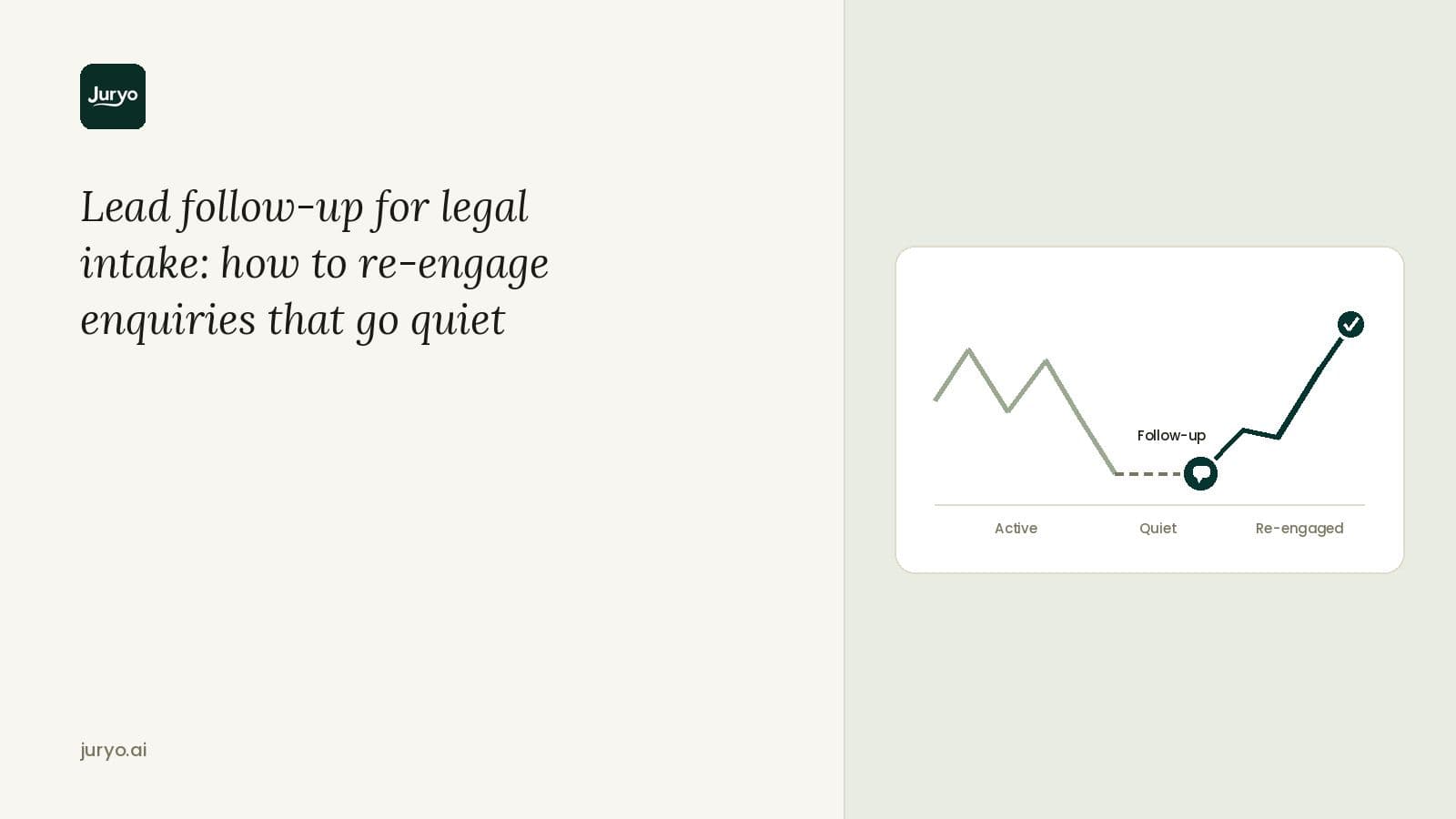
A prospect enquires about a road traffic accident, shares their details and waits for a callback.
By the time your firm responds, two other firms have already contacted them. A delayed or missed follow-up costs you a client who was interested in your services.
Lead follow-up means contacting prospective clients after their initial enquiry to answer questions, gather missing details and help them take the next step. For UK consumer law firms, that means responding quickly, following up across the right channels, knowing what to say and when to stop.
An enquiry that goes quiet still deserves attention. Our guide to how to automate law firm intake covers capturing enquiries, qualifying prospects and booking consultations. Here, we focus on re-engaging prospects who haven't booked.
George, Juryo's AI intake agent, follows up with prospects across phone, WhatsApp, email and web chat. Whether your team manages follow-up manually or George handles it, this guide covers recommended timings, message templates, channel choices, stopping rules and when to escalate an enquiry to a person.
The Lead Follow Up Sequence at a Glance
Your team needs a clear plan for following up with prospective clients who haven't booked a consultation.
Each follow-up should have a purpose, from checking whether they're still interested to helping them take the next step.
The table below outlines six steps for consumer legal enquiries, with suggested timings based on general best practice. Adjust them to the urgency of the enquiry, the practice area and the prospect's preferences.
| Step | What you do | Timing / result |
|---|---|---|
| 1. Respond | Reply on the channel the enquiry came in on. Phone call for a phone enquiry, message for a form or WhatsApp enquiry. | Within minutes during opening hours. The first conversation happens while the problem is still on their mind. |
| 2. Switch channel | If there is no answer, send a short WhatsApp or text that names the matter and offers a time. | Same day, 1 to 3 hours after step 1. Reaches people who will not pick up an unknown number. |
| 3. Summarise | Send an email that recaps what they told you, what happens next and a booking link. | Next morning. Gives them something to forward to a partner or reread. |
| 4. Second call | Call again at a different time of day from step 1. | Day 3. Catches people who work shifts or were busy the first time. |
| 5. Final message | A polite close: "we will keep your enquiry on file, reply here if you want to go ahead". | Day 7 to 10. Often gets the reply the others did not, and gives you a clean stop. |
| 6. Log and escalate | Record every touch and the outcome in the CRM. Hand urgent or high-value matters to a named person at any step. | Throughout. The file shows who tried, when, how, and what happened. |
Want George to run this process without someone setting reminders every single time? Book a demo.
Why Enquiries Go Quiet
Enquiries go quiet for four main reasons, and each needs a different follow-up message:
- Comparison shopping. In Clio’s 2019 consumer survey of US clients, 57% of people who had hired a lawyer said they contacted more than one firm to decide who to go with. Follow-up message: Confirm that you handle their type of case and offer a specific consultation time.
- Urgency fades. Their injury hurts less, the argument has cooled, or the landlord has gone quiet. They may decide to put the matter off. Follow-up message: Explain one specific consequence of delaying action in their type of case.
- The callback was missed. Someone said “we will call you tomorrow” and either did not, or rang once while the prospect was at work. Follow-up message: Apologise for the missed callback and offer two times for a call.
- Wrong channel. Most people will not answer an unknown mobile number but any read a WhatsApp message instead. Follow-up message: Send the same message through WhatsApp or another appropriate channel.
Speed to Lead: Why the First Five Minutes Decide the Rest
Speed to lead is the time between a new enquiry arriving and your firm’s first response. In other words, it measures how quickly your firm responds to a new enquiry.
A 2011 Harvard Business Review study found that 23% of 2,241 US companies never replied to a test enquiry. Separately, the Lead Response Management study by MIT and InsideSales found that calling a lead within five minutes made contact far more likely than calling after 30 minutes. The key takeaway for your law firm is simple: aim to respond within minutes, not hours.
The sooner you respond, the better your chance of speaking to the prospect and booking a consultation before they choose another firm.
Many law firms have room to improve. In Clio’s 2024 study of 500 US law firms, only 40% answered a test phone call, and just 33% replied to an email enquiry. On the other hand, Clio’s 2019 consumer survey found that 79% of people expected a response within 24 hours. Make sure every enquiry gets a prompt reply, whether it arrives by phone or email.
For UK firms, enquiries that arrive outside opening hours often go unanswered until the next morning. Set a rule for handling them: send an immediate acknowledgement, include a consultation booking link, and arrange for urgent enquiries to reach a named person rather than wait until the office opens.
How to qualify leads before you chase them
Qualify each enquiry on first contact so your team knows whether the firm can take the case. Our guide to how to automate law firm intake explains how to assess and qualify enquiries.
Before following up, check:
- Practice area: Which team should handle the enquiry?
- Urgency: Are there any potential deadlines to flag?
- Missing information: What do you still need to assess the case?
Take a personal injury enquiry as an example.
First, classify it under personal injury so it reaches the right team. Next, check the accident date to identify any potential deadline concerns. Finally, if the person hasn't explained their injuries, ask them to share that information in your next message. If the deadline needs legal assessment, ask a solicitor to review it before sending the next follow-up.
Use these details to decide what to ask next, how soon to follow up and when to involve a solicitor.
Timing and Channel: Building the Sequence
Five touches over seven to ten days, spread across at least two channels, is a sound default for consumer legal enquiries. Adjust it for practice area.
- Vary the channel, keep the thread. Phone first if they rang, then WhatsApp or SMS, then email. The prospect should never have to repeat their story because the firm changed channel.
- Vary the time of day. A second call at the same hour as the first usually meets the same voicemail.
- Space touches out after day one. Send two touches on day one, then one every two to four days. More than that reads as pressure.
- Respect opening hours for calls, but not for messages. A WhatsApp sent at 8pm is fine if the prospect messaged you at 8pm.
Follow-up rules in the UK
You can reply to someone who has asked your firm about legal services without relying on consent or the soft opt-in.
However, if you use their contact details to promote other services, different rules apply. This is where the Privacy and Electronic Communications Regulations (PECR) come in and set rules for electronic marketing.
Under the PECR, the soft opt-in allows you to market your own similar services to someone who has enquired. This applies only if you collected their details while discussing a potential sale and gave them a clear way to opt out both when collecting their details and in every subsequent message.
For example, an online enquiry form asking a prospect to provide details about the legal services they need counts as negotiations for a sale. Meanwhile, a prospect simply visiting your website without making an enquiry does not. These rules apply to electronic marketing sent by email, text message or direct message.
The ICO's direct marketing guidance explains the rules for electronic marketing, although it is under review following the Data (Use and Access) Act 2025. Check the latest guidance before setting up your follow-up sequence to ensure your messages comply with PECR, including any opt-out requirements.
What Each Follow-Up Message Should Say
Every follow-up message needs three things: a reference to their case, the next step and one clear ask.
- Reference the case details. Mention something the prospect told you so they know which enquiry you're following up on. For example, “I'm following up on your enquiry about the accident on the A56 last Tuesday” gives them more context than “I'm following up on your enquiry.” Avoid including sensitive details in an unsuitable channel.
- State the next step. Say what you're offering or what you need from them. This could be a 20-minute call with a solicitor, a request for specific documents or a fixed-fee quote.
- Make one clear ask. Give the prospect one simple way to respond. Offer two appointment times, such as “Reply 1 for Thursday at 10am or 2 for Friday at 4pm,” or include a link where they can book a call. Don't ask them to book a call, send documents and answer more questions in the same message. Focus on the one action that moves the enquiry forward.
Remember, respond to new enquiries within minutes during opening hours. For out-of-hours enquiries, send an automatic acknowledgement with a consultation booking link and route urgent cases to a named person.
If a prospect goes quiet after your first contact attempt or conversation, use the templates below to prompt a response and move the enquiry forward. Adapt each message to what you know about the prospect and adjust the timing to your opening hours and the urgency of the case.
Same-day WhatsApp
Hi [Name], it's [Your name] at [Firm]. Following up on your enquiry from today. A solicitor has time to speak on Thursday at 10am or Friday at 4pm. Would either suit you? Reply STOP if you don't want further messages.
Next-morning email summary
Subject: Your enquiry: next steps
Hi [Name],
Thanks for contacting [Firm] yesterday. The next step is a short call with a solicitor. Choose a time here: [booking link].
If you'd prefer no further follow-up, reply to let us know.
Kind regards,[Your name][Firm]
Final close (day 7 to 10)
Hi [Name], we haven’t heard back, so we'll stop following up for now. We’ll keep your enquiry on file. If you’d like to go ahead, reply here and we’ll pick up where we left off.
For family enquiries and other sensitive matters, avoid putting case details in message previews. Confirm which channel and time are safe before sending follow-up messages.
Practice Area Differences
The right follow-up depends on the type of case you're dealing with.
If someone contacts you about an immigration matter, check whether there's a deadline coming up. If they're asking about conveyancing, get back to them with the information they need to compare quotes.
Here's how to approach follow-up across different practice areas.
| Practice area | Why they go quiet | How to adjust the follow-up |
|---|---|---|
| Personal injury | Pain eases, an insurer calls first or another claims firm responds sooner. | Respond quickly and ask for the accident date early. Most personal injury claims must start within three years of the injury or the date of knowledge. |
| Family | The person is not ready to proceed, or a partner reads their phone. | Use slower, gentler gaps. Ask which channel and time are safe before sending anything. Never put case detail in a message preview. |
| Immigration | The prospect is waiting for a Home Office letter or is unsure whether the firm handles their route. | Start by asking when the decision was sent. Immigration appeals generally have a 14-day deadline for people in the UK and 28 days for those abroad. So, escalate enquiries involving refusal letters to a person rather than leaving them in the follow-up sequence. |
| Employment | The prospect is still employed or waiting to see what their employer does. | Ask when the workplace issue happened. Most tribunal claims, including unfair dismissal, have a six-month deadline for issues arising on or after 1 October 2026, compared with three months for earlier issues. Claimants usually need to contact ACAS before making a tribunal claim, and early conciliation affects the deadline. |
| Conveyancing | The prospect is comparing quotes from several firms. | Contact the prospect within an hour of sending the quote and follow up once more the next day. A long sequence is unnecessary. |
When to Stop and When to Escalate to a Person
Stop when the prospect declines, opts out, confirms they have instructed another firm or reaches the end of the sequence without replying. Escalate as soon as urgency, vulnerability or the complexity of the enquiry calls for human judgement.
- Stop rules. Stop follow-up if the prospect declines, opts out, confirms they've instructed another firm or doesn't reply by the final touch. Record the reason in the CRM.
- Escalation rules. Escalate immediately if a deadline falls within 14 days, the client faces domestic abuse, detention or serious injury, the matter is high-value, or the prospect asks for a solicitor by name. Make clear who handles escalations in each practice area.
- One owner per enquiry. Assign one person to oversee each follow-up sequence and record them as the owner in your CRM, even when other team members handle individual calls or messages.
Logging Follow-Up to the CRM and Measuring Response Rate
Record every follow-up attempt, including the channel, time and outcome. Track replies as well as bookings to see which attempts bring prospects back.
- What to log: Record the date and time, channel, team member responsible, outcome (no answer, replied, booked, declined or opted out) and reason for closing the enquiry.
- What to measure monthly: Track key metrics like speed to lead (median minutes to first response), response rate (the share of quiet enquiries that reply to any follow-up), response touch (which attempt gets a reply) and follow-up conversion (consultations booked through follow-up).
- Compare by practice area and channel: Identify which channels bring the most prospects back and which follow-up attempts get the most replies. Check the final message, too, to see whether it prompts responses from prospects who ignored earlier attempts.
Answering Service vs. Full Intake: Who Does the Follow-Up?
A traditional answering service takes a message for your team to act on later. Full intake handles the enquiry, qualifies the prospect and completes the follow-up sequence.
Here's how the two approaches compare at each stage of intake:
| What happens | Traditional answering service | Full intake with George (by Juryo) |
|---|---|---|
| Initial enquiry | Takes the prospect’s name, phone number and a brief description of their matter, then emails the details to your firm. | Speaks with the prospect, qualifies them against your firm’s criteria and books a consultation. |
| Follow-up | Usually leaves follow-up to your team. If a prospect misses your callback, it is up to your team to try again. | Follows up proactively by phone, WhatsApp, email and web chat until the prospect responds. |
| Enquiry history | You may have the original enquiry in your inbox and callback notes in individual call logs, with no complete record in your CRM. | Records every interaction and outcome in one CRM record, so you can see the full follow-up history without chasing colleagues for updates. |
| Next steps | Your team must contact the prospect again, arrange a consultation and record what happens next. | Books the consultation and passes the enquiry details and follow-up history to your CRM. |
See which legal answering services on features and pricing offer the level of intake support your firm needs.
How George Follows Up
George follows up with quiet enquiries across phone, WhatsApp, email and web chat, using the schedule your firm sets.
Unlike most legal intake software, George remembers and carries the conversation across channels, so prospects don't have to repeat what they've already told you.
- Proactive follow-up until the prospect responds. George follows up with quiet prospects automatically, so your team doesn't need to set reminders or chase every enquiry manually. You get to choose how many times George follows up and how long to wait between attempts for each practice area.
- Shared memory across channels. George remembers what a prospect shared over the phone when they follow up on WhatsApp, email or web chat. They don't have to explain their case again.
- Messages that reference the case. George uses details from the conversation and your firm's uploaded knowledge base to make each message relevant to the enquiry and explain clearly what the prospect needs to do next.
- Configurable by practice area, urgency and tone. Set George's follow-up schedule and tone according to the case type and urgency. For example, if someone enquires about an immigration decision with an upcoming appeal deadline, George can prioritise the enquiry and flag it for prompt review.
- Escalation to a person. When an enquiry meets your firm's escalation rules, such as a near deadline or a vulnerable client, George passes it to the person assigned to handle it.
- Books, collects, signs. When a prospect replies and is ready to proceed, George books the consultation, collects documents and gets the engagement letter signed.
- English and Spanish, 24/7. George handles enquiries in both languages at any time, including evenings, weekends and holidays when your office is closed.
- CRM handover. George organises the conversation into structured fields, including case type, key dates, opposing parties and qualification outcome, then sends the record to your firm's CRM. George works alongside Clio Manage, Filevine, MyCase or a spreadsheet. If the CRM is temporarily unavailable, the record is queued and sent again when the connection is restored.
- Data handling. Data is stored in the EU, a Data Processing Agreement is available, and conversations are not used to train models.
Juryo's Results
Juryo reports that 100% of leads and clients are contacted and answered, with an average time to first contact under 35 seconds, and a 71% increase in conversion from lead to signed contract. Firms using George include Legalitas, Sello Legal, Indemnizame and DVuelta.
If you're interested in how AI supports law firm sales, see our guide to AI sales representatives for law firms.
FAQs
What is lead follow-up for a law firm?
Lead follow-up is contacting prospective clients who enquired but didn't book a consultation on their first call or form. It involves reaching out again on a set schedule until they book or decline. Each message should refer to their enquiry, offer one clear next step and use an appropriate channel.
How to follow up with leads without being pushy?
Reference the enquiry, offer one next step and make one clear ask. Space out later attempts, change the channel or call time when appropriate, and stop as soon as the prospect declines or opts out. Keep each message relevant to the person's enquiry rather than adding unrelated promotions.
How quickly should a law firm respond to a new enquiry?
Aim to respond within five minutes during opening hours and acknowledge enquiries that arrive after hours straight away. A quick first response gives your firm a chance to speak to the prospect before another firm does. It also helps you gather the details needed for relevant follow-up.
How many times should you follow up with a lead?
Around five touches over 7 to 10 days is a practical starting point for consumer legal enquiries, spread across at least two channels. Shorten the sequence for straightforward conveyancing quotes and adjust the tone and spacing for sensitive family matters. Stop earlier if the prospect declines or opts out.
Can a UK law firm follow up by WhatsApp or email?
Yes, you can follow up by WhatsApp or email about someone's own enquiry without consent or the soft opt-in. The ICO treats these messages differently from marketing messages that promote other services, which must follow PECR rules. Include an opt-out where required and stop contacting anyone who opts out.
When should you stop following up?
Stop when the prospect declines, opts out, confirms they have instructed another firm or has not replied after the final touch. Record the reason in the CRM so the team knows why the follow-up ended and does not contact the person again by mistake.
Does George follow up automatically?
Yes. George follows up across phone, WhatsApp, email and web chat until the prospect responds. If they switch channels, George remembers the earlier conversation and references it as needed. Your firm sets how often George follows up and how long to wait between attempts for each practice area. If an enquiry meets your escalation rules, George passes it to an assigned team member.
How much does Juryo cost?
Juryo's pricing is based on success. To discuss pricing for your firm, Book a demo.
Final Verdict
A consistent lead follow-up process helps your firm reconnect with prospects who have not booked. Respond quickly, try another channel if needed, refer to their enquiry, offer one clear next step, and record every attempt in your CRM.
Your team can manage follow-ups manually, as long as someone is responsible for each enquiry. George handles follow-up across phone, WhatsApp, email and web chat, using the timing and number of attempts your firm sets.
Juryo reports that 100% of leads and clients are contacted and answered. Firms using George include Legalitas, Sello Legal, Indemnizame and DVuelta.