The best AI sales representative for law firms (2026)
August 20, 2026 · 14 min read
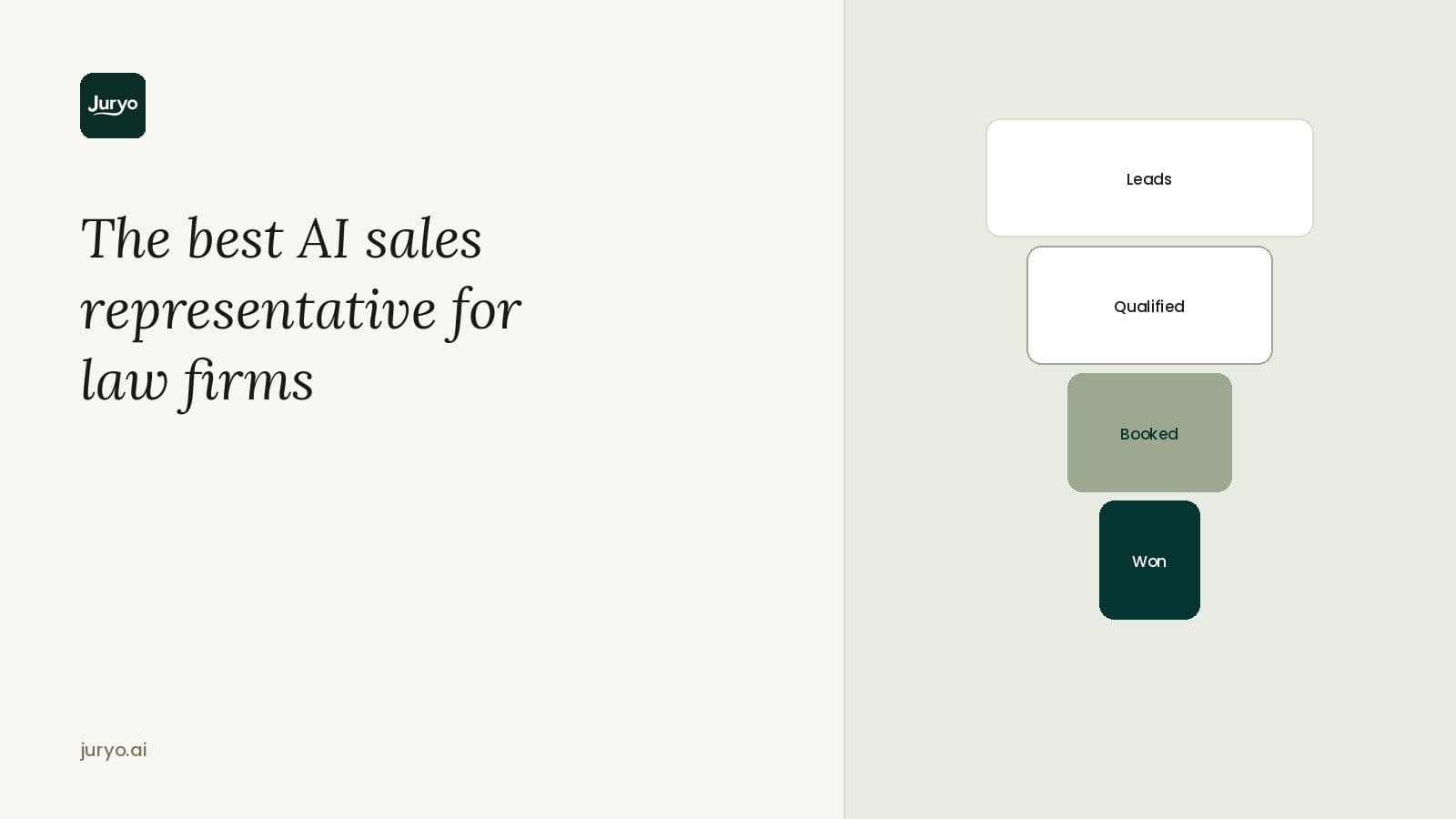
Juryo's AI agent, Jorge, is the AI sales representative built specifically for law firms: it answers by voice and WhatsApp, in English and Spanish, 24/7, and runs full case intake instead of just taking a message. After hours, calls go to voicemail. Web chat widgets can't tell a car-accident lead from a spam bill. And every call that isn't answered in minutes is usually a signed matter walking to the next firm on the search results. Jorge is built for exactly that gap.
This is not a category overview of legal AI agents. It's a working walkthrough of one: how Jorge handles a lead from the first ring to a booked consultation, and what changes for the firm once that whole path runs on its own.
What is an AI sales representative for law firms?
An AI sales representative for law firms is software that answers, qualifies, and books legal leads the way a trained human intake specialist would, rather than a scripted phone tree or a website FAQ bot. It works the phone and messaging channels where legal leads actually arrive, asks the questions that decide whether a case is viable, and schedules the consultation on first contact.
That last part is what separates a legal AI agent from a chatbot. A chatbot answers frequently asked questions on a website. A legal AI sales rep works voice and WhatsApp, screens the matter, and hands the attorney a qualified, scheduled lead. In the intake funnel, this is the layer between "a prospect finds the firm" and "a prospect is a booked, qualified consult," and it is the layer most legal AI software still leaves to a human.
How it differs from a call center or a human intake rep
A traditional call center answers and forwards a message. It doesn't ask legally relevant qualifying questions consistently, so the firm still starts the real conversation from zero on the callback. A single human intake coordinator can qualify well, but can't cover nights, weekends, and a second language without added headcount. Jorge does both by design: consistent qualification on every call, at any hour, in English or Spanish.
Answering service vs full intake: the difference that actually matters
This is the distinction that decides whether a tool is worth paying for, so it's worth stating plainly.
An answering service takes a message and passes it along. Nothing about the lead is qualified. The firm still has to call back and begin the conversation from scratch, usually hours later, when the prospect has already called two other firms. A bilingual answering service is still just a faster voicemail.
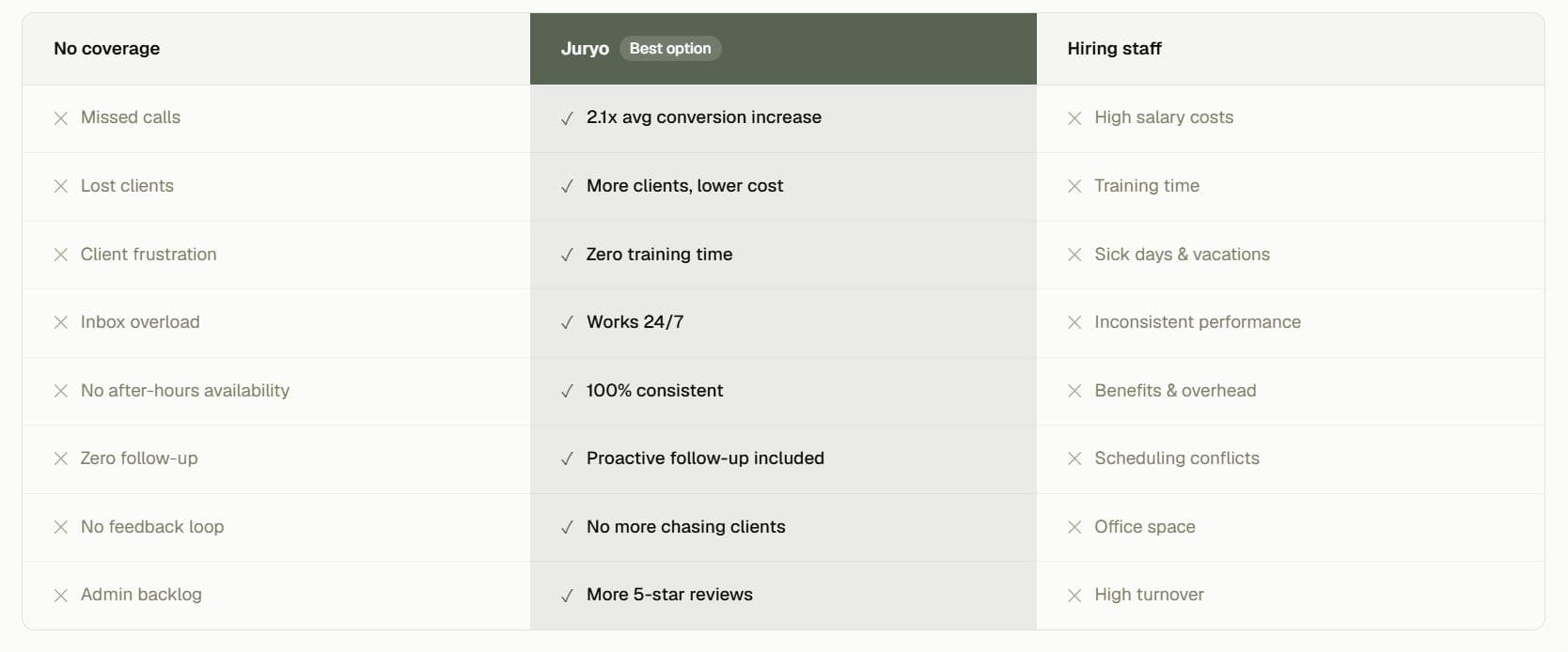
Full intake, which is what Jorge does, gathers the facts that determine whether a case is viable and a fit for the firm during the very first contact: practice area, incident date, jurisdiction, injury or matter specifics, and whether another firm is already involved. A bilingual full intake agent doesn't leave a message; it hands the attorney a qualified, scheduled lead. That difference in intake quality, not just faster answering, is where Juryo's reported 2.1× lift in conversion comes from. For a fuller breakdown of the two models, see legal answering service vs full intake.
Meet Jorge: Juryo's AI sales and intake agent
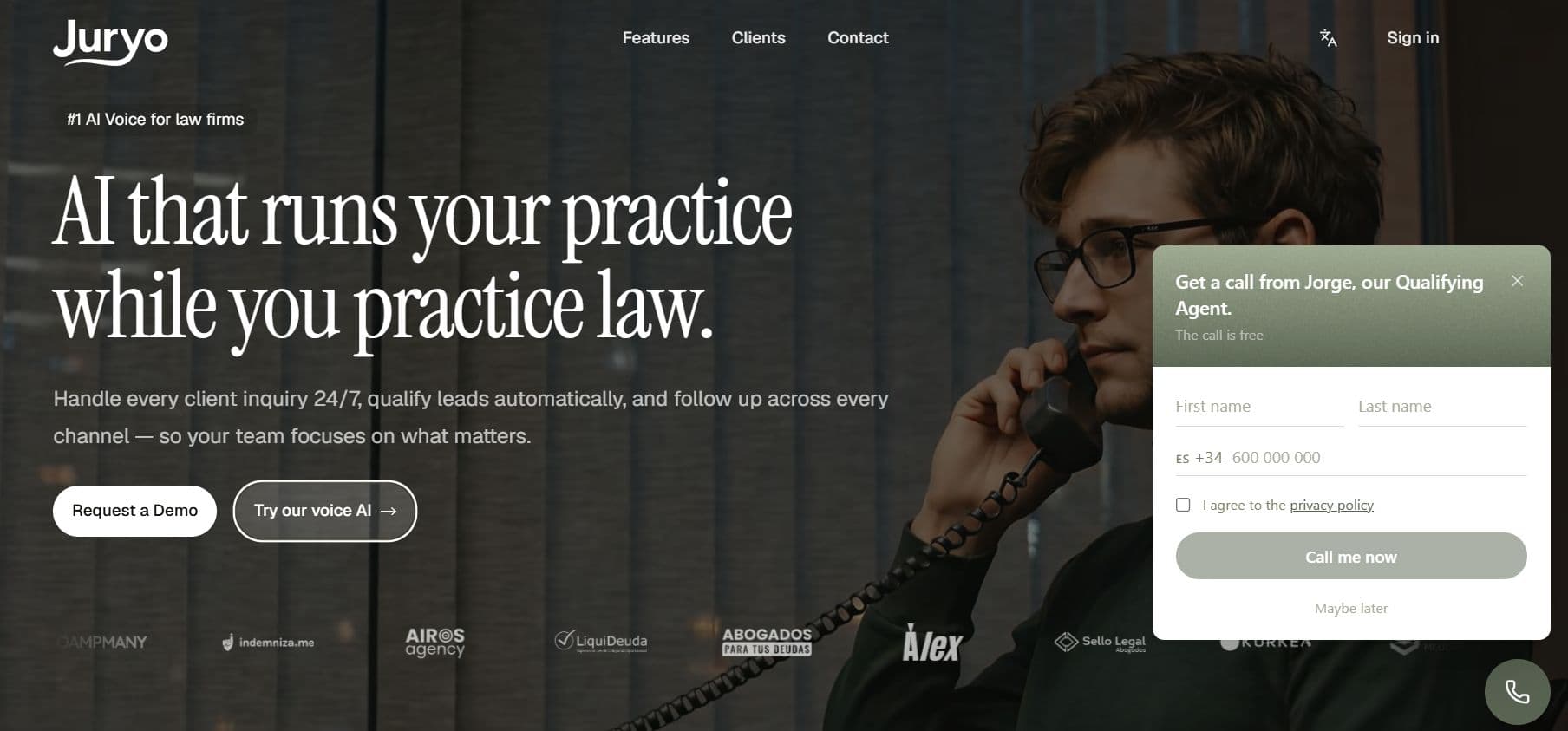
Jorge is Juryo's intake agent. It manages phone and WhatsApp communications in English and Spanish, 24/7. Because it uses a single shared system across all channels, it maintains conversation history. A client who calls on Friday and follows up via WhatsApp on Saturday doesn't have to start over; Jorge remembers the context of the previous interaction. If you want to see the language handling in detail, here's bilingual legal intake, step by step.
It's built for the firms that live on lead volume and fast response: personal injury, immigration, family, criminal defense, and employment practices in the consumer legal market. These are the firms where a lead going cold at 20:00 on a Friday is a lost case, not a lost message.
Example
Take a typical personal injury firm running forty to sixty leads a month with one intake coordinator. A prospect calls at 19:40 after a car accident, well past close. Today, that call goes to voicemail, and by Monday the caller has retained the firm that picked up. With Jorge in place, the call is answered on the first ring.
Jorge asks when and how the accident happened, whether there were injuries, whether the caller has seen a doctor, and whether another firm is already representing them. The matter clears the firm's own intake criteria, so Jorge offers the next open consultation slot and books it into the calendar on the same call. It then messages the caller a confirmation and a document checklist.
By the time the coordinator arrives Monday, the lead is qualified, booked, and documented, with no callback required. Nothing here depends on a metric the firm can't verify: the lead is simply handled instead of missed.
Step by step: how Jorge works as an AI sales rep
| Step | What happens | Result |
|---|---|---|
| 1. Lead makes contact | Prospect calls, texts, or messages on WhatsApp; Jorge answers immediately in English or Spanish | No ring-out, no voicemail, any hour |
| 2. Jorge qualifies the case | Case-specific questions: practice area, incident date, injury or matter details, prior representation | 2 to 5-minute conversation |
| 3. Jorge books the consultation | Checks availability and schedules the consult directly, confirming by phone or WhatsApp | Booked same session, no back-and-forth |
| 4. Jorge follows up automatically | Re-engages leads who went quiet, on the channel they first used | Systematic follow-up until the client responds |
| 5. Firm reviews outcomes | Intake team reviews call and chat outcomes and conversion data | Response and conversion visible in one place |
Step 1: The lead makes contact
Jorge covers all the entry points a legal lead actually uses: an inbound call, an SMS, or a WhatsApp message. It picks up in whichever language the prospect speaks or writes first, with no menu and no "press 2 for Spanish" step. The prospect just talks, and Jorge answers.
Step 2: Jorge qualifies the case
For a personal injury lead, Jorge asks when the incident happened, the type of injury, whether the caller has already seen a doctor, and whether another firm is involved. For an immigration or employment matter, the questions change. The script adapts to the practice area against the firm's own intake criteria, rather than reading one generic checklist to everyone.
Step 3: Jorge books the consultation
Instead of promising a callback, Jorge checks the firm's calendar and confirms a specific time on the same call or chat. The consult is booked in the moment the prospect is most motivated, then synced to the firm's CRM with reminders scheduled automatically.
Step 4: Jorge follows up automatically
Leads who don't answer or go quiet get a re-engagement sequence on the channel they first used. This proactive follow-up, rather than a one-and-done answer, is the mechanism behind Juryo's reported conversion gains: no prospect is quietly forgotten.
Step 5: The firm reviews outcomes
Call and chat outcomes, conversion by source, and response rate are visible to the intake team, so the firm can see what's converting instead of guessing. See Jorge in action.
Results from law firms using Jorge
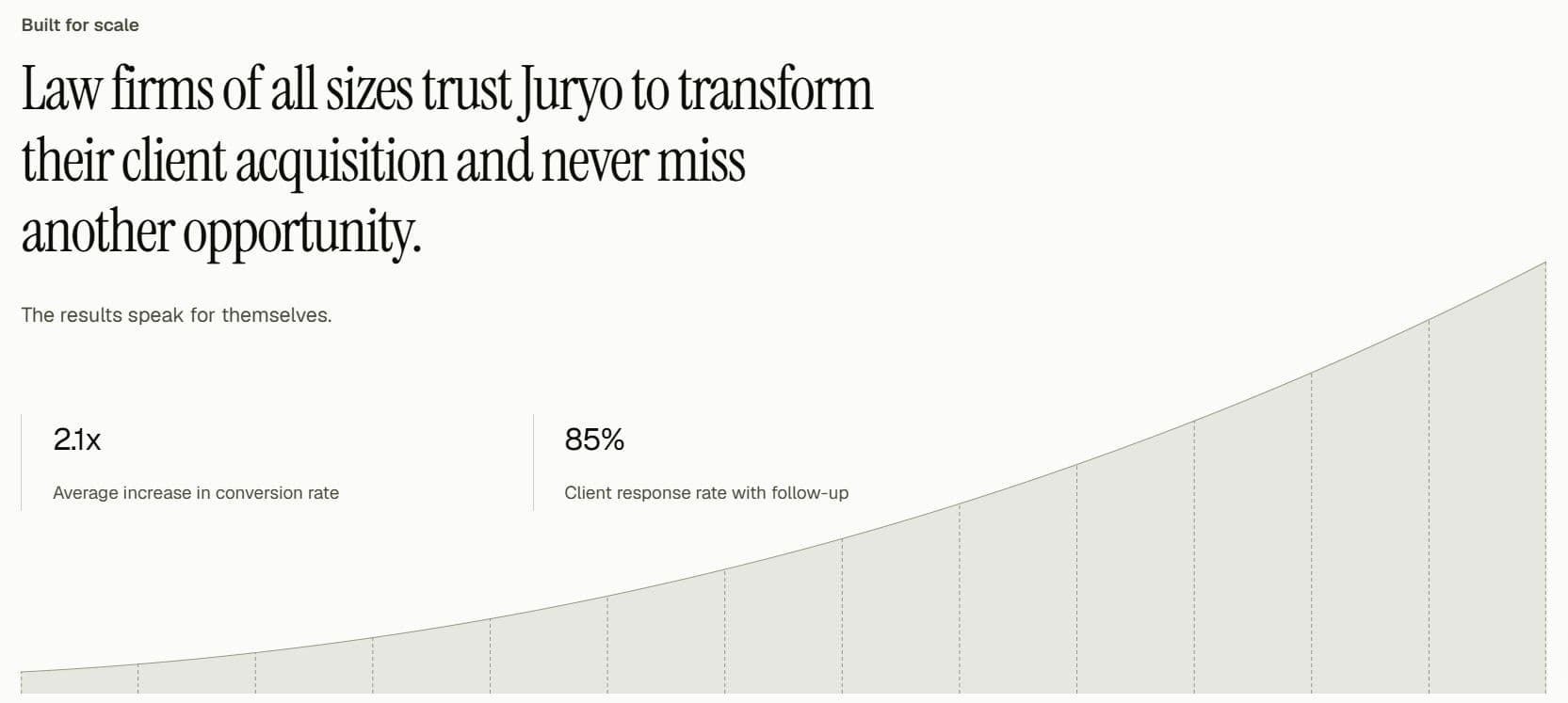
Juryo reports a 2.1× average increase in conversion rate and an 85% client response rate off the back of the automated follow-up. Those are the outcomes of the exact step-by-step process above: faster first response, consistent qualification, and persistent follow-up on the client's own channel.
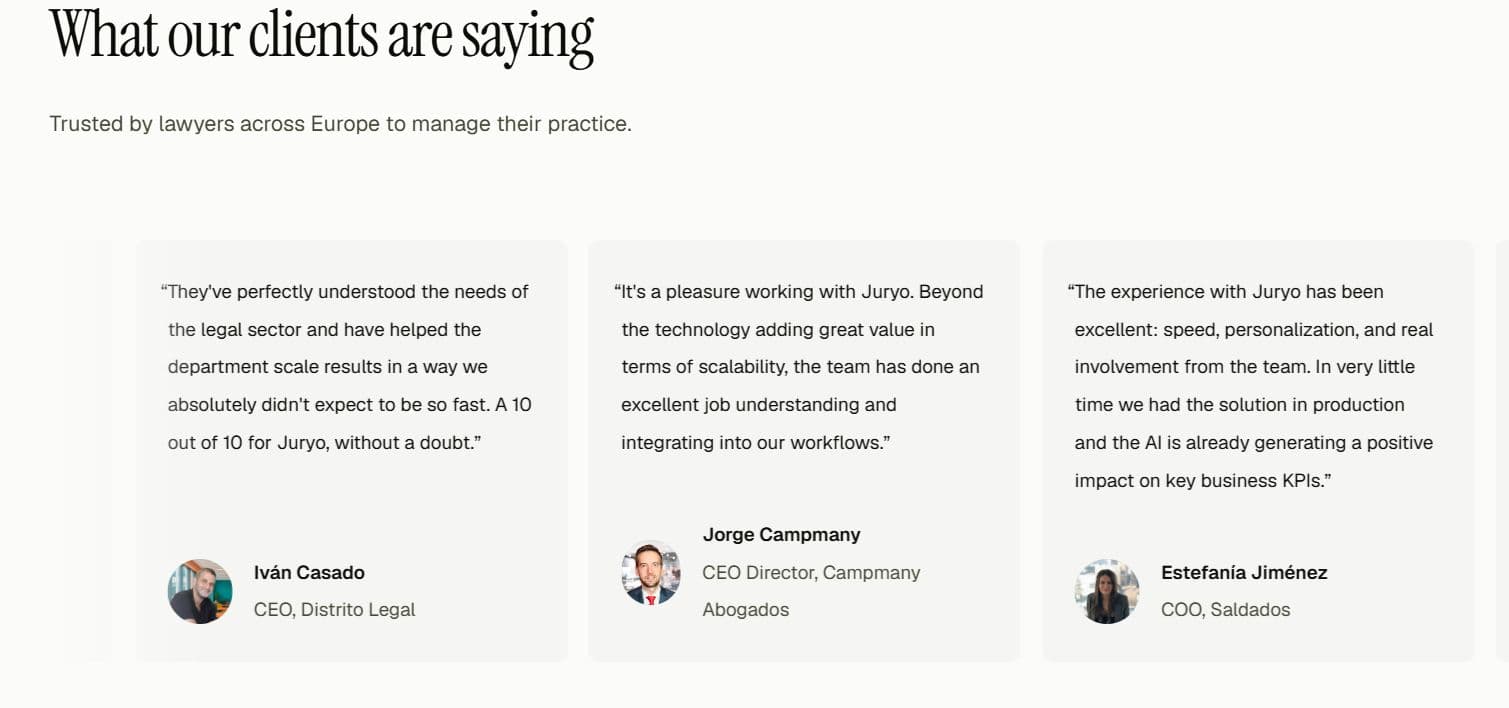
The proof sits with firms already running Juryo. Campmany Abogados, Distrito Legal, Saldados, and Bufete Robles are among the practices using the platform, each with an attributed account of the results. Distrito Legal describes scaling results faster than expected; Bufete Robles says it professionalized the firm's phone service better than several humans they'd tried. These are high-volume consumer practices, the same profile as the US firms Jorge is built for, which is why the pattern travels: the constraint is always the lead answered late, and that constraint is the same in Madrid or Miami.
Juryo pricing
Juryo's pricing is success-based: the firm pays on the conversions Juryo actually produces, rather than per seat, per call, or per minute. There's no published flat rate, because what you're buying is converted leads, not answered calls, so the cost tracks the result instead of the volume of activity. Exact terms are tailored to the firm and provided on request, after a short demo.
Jorge vs generic chatbots and traditional answering services
Set against the two things firms usually compare it to, the difference is structural rather than a matter of features.
A generic chatbot handles website FAQs. It doesn't work on the phone or WhatsApp channels where most legal leads actually arrive, and it doesn't qualify or book anything.
A traditional answering service, human or scripted, takes a message. It doesn't ask legally relevant questions, doesn't screen the matter, and doesn't schedule the consultation.
Jorge does full intake across both channels, in both languages, 24/7, from one agent: it qualifies, books, collects documents, and follows up. If you're weighing these options, it's worth seeing how AI receptionists and answering services compare for law firms before you decide.
Who should use an AI sales rep like Jorge
Jorge fits firms in personal injury, immigration, family, criminal defense, or employment law that get leads outside business hours or from Spanish-speaking callers. It's built for practices currently leaning on an answering service or a single intake coordinator who can't scale to nights, weekends, or a second language.
And it's for firms losing leads in the gap between "the call comes in" and "the attorney calls back," where speed to qualify and schedule decides whether the case is signed. Among the legal AI companies serving this segment, the ones worth shortlisting are those that run intake end to end, not just the ones that answer. If you're still mapping the landscape, start with more AI tools for lawyers.
Limitations
Jorge is not a replacement for attorney judgment on case merit. It qualifies and schedules; the attorney still decides whether to take the case. It works best for firms with defined intake criteria per practice area, so firms with highly bespoke or unusual matter types may need more custom scripting at setup. And because pricing is success-based rather than a published flat rate, a firm that wants a fixed number before a conversation has to go through a demo to get tailored terms.
Final verdict
Among legal AI agents built for law firms, Jorge is the one that does full intake rather than just answering: phone and WhatsApp, English and Spanish, qualification, booking, documents, and follow-up, in one bilingual agent. Juryo reports a 2.1× average increase in conversion and an 85% response rate, with firms like Campmany Abogados, Distrito Legal, Saldados, and Bufete Robles already running it.
It suits firms losing after-hours or Spanish-language leads, and it stops short of replacing attorney judgment, which stays with the lawyer where it belongs. The fastest way to judge it is to hear it work. See Jorge in action.
FAQs
Is an AI sales rep for law firms the same as an answering service?
No. An answering service takes messages. Jorge runs full intake, qualifying and scheduling the lead on first contact, so the attorney receives a ready-to-review file instead of a callback list.
Does Jorge work in Spanish as well as English?
Yes. Jorge handles both English and Spanish across voice and WhatsApp, from the same agent, 24/7. Spanish-speaking clients get a complete intake in their own language.
How much does Juryo cost?
Juryo prices on successful conversions rather than a flat seat or per-call fee, so what a firm pays tracks the leads it actually converts. Exact terms are tailored and provided on request; there's no published rate card.
Is using an AI agent for legal intake safe and compliant?
Jorge follows standard intake consent and data-handling practices, and it doesn't give legal advice or decide case merit: it collects structured intake and schedules, leaving judgment to the attorney. Firms should confirm the specifics against their own jurisdiction's rules during setup.
Can law firms use Jorge for follow-up, not just first contact?
Yes. Jorge's automated follow-up sequences re-engage leads who go quiet, on the channel they first used, and that persistence is a large part of why Juryo reports higher conversion among its clients.
What size firm is Jorge built for?
Small to mid-size consumer law firms that run on lead volume and fast response, across personal injury, immigration, family, criminal defense, and employment.
Recommended Reading
- The 7 Best AI Receptionists and Virtual Receptionists for Law Firms (2026)
- 5 Best AI Legal Intake Tools for Law Firms (2026)
- The 7 Best Legal Answering Services for Law Firms (2026)
- The 7 best AI tools for lawyers (2026, tested)
- This is the best bilingual legal answering service (English + Spanish) in 2026
- How to automate law firm intake: a step-by-step guide
- 5 best AI legal assistant tools for law firms in 2026