How to Grow a Law Firm Without Hiring More Staff
November 10, 2026 · 21 min read

Most law firms that want to grow start by hiring new team members. This includes paralegals, fee earners, and receptionists. More people should mean more enquiries handled.
However, what happens to the calls that come in after 7 PM? What about the WhatsApp message that nobody answered until Monday? Or what about the engagement letter that your team just didn’t chase? These small actions cause law firms to lose enquiries that they paid to generate.
This guide will show you how to grow a law firm without hiring more staff. It covers five levers that add capacity without adding payroll, then closes with when hiring is the right call.
A B2C law firm can usually grow without new staff by recovering the enquiries it already loses, taking the repetitive client-facing work off its fee earners and outsourcing selectively. Hiring becomes the right answer once those are fixed, because law firm growth is safer when a new salary follows demand the firm can already see.
Juryo is the AI operating system for B2C law firms. Its AI agents cover each of the client-facing jobs in this guide. A law firm can start with one agent and add the others when it needs them.
Juryo has devised a system of five levers that can help your law firm grow without hiring more staff. Here are the five levers, in the order most firms should pull them:
- Answer every enquiry, including the ones outside office hours
- Qualify the enquiries before a fee earner spends time on them
- Take the client-facing admin off your fee earners
- Cover a second language without a second hire
- Outsource selectively
The real constraint: You are probably losing clients you already paid for
Before most B2C firms have a capacity problem, they have a leak. Enquiries they paid to generate go unanswered, unsigned, or unfinished. Most firms cannot say how many enquiries they missed last month, because a missed call leaves no record in the CRM. The caller simply moves on to the next law firm on their list.
You can measure this leak by comparing your last month’s call log and WhatsApp inbox against the enquiries recorded in your CRM. The gap you find is the number of people who contacted you and were never followed up with. Then check two more things:
- Check the number of engagement letters that were sent last month, but were never returned by the client.
- Check the number of new clients in your CRM who have documents still missing.
Once you have all this data, you have a clear image of paid-for leads that you’re currently missing out on. That is the easiest and cheapest growth available to you. A firm losing a third of its enquiries does not have a capacity or team strength problem yet. It has a leak, and the first job is to stop the leak.
For most law firms the leak starts at first contact, which is why George, Juryo’s qualification agent, is the agent most Juryo clients hire first. Book a demo today to see how George works on your own enquiry flow.
Lever 1: Answer every enquiry, including the ones outside office hours
When you answer every enquiry on the channel it arrives on, preferably within minutes, 24/7, it recovers the most work the firm has already paid for.
B2C legal enquiries often cluster outside office hours. A road traffic accident, a dismissal on a Friday evening, a family emergency, or a letter from the Home Office does not wait for 9 to 5, and the client gets in touch when it happens.
The person who rings at 9 PM and reaches your voicemail rings the next firm on the list immediately. In consumer law, the firm that holds the first real conversation usually signs the client, so the speed and the quality of the first contact determine where the instruction goes.
Additionally, answering the enquiry on the channel it arrives on matters just as much, because it matches client intent and increases your chances of conversion. How do you improve the speed, quality, and channel coverage for enquiries your law firm receives? There are three ways to cover it:
| Option | Hours covered | What happens in the conversation | How the cost behaves |
|---|---|---|---|
| In-house receptionist | Office hours: a 9 to 5, Monday to Friday desk covers under a quarter of the hours in a week | One call at a time; qualification depends on who picks up | A fixed salary, paid whether or not the enquiries get signed |
| Answering service | Out of office hours and overflow; many now screen enquiries and book appointments | The enquiry is captured and passed to the firm; signing the engagement letter and the follow-up come back to your team | Usually based on usage, paid whether or not anyone signs |
| George, Juryo’s qualification agent | 24/7, on voice, WhatsApp, email, website, and social media | Qualifies the enquiry against the firm’s own criteria in the same conversation and books the consultation | Based on successful conversion |
The cost difference is structural. Juryo’s pricing is based on successful conversion, so the cost follows the clients the firm signs. For a wider view of the market, feel free to check out Juryo’s comparison of the best AI receptionist for law firms.
Lever 2: Qualify enquiries before a fee earner spends time on them
The fastest gain in law firm productivity is making sure fee earners only speak to enquiries the firm can take. This means qualifying leads is a very important part of the client intake process for law firms. Every half hour spent on a call that was never going to become a client is a half hour taken from chargeable work.
The time is the least visible cost for a small law firm because it never appears on a bill. A personal injury solicitor who spends a Tuesday afternoon on three enquiries outside the firm’s practice areas has lost the afternoon, and nobody records it.
How do you deal with this problem? Lead qualification can be done by writing down the criteria for each practice area, including the hard disqualifiers:
- An area of law the firm does not cover
- An incident date outside the time window the firm has set for taking that type of case
- A case type or value below the threshold the firm works to
George qualifies each enquiry against the criteria that you define and books the viable clients into the firm’s calendar as appointments, and sends a full report on each lead. Fee earners start the consultation knowing the facts. The edge cases or borderline cases go to a solicitor to decide whether the firm will take them on.
You can check out Juryo’s guide on how to automate law firm intake which sets out the steps in more detail. Pulling this lever allows your fee earners to get back their chargeable time. This creates more capacity without adding headcount.
Lever 3: Take the client-facing admin off your fee earners
Law firm efficiency is mostly about the repetitive client-facing work between the first call and the open case, and after it. That is the work a first hire would mostly do, and it is the most automatable work in the firm. Here’s how it can work:
| Client-facing job | Who usually does it today | What it costs the firm | Which Juryo agent takes it |
|---|---|---|---|
| Following up enquiries that did not book first time | Reception, if anyone | Paid-for enquiries that quietly go to another firm | George, qualification |
| Presenting the firm, handling objections, getting the engagement letter signed | A fee earner, between matters | Clients who say yes on the call and never sign | James, sales |
| Chasing ID, payslips, medical records, and other documents | A paralegal or the fee earner | Files that sit incomplete for weeks | Jessica, onboarding |
| Answering “any update on my case?” calls and messages | The fee earner, as a switchboard | Interrupted chargeable time | Julia, customer support |
These four jobs are the client-facing side of law firm operations, and each of them can be handed over separately. A firm whose problem is unsigned engagement letters does not need to change how it answers the phone first.
Focusing on onboarding and getting the engagement letters signed should be the first priority for such law firms. With Juryo, you can achieve automated follow-ups and improved chances of getting signed engagement letters. Not only that, each conversation becomes a structured record on your firm’s CRM or case management software, so nobody has to retype everything again and again. Juryo integrates with Clio Manage and works alongside your case management system.
If you’re a firm that’s struggling with getting its engagement letters signed, feel free to book a demo with James.
Lever 4: Cover a second language without a second hire
Clients don’t always speak English and that’s why firms often have to hire bilingual staff or dedicated language-specific teams for the client-facing work. The fourth lever is covering a second language without a second hire. Juryo makes that possible with its set of agents working in English and Spanish, 24/7.
For UK firms serving Spanish-speaking clients, bilingual capacity is usually a hiring problem. The firm relies on one bilingual member of staff, who works office hours, takes holidays, and can handle one conversation at a time.
A translated greeting is a different thing from a full qualifying conversation, a signed engagement letter, and a document request in the client’s own language, followed by answers about the case months later.
Juryo’s AI agents work in English and Spanish across every stage, with one shared memory, so a client who starts in Spanish on WhatsApp on Sunday carries on in Spanish when James sends the engagement letter. You can check out Juryo’s guide on bilingual legal answering service options to learn more about these services.
Lever 5: Outsource selectively
Outsourcing work that does not need the firm’s judgement or supervision allows you to grow your law firm without hiring more staff. What outsources well? Here are Juryo’s recommendations:
- Overflow call handling
- Bookkeeping
- Marketing execution
- Document production
There are also activities that do not outsource well, which include:
- Legal judgement
- The client relationship
- Anything that needs supervision the firm cannot provide
The trade-off is real. Outsourcing adds coordination work, and a badly briefed supplier costs more time than it saves.
Answering service vs full client journey: Why the difference decides whether you need to hire
An answering service captures the enquiry and hands the work back to the firm in many cases. So, in practice, it doesn’t remove your need to hire more staff. Juryo’s agents do the work themselves right from the first call to a signed client with a complete file.
What a traditional answering service does
- Answers the call or chat and records the enquiry. The leading UK providers now also screen enquiries, book appointments and pass details into the firm’s CRM.
- Leaves the next steps with the firm. Someone at the firm still presents the fee, sends the engagement letter, chases the signature, and collects the documents, so the delay moves further down the line.
To learn more about your options in detail, you can check out Juryo’s comparison of the best legal answering service providers.
What Juryo’s agents do instead
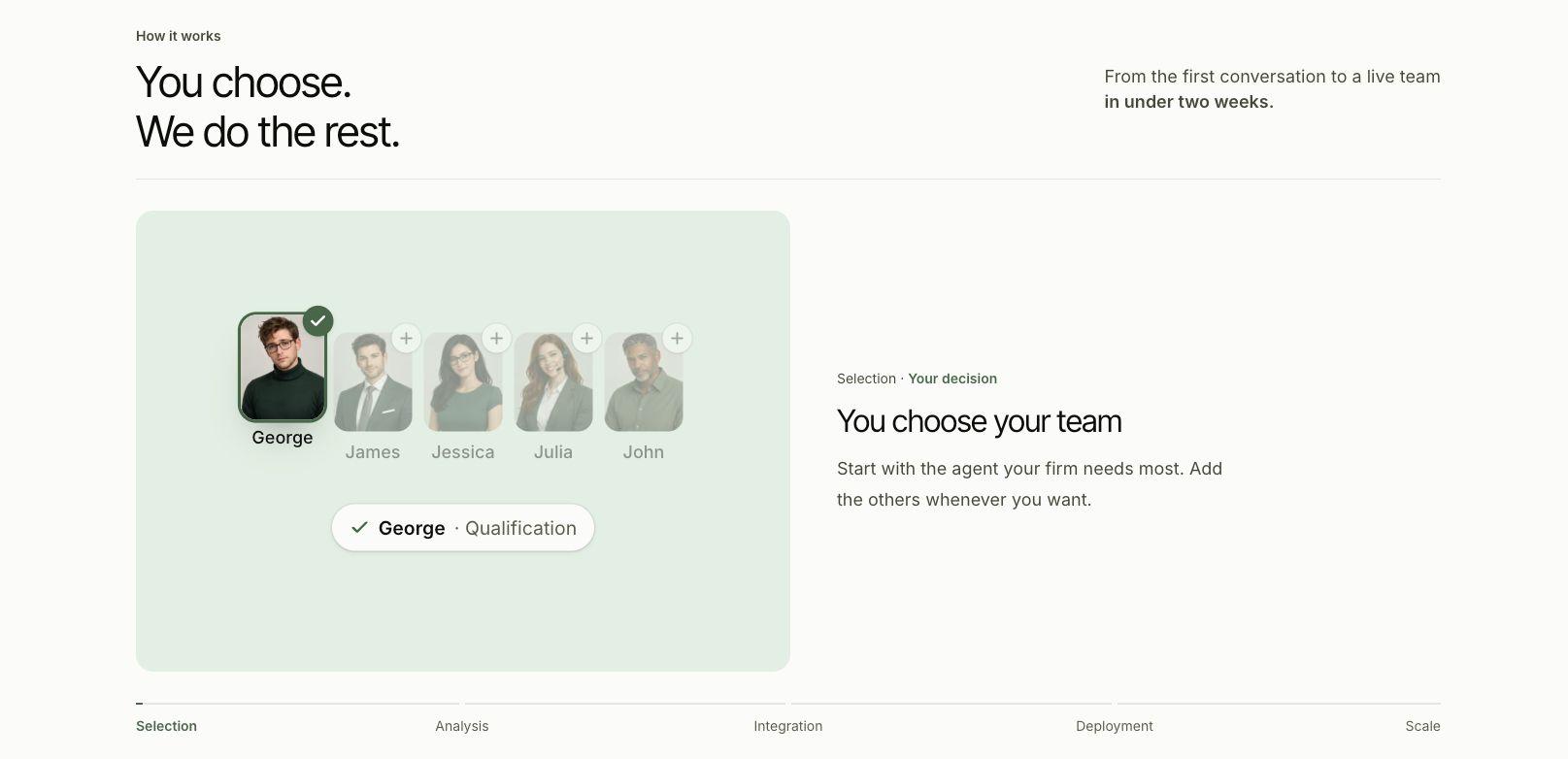
Juryo works simply: the firm hires one agent for the job it needs most, proves it, and also adds the others when it needs them. Each agent runs one client-facing job, 24/7, and all of them share one memory.
- Start with one agent: Most firms losing enquiries start with George. Firms losing signatures start with James. Starting small lowers the risk for a cautious partner and follows the same order as the guide.
- George, qualification: Contacts every lead the moment it comes in on phone, WhatsApp, email, website or social media, qualifies it against the firm’s own criteria, follows up, and schedules the appointment. Only warm, qualified leads reach the team, each with a full report.
- James, sales: Presents the firm’s pitch, handles objections, closes, sends the engagement letter, and collects the signature. The result is a signed client with every step documented. You can read more about AI sales representatives for law firms in Juryo’s guide.
- Jessica, onboarding: Asks each new client for every document the case needs and follows up until the file is complete.
- Julia, customer support: Answers existing clients’ questions about their case at any hour, with full context, and escalates what is urgent.
- One platform: Voice, WhatsApp, email, website, and social media, in English and Spanish, with one shared memory, so a client never repeats themselves. Juryo integrates with Clio Manage and works alongside your case management system. Every agent tells clients openly that it is an AI agent and passes anything beyond its remit to the firm’s people.
- Set up around the firm: Juryo analyses the firm’s processes, configures each agent to its criteria, tone, and rules, and goes live in under two weeks. The agents take over the client-facing side of law firm operations one job at a time, while the firm’s people keep the legal work.
Proof: What Juryo reports across its clients
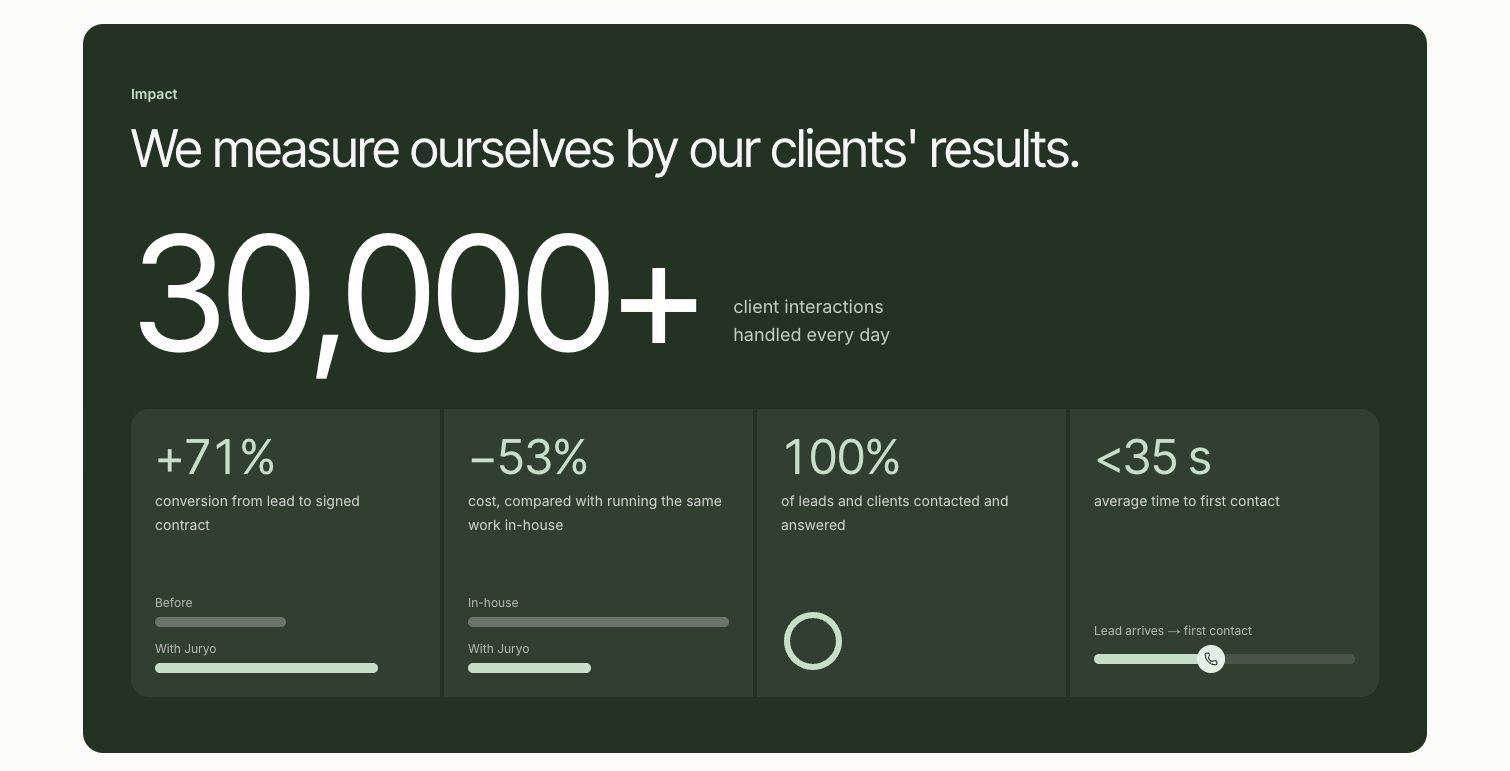
Juryo reports 53% lower cost than running the same work in house across its clients. That is this guide's argument in one number: the same client-facing work, done without the in-house cost.
Juryo also reports +71% conversion from lead to signed contract across its clients, which is growth from enquiries a firm already receives.
Firms using Juryo include Legálitas, Sello Legal Abogados, indemniza.me, Devuélveme Mi Dinero and Saldados.
Juryo pricing
Juryo’s pricing is based on successful conversion. As Juryo is paid when the firm signs clients, the incentives are aligned for both parties. This makes it a lower-risk alternative to a fixed hire.
Feel free to book a demo and check out how Juryo’s AI agents can help you grow your law firm without hiring more staff.
When you should actually hire
You should consider hiring more staff when the bottleneck you’re facing is legal capacity. Once the leak is fixed and the client-facing operations are off your fee earners, a full diary is a strong reason to add more staff to your team.
To summarise, hire when:
- Fee earners are turning away qualified work they would like to take
- The constraint is the number of solicitors who can run cases, and the admin around those cases is already handled
- A practice area needs expertise the firm does not have
- The work is predictable enough to justify a fixed monthly cost
It is important to note that the order mentioned above matters. You must first fix the leak, take the admin off the fee earners, then hire into demand you can already measure. Law firm growth built in that order puts each new salary behind work that is already arriving.
Honest limitations
The levers talked about in this guide recover and convert demand. However, they have limits that you should know about.
- None of this creates demand: A firm with genuinely too few enquiries has a marketing problem, and this guide does not solve it
- Low volume means a smaller gain: Firms with very few enquiries have less to recover, so the absolute improvement is smaller
- An undefined process produces bad outcomes faster: Write down the criteria and the steps first. Juryo analyses the firm’s processes as part of setting the agents up
- Legal judgement stays with the solicitor: The agents qualify, sign, collect, and answer. A solicitor decides on the merits of every case
Conclusion
Find where enquiries leak, from first contact to qualification, signing and document collection, hand that client-facing work to agents one job at a time, then hire into demand you can see. That is how you grow a law firm without hiring before the work is there.
So, to get started, be sure to check your last month’s phone log and WhatsApp inbox against the enquiries recorded in your CRM. The gap will tell you where to begin. George answers and qualifies every enquiry, James gets the engagement letter signed, Jessica completes the file and Julia answers clients while their case runs. Across its clients, Juryo reports 53% lower cost than running the same work in house.
Book a demo today to see how Juryo’s AI agents can help you optimise operations, improve lead response times, and increase your enquiry conversion rates.
FAQ
How can a law firm grow without hiring more staff?
A law firm can grow by recovering the enquiries it already loses, qualifying them before fee earners spend time, and taking the client-facing admin off the fee earners. Covering a second language and outsourcing selectively also help. Once those are fixed, hire into the demand the firm can measure. Juryo's AI agents cover each client-facing job, one agent at a time.
What are the best law firm growth strategies for a small firm?
Five levers, in order.
- Answer every enquiry at any hour.
- Qualify before a fee earner spends time.
- Hand the client-facing admin, from engagement letters to document chasing, to agents.
- Serve Spanish-speaking clients without a bilingual hire.
- Outsource work that needs no legal judgement.
Then hire for legal capacity.
Where should a law firm start scaling?
Add capacity one job at a time, starting with the stage that leaks most. If enquiries go unanswered, start there. If engagement letters sit unsigned, start with signing. Prove the gain, then move to the next stage. Juryo works the same way: firms hire one agent first and add the others when they need them.
Should I hire a receptionist or use AI?
Compare coverage, qualification, and cost. A receptionist covers office hours, one call at a time, on a fixed salary, and brings a familiar voice to regular clients. George, Juryo's qualification agent, covers every channel 24/7, qualifies in the same conversation and escalates what needs a person. No one method outranks the other. The two can work together.
How do I know how many enquiries my firm is missing?
Compare last month's phone log and WhatsApp inbox against the enquiries recorded in your CRM. The gap is the number of people who got in touch and were never followed up with. Then count the engagement letters sent but not signed, and the new clients whose files are still incomplete.
What should a law firm outsource?
Outsource work that needs neither the firm's judgement nor close supervision: overflow call handling, bookkeeping, marketing execution and document production. Keep legal judgement and the client relationship in house, and brief every supplier properly, because a badly briefed supplier costs more time than it saves.
Do AI agents replace my staff?
They take the repetitive client-facing work, such as follow-up, signing engagement letters, document chasing, and case updates, so your team spends its time on clients and cases. Juryo's agents escalate anything beyond their remit to the firm's fee earners, who supervise them, and a solicitor still decides on the merits of every case.
Can I start with one Juryo agent?
Yes, firms hire one agent at a time and add the others when they need them. Most start with George if enquiries go unanswered, or James if engagement letters go unsigned. Juryo analyses the firm's processes, sets the agent up around its criteria, tone and rules, and goes live in under two weeks.
How much does Juryo cost?
Juryo's pricing is based on successful conversion, so Juryo wins when the firm wins. A salary or a traditional supplier is paid whether or not anything changes; Juryo is paid when the firm signs clients. Book a demo to see George working on your own enquiries.
Recommended Reading
Intake and reception
5 Best AI Legal Intake Tools for Law Firms (2026)
How to automate law firm intake: a step-by-step guide
The 7 Best AI Receptionists and Virtual Receptionists for Law Firms (2026)
The 7 Best Legal Answering Services for Law Firms (2026)
This is the best bilingual legal answering service (English + Spanish) in 2026
How to Connect AI Intake to Your Law Firm CRM
Best WhatsApp AI Agent for Law Firms in 2026
Sales and lead follow up
The best AI sales representative for law firms (2026)
Lead Follow Up for Legal Intake: How to Re-Engage Enquiries That Go Quiet
Onboarding and client service
Best Client Onboarding Software for Law Firms
10 Best AI Customer Service Software Tools for Law Firms (2026)
Alternatives and comparisons
The 7 Best Moneypenny Alternatives for Law Firms (2026)
Legal AI guides
How to Use Legal AI in Your Law Firm: A 2026 Guide
Legal Workflow Automation with AI: How Law Firms Actually Do It