AI and GDPR in Legal Intake: How Intake Conversations Are Stored, Used and Protected
November 19, 2026 · 27 min read
AI and GDPR are compatible in legal intake, and the hard part is the data, not the law. A personal injury enquirer usually describes their injury in the first minute. A family enquirer often mentions violence in the second. By the end of the conversation, an AI agent holds health data, criminal offence data, and a detailed account of someone’s legal problem. This makes the conversation transcript a detailed client file before anyone at the firm has read it. UK GDPR lets a firm process that data to give legal advice. The real questions are where the conversation is stored, who controls it, how long it is kept, and whether it is used to train AI models.
So, an intake conversation is a client file from its first sentence. Each section below answers one of four questions and shows how a well-configured setup handles it.
Juryo is the AI operating system for B2C law firms, and George, Juryo’s qualification agent, is the example used throughout. The same answers hold when the conversation passes to Juryo’s other agents for signing, onboarding, and support, because they share one memory and one record. If you are still mapping the process itself, start with how to automate law firm intake.
This guide covers what intake collects, the lawful basis, controller and processor roles, storage, retention, training, call recording, AI disclosure, DPIAs, and WhatsApp. It explains the rules and should not be considered legal advice.
What data does an AI intake conversation collect?
In a B2C legal practice, an AI intake conversation captures more than just contact information. For starters it collects the facts of the case. These facts are special category or criminal offence data, in most cases.
A message service records a name and a number. A qualifying agent asks what a fee earner should ask, so it captures what the case turns on:
- The injury
- The arrest
- The visa history
People also volunteer more than they are asked, especially out of hours and on WhatsApp. So, plan for what enquirers say as well as what the questions ask.
The ICO says unproven allegations are still personal data relating to a criminal offence. So, a family enquiry describing abuse can contain criminal offence data even when nobody has been charged. Immigration status is not special category data itself. However, immigration and asylum enquiries regularly reveal racial or ethnic origin, religion, political opinions, or sexual orientation, which are special category data.
| Practice area | What callers typically disclose | UK GDPR category | Condition the firm usually relies on |
|---|---|---|---|
| Personal injury / clinical negligence | Injuries, treatment, GP, and hospital details, mental health effects | Special category (health), Article 9 | Article 9(2)(f) legal claims |
| Criminal | Arrest, charge, bail conditions, allegations, previous convictions | Criminal offence data, Article 10 | DPA 2018 Schedule 1 paragraph 33 legal claims |
| Immigration | Nationality, VISA, and status history, along with reasons for asylum claims | Personal data; often reveals special category data (ethnic origin, religion, political opinion, sexual orientation) | Article 9(2)(f) where special category data is revealed |
| Family | Children’s details, domestic abuse, health, relationship history | Special category (health, sex life) and criminal offence data (allegations) | Article 9(2)(f) and Schedule 1 paragraph 33 |
| Employment | Disability, sickness absence, trade union membership, grievances | Special category (health, trade union membership) | Article 9(2)(f) |
Once the enquirer instructs, the same file keeps growing. The engagement letter, the ID, the medical records, and payslips collected by Jessica, Juryo’s onboarding agent, and the case questions answered by Julia, Juryo’s customer support agent, all join it.
Firms that want to see how George structures an intake record by practice area can Book a demo.
Is AI intake lawful under UK GDPR?
Yes, seeking and giving legal advice is one of the clearest lawful purposes in UK GDPR, and the special category and criminal offence conditions both cover it.
Lawful basis for the enquiry itself
For a prospective client, the usual bases under UK GDPR Article 6 are steps taken at their request before entering a contract (Article 6(1)(b)) or legitimate interests (Article 6(1)(f)). It is up to the firm to pick one and record it. The AI agent does not change which one applies.
The basis attaches to the purpose. A conversation with George at 11PM is processed for the same purpose as a call to reception at 11AM.
Special category and criminal offence conditions
UK GDPR Article 9(2)(f) covers processing necessary to establish, exercise or defend legal claims. The ICO says legal claims include prospective proceedings and obtaining legal advice, and that this condition needs no appropriate policy document. For criminal offence data, Article 10 applies together with DPA 2018 Schedule 1 paragraph 33 (legal claims), again with no appropriate policy document required.
The limit is necessity. The data must be relevant and proportionate, so a good setup asks only what the firm’s qualification criteria require. A personal injury enquirer is asked about the accident and the injury and nobody asks for a full medical history. The ICO marks its special category guidance as under review following the Data (Use and Access) Act 2025.
Confidentiality from the first sentence
SRA Code of Conduct paragraph 6.3 requires solicitors to keep the affairs of current and former clients confidential. An enquirer who instructs becomes a client, and the intake record becomes the start of their file. It is crucial to treat every intake conversation with the confidentiality of a client file from the first sentence, whether or not the enquirer goes on to instruct.
Automated qualification and Article 22B
Qualifying, booking, and routing can run autonomously. However, a decision to turn someone away on the strength of their health data should have meaningful human involvement.
Since 5 February 2026, section 80 of the Data (Use and Access) Act 2025 has replaced UK GDPR Article 22 with Articles 22A to 22D. Most solely automated significant decisions are now allowed with safeguards. Article 22B is the exception that matters for intake: a significant decision based entirely or partly on special category data may not be taken solely by automated processing unless the person gave explicit consent, or the decision is necessary for a contract or required or authorised by law and Article 9(2)(g) applies.
A well-configured setup escalates borderline and declined enquiries to a person, and the enquirer can always reach one. The Article 22C safeguards (informing the person, letting them make representations, obtaining human intervention, and letting them contest the decision) are the firm’s duties as controller, and the firm decides where a person reviews the outcome.
George qualifies against the firm’s own criteria and escalates anything beyond its remit to fee earners. This gives the firm a clear point to put in that review.
Who controls the conversation: Controller, Processor, and the DPA
The firm is the controller. The provider processes the conversation on the firm’s instructions, and UK GDPR Article 28 requires a written contract detailing this arrangement.
The firm decides why the data is collected and what happens to it, exactly as it does for its case management system. The ICO’s guidance on AI and data protection (last updated 15 March 2023) ties the role to who controls the purposes and means of processing, whatever the contract calls it. A provider acting only on a client’s instructions can be deemed a processor. A provider that trains its own AI model on the data is likely a controller for that training, which is why the training section discussed below matters.
UK GDPR Article 28(3) requires processing by a processor to be governed by a contract under which the processor acts only on the controller’s documented instructions. Article 28(9) requires the defined contract in writing, which includes support for electronic contracts. The data processing agreement (DPA) also covers staff confidentiality, security, sub-processing, help with data subject rights, deletion or return of data at the end, and audit.
Juryo provides a DPA, covering every agent the firm uses.
Where is intake data stored?
For a UK firm, data stored in the EU needs no extra transfer paperwork, because the UK’s adequacy regulations cover every EEA country.
The ICO’s brief guide to international transfers (last updated 15 January 2026) explains that where UK adequacy regulations apply, personal information can flow from the UK without an additional safeguard. There is no IDTA, UK addendum, or transfer risk to complete in such cases. A transfer risk assessment comes in only when a firm relies on a safeguard instead. The ICO still expects firms to make checks on any organisation they share personal information with, under their other UK GDPR obligations.
The European Commission too, renewed both UK adequacy decisions on 19 December 2025. This decision is set to run until 27 December 2031. Juryo stores data in the EU.
How long are intake conversations kept?
The intake conversations are kept as long as the firm decides, and the firm should decide deliberately. This is because the UK GDPR Article 5(1)(e) storage limitation puts the duty on the controller.
Sometimes in practice, law firms split the records in two. When an enquirer instructs, the intake record joins the client file and follows its retention policy, along with the onboarding and support conversations that come later. When an enquirer does not instruct, keep the record only while the firm has a reason, such as conflict checks, or a complaint.
Juryo’s retention is set to each firm’s needs, from storing no data at all to keeping it indefinitely. The default is to keep it, so a firm should set the period at onboarding to match its own retention policy. That is controller responsibility work as intended: Juryo provides the control, and the firm decides how to use it.
There is also a second copy to think about. Once the record reaches the firm’s CRM or case software, that copy follows the firm’s own retention rules, so both copies need a policy.
Do intake conversations train AI models?
Juryo does not use conversations to train AI models. In general, intake conversations should not be used to train models.
For a law firm, training is the central AI data privacy question. Training on client conversations uses confidential information for a purpose the client never contemplated, which sits badly with SRA paragraph 6.3 and with UK GDPR Article 5(1)(b) purpose limitation.
Training also decides the provider’s role. A provider that trains on the firm’s data is making its own decisions about that data, and the ICO treats it as likely to be a controller for that training. A provider that does not train stays inside the processor role the DPA describes.
The agents still improve over time, because Juryo’s team refines each agent’s setup with the firm.
Call recording and telling callers they are speaking to an AI
For a UK firm, UK GDPR transparency answers both questions. Tell callers at the start that the conversation is recorded or transcribed and why, and, as good practice, tell them they are speaking to an AI. The EU AI Act disclosure duty falls on the provider of the AI system, and a UK firm speaking to the UK callers has no duty under it.
Call recording laws UK: What applies when an AI agent takes the call
When the firm’s own agent takes the call, UK GDPR governs recording and transcription. The firm needs a lawful basis, a privacy notice under UK GDPR Article 13 at the start, and a defined retention period.
The reason sits in the Investigatory Powers Act 2016, section 4. Interception means making the content of a communication available to someone who is neither the sender nor the intended recipient. When the firm’s own agent is the intended recipient, recording is arguably not interception. This leaves UK GDPR as the default framework.
Ordinary business recordings work differently. Where recording is interception, such as, staff calls on the firm’s phone system, the 2018 business interception regulations permit it when the conditions in regulation 3 are met. Regulation 4(1)(c) requires that “the system controller has made all reasonable efforts to inform every person who may use the telecommunication system that communications transmitted by means of that system may be intercepted”. That is the general rule within call recording laws UK firms already follow for their phone lines. AI transcripts sit under UK GDPR.
For an AI agent, the transcript is the record whether or not audio is kept, so GDPR call recording duties apply to the transcript itself. In practice, AI call recording needs a short spoken notice at the start of each call, and a privacy notice link in the first reply on WhatsApp, web chat, and email.
Disclosing that the caller is speaking to an AI
For a UK firm speaking to UK callers, no statute requires an AI disclosure. UK GDPR transparency under Article 13 and Article 14 does require the firm to tell people how their data is processed, and saying an AI agent is handling the conversation is the clearest way to do that. Treat disclosure as best practice for the firm.
The EU AI Act puts its duty on the provider. Article 50(1) has applied since 2 August 2026. It requires providers of AI systems that interact directly with people to design them so those people are informed they are dealing with an AI system. This is the general practice, unless the fact is obvious to a reasonably well-informed, observant, and circumspect person in the circumstances. Article 50(5) requires the information to be clear and distinguishable, at the latest at the first interaction. Juryo is an EU-based provider, so building AI disclosure into the system is Juryo’s obligation under Article 50(1). Juryo’s AI agents tell clients openly that they are AI agents in direct conversations.
Article 2(1)(c) reaches providers and deployers outside the EU only where the AI system’s output is used in the EU, so a UK firm with UK callers has no AI Act duty of its own. Trust settles the rest. An enquirer who later learns they were speaking to an AI has reason to doubt the firm, so a good setup says it is an AI at the start and offers a person.
Do you need a DPIA for AI intake?
Yes, almost certainly. The ICO’s AI guideline (last updated 15 March 2023) says that in the vast majority of cases, using AI involves processing likely to result in a high risk to people’s rights and freedoms. That triggers the legal requirement for DPIA under UK GDPR Article 35 and intake adds special category data at scale.
The DPIA for AI intake should cover:
- The data collected in each practice area, (use this table for reference)
- The lawful basis and the Article 9 and Schedule 1 conditions
- The controller and processor split under the DPA
- The storage location and the retention setting
- The training position
- Where a person reviews declined enquiries
- The transparency notices on each channel
- Every stage the agents cover: qualification, sales, onboarding and support
The ICO marks its AI guidance as under review following the Data (Use and Access) Act 2025. The DPIA (Data Protection Impact Assessment) is the document that answers the COLP’s (Compliance Officer for Legal Practice’s) question, and the facts in this article are its inputs. To learn more about where AI fits in the rest of the firm, see how to use legal AI in your law firm.
WhatsApp and other channels
WhatsApp acts as a separate party. On the WhatsApp Business Platform, Meta acts as the processor for the business, under its own data processing terms.
Meta’s Cloud API terms (last updated 23 September 2026) make the business the controller and Meta Platforms Ireland the processor under the WhatsApp Business Data Processing Terms. The WhatsApp Business Platform data privacy and security page (updated 16 June 2026) describes the same processor role. The terms also let Meta use some data as a controller to ensure the safety, security, and integrity of Cloud API. Both points generally belong in the firm’s DPIA.
Many consumer clients prefer WhatsApp, immigration and Spanish-speaking clients especially, and they expect a reply where they originally wrote. The right setup in this scenario is a business account covered by the firm’s privacy notice and DPIA. The setup should not use staff personal phones. You can check out this guide on the best WhatsApp AI agent for law firms to learn more about your options.
Shared memory across channels and agents gives one record per person, whether they spoke to George on the phone, signed with James, Juryo’s sales agent, on WhatsApp, or sent documents to Jessica by email. One record makes access requests and deletion easier to honour.
Answering service vs full intake: Why the data protection stakes differ
Data protection stakes differ between an answering service and AI intake software because a message service holds less, but scatters it. Juryo’s agents hold more, in one record under the firm’s setting. Here’s a detailed overview of how the stakes differ.
What a message-taking service holds
A legal answering service takes a phone note: a name, a number, and a line on the problem. The volume of sensitive data is low, but the note often sits in emails, shared inboxes, and call logs outside the firm’s systems.
Someone still has to call back and ask the qualifying questions, so the sensitive part of the conversation happens later, often on a mobile and often without a record. The engagement letter, the document chasing, and the client’s case questions then spread across more inboxes and phones.
What Juryo’s agents hold instead
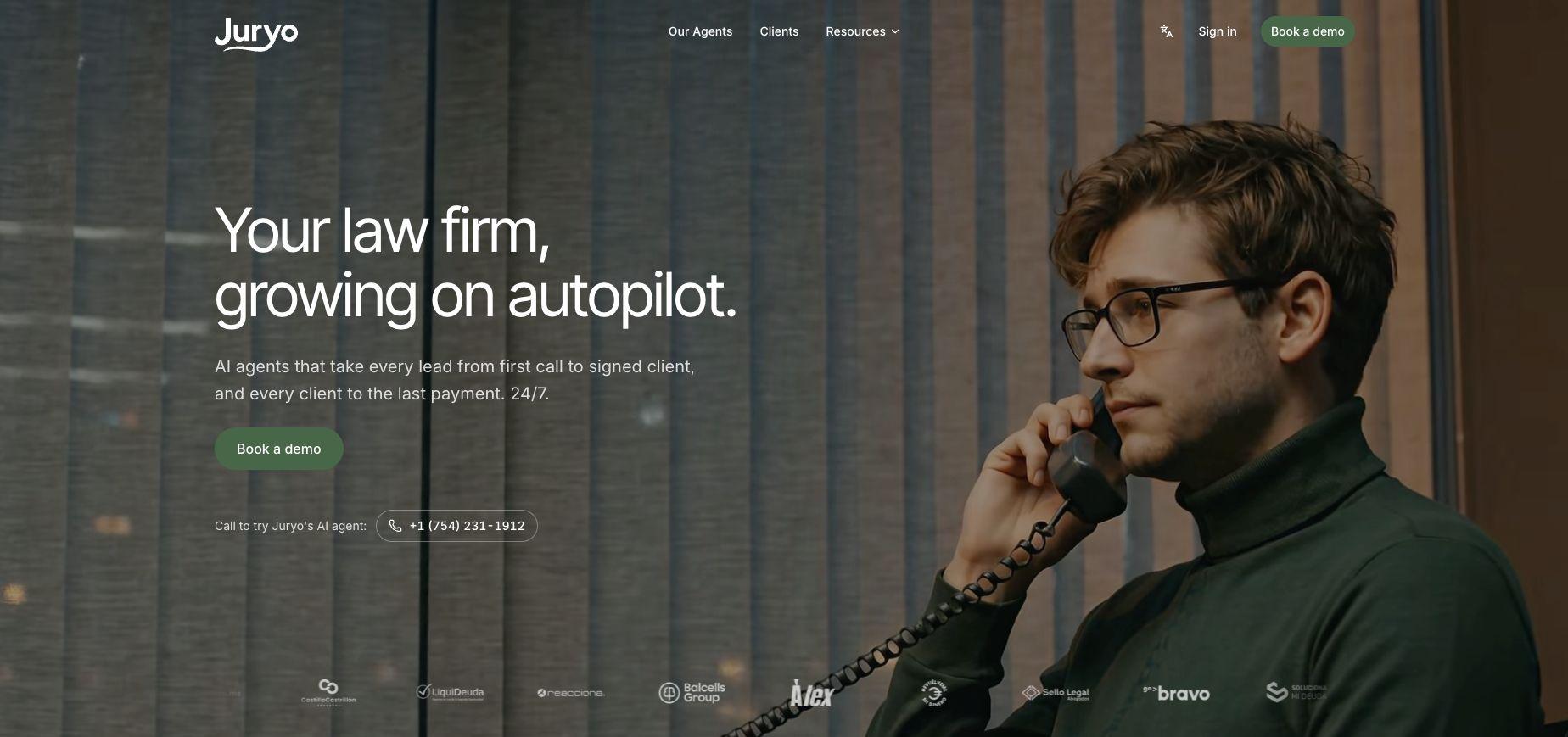
Juryo’s agents hold a qualified case file. It contains the facts, the special category data, the booking, the signed engagement letter and the documents. The stakes are higher, which is why storage, retention, training, and the DPA matter more in this regard than for a message service.
The firm also gets more control. One structured record (case type, key dates, opposing parties, qualification outcome) in the firm’s CRM or case software is easier to secure, retain correctly, and produce on a subject access request than notes scattered across inboxes. Juryo integrates with Clio Manage and works alongside Filevine, MyCase, and your case management system or a spreadsheet.
- George qualifies and books
- James sends the engagement letter and collects the signature
- Jessica collects the documents
- Julia answers the client’s questions regarding the matter
The whole record is created under the firm’s settings.
How Juryo’s agents handle client data
Juryo stores conversation data in the EU, keeps it for as long as the firm sets, does not train models on it, and sends the record to the firm’s system under a DPA. The same applies for all Juryo agents.
| GDPR requirement | What it means for intake | How Juryo handles it |
|---|---|---|
| Processor contract (Article 28) | The firm needs a written DPA with any provider processing its client conversations | A DPA is available |
| International transfers (Chapter V) | Data leaving the UK needs a transfer mechanism | Data is stored in the EU, covered by the UK adequacy regulations |
| Storage limitation (Article 5(1)(e)) | Keep conversation data no longer than needed | Retention is set by the firm, from not storing at all to indefinite; the default is to keep it, so set it at onboarding |
| Purpose limitation (Article 5(1)(b)) | Data collected for legal advice is not reused for unrelated purposes | Conversations are not used to train models |
| Records not lost if the firm’s system is down | A record should reach the firm’s system even when the system is briefly unavailable | If the firm’s system is unreachable, the record is queued and retried |
| Escalation to a fee earner | The firm can put a person in front of significant or borderline outcomes (edge cases) | Agents work to the firm’s criteria and escalate anything beyond their remit to the firm’s fee earners |
Juryo’s AI agents work across voice, WhatsApp, email, and web chat with one shared memory across all agents. Every AI agent can function in English and Spanish 24/7. Each conversation lands in the firm’s systems as a structured record, and our guide explains how to connect AI intake to your law firm CRM.
Proof: The scale behind the settings
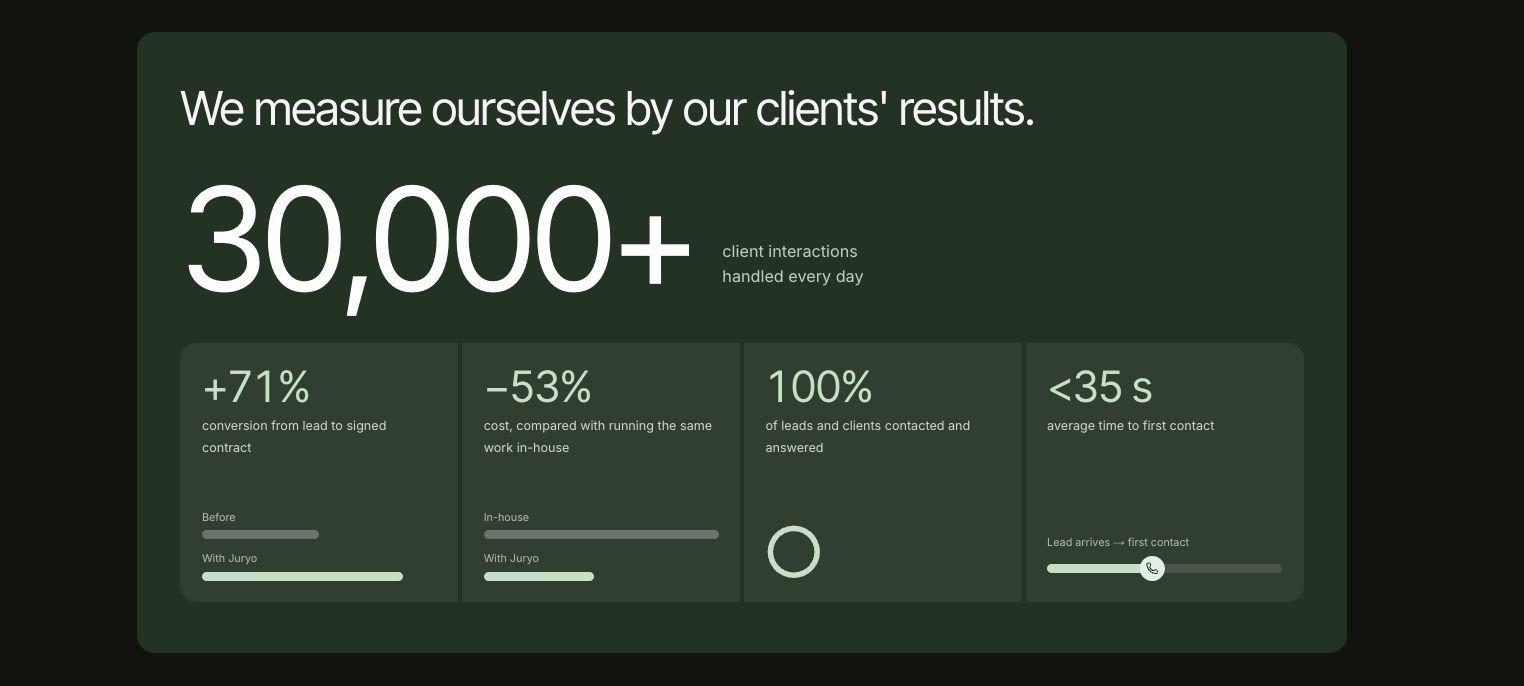
Juryo reports 30,000+ client interactions handled every day across its clients, and the data settings above apply to every one of them.
Firms using Juryo include Legálitas, Sello Legal Abogados, indemniza.me, Devuélveme Mi Dinero and Saldados.
AI and GDPR compatibility in legal intake, make it seamless with Juryo
AI and GDPR are compatible in legal intake. The work lies in answering the four questions mentioned previously for every conversation, from the first call to the last support message: where it is stored, who controls it, how long it is kept, and whether it is used to train anything.
A well-configured setup makes the firm the controller under a DPA and stores data in the EU or the UK. Retention matches the firm’s own policy and no model trains on the conversations. Callers hear a recording notice and an AI disclosure at first contact, a person reviews declined enquiries, and a DPIA sits on file.
George and the rest of Juryo’s AI agents work to that standard:
- Data stored in the EU
- A DPA is made available
- No training on conversations
- Retention set by the firm
- Open AI disclosure in direct conversations with clients
Book a demo today to see how George can handle your firm’s enquiries.
FAQs
1. Is AI intake GDPR compliant?
Yes, when it is set up correctly. The firm acts as controller under a written DPA, records an Article 6 lawful basis and relies on Article 9(2)(f) for special category data. It completes a DPIA, sets a retention period and tells callers at the start how their conversation is recorded and used.
2. What does AI and GDPR mean for law firms?
It comes down to four questions for every client conversation: where it is stored, who controls it, how long it is kept, and whether it trains a model. A firm that can answer all four for its intake, onboarding and support conversations has the substance of its DPIA ready.
3. Do AI intake tools use conversations to train models?
Some providers may, which makes them likely controllers for that training under ICO guidance. However, it sits badly with purpose limitation and client confidentiality. Juryo does not use conversations to train models, so it stays inside the processor role its DPA describes, and the firm's client conversations serve only the firm's own purposes.
4. Where is AI intake data stored?
Juryo stores conversation data in the EU. For a UK firm, that needs no extra transfer paperwork: UK adequacy regulations cover every EEA country, so no IDTA, UK Addendum or transfer risk assessment is required. However, the firm should still make the usual checks on any organisation it shares personal information with.
5. How long should a law firm keep intake conversations?
In line with the firm's own retention policy, split by outcome. When an enquirer instructs, the record joins the client file and its retention period. When they do not, keep it only while there is a reason, such as conflict checks or a complaint. Juryo's default is to keep data, so your law firm must set the retention period at onboarding.
6. What are the call recording laws in the UK?
When the firm's own AI agent takes the call, UK GDPR governs: a lawful basis, a privacy notice at the start, and a retention period. The 2018 business interception regulations are the general rule for business recording that counts as interception, and they also require reasonable efforts to inform everyone using the system.
7. Do you have to tell callers they are speaking to an AI?
For a UK firm speaking to UK callers, no statute requires it, but UK GDPR transparency makes it the right practice. Under EU AI Act Article 50(1), which has applied since 2 August 2026, the duty to design AI disclosure into the system sits with the provider, unless it is already obvious to the caller.
8. Do I need a DPIA for AI intake?
In almost every case. The ICO says the use of AI will, in the vast majority of cases, trigger the legal requirement for a DPIA under UK GDPR Article 35. Intake adds special category and criminal offence data, so plan the DPIA before the first agent goes live.
9. Is WhatsApp safe for client intake?
It can be, on the WhatsApp Business Platform. There, Meta acts as a processor for the business under its data processing terms, with some controller use of data for the safety, security and integrity of the service. Use a business account covered by the firm's privacy notice and DPIA, never staff personal phones.
Recommended reading
Intake and reception
5 Best AI Legal Intake Tools for Law Firms (2026)
How to automate law firm intake: a step-by-step guide
The 7 Best AI Receptionists and Virtual Receptionists for Law Firms (2026)
The 7 Best Legal Answering Services for Law Firms (2026)
This is the best bilingual legal answering service (English + Spanish) in 2026
How to Connect AI Intake to Your Law Firm CRM
Clio AI: The 5 Best AI Intake Agents That Integrate With Clio (2026)
Best WhatsApp AI Agent for Law Firms in 2026
Best AI appointment scheduling tool for law firms in 2026
Sales and lead follow up
The best AI sales representative for law firms (2026)
Lead Follow Up for Legal Intake: How to Re-Engage Enquiries That Go Quiet
Onboarding and client service
Best Client Onboarding Software for Law Firms
10 Best AI Customer Service Software Tools for Law Firms (2026)
Collections
Law Firm Collections: How to Recover Overdue Instalments Without Chasing Clients
Alternatives and comparisons
The 7 Best Clio Grow Alternatives for Law Firm Intake (2026)
The 7 Best Intaker Alternatives for Law Firm Intake (2026)
The 7 Best Lawmatics Alternatives for Law Firms (2026)
The 7 Best Lead Docket Alternatives for Law Firm Intake (2026)
The 7 Best Moneypenny Alternatives for Law Firms (2026)
The 7 Best Smith.ai Alternatives for Law Firms (2026)
Juryo vs Lexidesk: Which Legal Intake Agent Fits Your Firm (2026)
Juryo vs Ruby Receptionist vs Answering Legal: which is best for legal intake in 2026?
Legal AI guides
The 7 best AI tools for lawyers (2026, tested)
5 best AI legal assistant tools for law firms in 2026
How to Use Legal AI in Your Law Firm: A 2026 Guide
Legal Workflow Automation with AI: How Law Firms Actually Do It